Mr Speaker
p. 27 · Read in the full issue
How they elected Mr Speaker
The election of John Guise as Speaker of the Papua-New Guinea House of Assembly removes from the active arena a man who has long been an enigma of New Guinea politics.
Guise, 53, born in a village near Dogura, Papua, a part-European ivho has chosen in recent years to call himself a Papuan, became P-NG’s first full-time politician in 1961 when he was elected to the Legislative Council and has held his seat since with big majorities. A : ather of eight, he lives in a village n the Marshall Lagoon area of Papua, and his usual dress is a pair )f old trousers and a singlet, shoes )ut no socks.
He is a former sergeant-major of >olice (where he was noted for his mart turn-out), an active layman of he Anglican Church, chairman of the mportant Constitutional Committee n the last House (on which he did xcellent work), and Leader of the elected Members in the same House mtil the title was abolished by his olleagues as a means of getting rid f him (for he was not entirelv rusted).
Fence-sitter
Guise, politically, is a fence-sitter; mixed-up personality with an mbition to be successful but not sure f the direction he should travel, nd thus which signposts he must )ok for in order to get there. His lection to the high post of Speaker anking in protocol after the Admini rator and Chief Justice) has solved is dilemma for him.
His nomination for the position ime late, and after much cogitation, amantu coffee planter Mick Casey ad nominated, and wanted the nsition. But he was a new member, ad old hands Roy Ashton, a New ritam planter, and Percy Chatterton tired Papua missionary, allowed ieir names to go in so as to give e Assembly a choice. Ashton had eferred to hope for one of the inisterial positions and wasn’t an ithusiastic starter.
At this point John Guise nomina □. Chatterton then withdrew; as European in a Papuan electorate * dld n ot want to contest the icakership against a Papuan. The embers cast their votes in a secret illot, using symbols for their choice the three men. Guise won easily.
Why did he stand and where did
his support come from?
The explanation is to be found in his support of the Pangu Pati. He had joined the party late, after fence sitting to see how it would go, and he was not at ease there, nor was the party at ease with him. Guise realised he could not hope to control the party, which was in the hands of younger men.
Pangu's position
Pangu now took the line that its members should not accept ministerial positions in the new House. When it became obvious that this view would be accepted as policy by the party, Guise had to decide on his future.
He knew the Administration would offer him a Ministerial post ($5,000 a year, with a car and the use of a house). If he remained with Pangu he would be a backbencher (on $3,000), with every prospect of being overshadowed in the next four years by the younger, more radical men.
He could be sending himself into the political wilderness. He decided to try for the Speakership ($5,000, plus allowances and great prestige).
Once nominated he was appre hensive about his chances. If Chatter ton had remained in the ballot Guise might have been justified in his fears, for Chatterton almost certainly threw away the Speakership by withdrawing.
But Guise’s nomination got the support of Pangu, which wanted to avoid a public showdown over the ministerial issue. The Highlands bloc also supported Guise, believing that he would be more useful as Speaker than in shaking things up on the benches.
What he wore
Only the Administration was un happy. It still saw Guise as good ministerial material and preferred to see Ashton as Speaker. (In the end result, Ashton became Ministerial Member for Works—the only Euro pean to get a ministerial post).
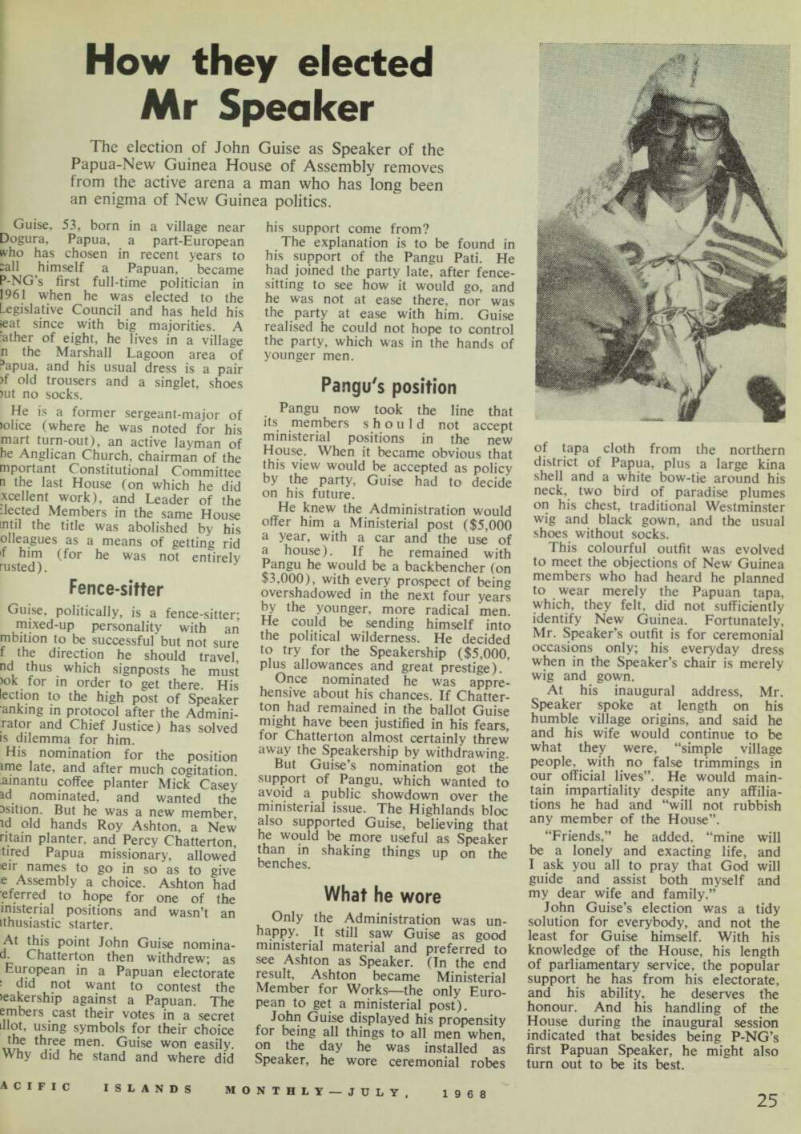
John Guise displayed his propensity for being all things to all men when, on the day he was installed as Speaker, he wore ceremonial robes
of tapa cloth from the northern district of Papua, plus a large kina shell and a white bow-tie around his neck, two bird of paradise plumes on his chest, traditional Westminster wig and black gown, and the usual shoes without socks.
This colourful outfit was evolved to meet the objections of New Guinea members who had heard he planned to wear merely the Papuan tapa, which, they felt, did not sufficiently identify New Guinea. Fortunately, Mr. Speaker’s outfit is for ceremonial occasions only; his everyday dress when in the Speaker’s chair is merely wig and gown.
At his inaugural address, Mr.
Speaker spoke at length on his humble village origins, and said he and his wife would continue to be what they were, “simple village people, with no false trimmings in our official lives”. He would main tain impartiality despite any affilia tions he had and “will not rubbish any member of the House”.
“Friends,” he added, “mine will be a lonely and exacting life, and I ask you all to pray that God will guide and assist both myself and my dear wife and family.”
John Guise’s election was a tidy solution for everybody, and not the least for Guise himself. With his knowledge of the House, his length of parliamentary service, the popular support he has from his electorate, and his ability, he deserves the honour. And his handling of the House during the inaugural session indicated that besides being P-NG’s first Papuan Speaker, he might also turn out to be its best.