pack at a handy price
pp. 36-38 · Read in the full issue
New Guinea bargain is a handy pack at a handy price
A discreet cough, that universal Papuan substitute for a door knock, distracted my attention from a tricky bit of translation, and I went out on to the verandah. At the foot of the steps stood a small boy with a scrawny village fowl tucked under his arm.
He was not, at the moment, my favourite pupil. Only the previous day he had failed to endear himself Ym to me by replying “Okay baby” when 111 HIHHHH I had told him to go get me some chalk. He had explained that he had roj heard an American soldier say this M MX to his sister so had thought it must ■>*£9 H I said, “What do you want?”
“I want to sell you this kokoroku,” he replied.
“Is it yours?”, I asked suspiciously.
Gesturing skyward with his free hand he called on God to witness that it was. Irreverently perhaps, I said that 1 would like to have the evidence of his earthly father on the point.
He departed with a pained expression, and ten minutes later reappeared with dad, who said, “Yes, it’s really his fowl. He can sell it if he wants to.”
At this point the fowl made a determined effort to withdraw from
To The Point
With
Percy
Chatterto
the conference, and its youthful owner’s laplap fell off. He grabbed the bird with both hands and deftly retrived the laplap with the toes of one foot.
When decorum had been restored, I asked him what he wanted for his fowl. “Skwemit”, he replied suc cinctly.
Seeing my puzzled expression, he repeated his answer with the air of one who suffers fools though not gladly. “Square meat”, he articulated.
This I understood. In the old days, as now, canned meat came in
tins of two shapes—square (or, you want to be pedantic, taper oblong) and round. And in tho simpler days the shape of the t gave a clue to the contents.
Square tins contained honest-t goodness bully beef—Hellaby’s « Fray Bentos maybe, while round ti harboured products variously knov as luncheon beef, meat loaf, can pie, or what have you.
My young Papuan friend did n want to be fobbed off with one < these; he wanted genuine corn* beef.
“Why not eat the fowl yourself?
I asked.
“Don’t want to,” he replied, ' want skwemit.”
I fetched a tin of bully, and tl bargain was concluded to our mutui satisfaction. I have tasted tender birds, but it was a welcome chanj from canned stuff.
Not that I despise bully beef; i fact, I have a very real affection fc it. On one occasion during the wa I set out on a patrol of the missio district of which I was then i charge. Its population had bee about doubled by war-time evacuee from the Port Moresby area, an the trip took me a full month, wit an overnight stop at each village an evacuee camp I came to.
Nothing but chooks
Although I had my own tucke box, the folk I was visiting too pleasure in providing me with a least one meal during my stop-ovei Generally a chook provided the prc tein intake.
They came evening after evenin —big fowls, small fowls, toug] fowls, tender fowls, fat fowls, leai fowls, boiled fowls, roast fowls. An< for twenty-nine evenings I dog gedly consumed a sufficient portioi
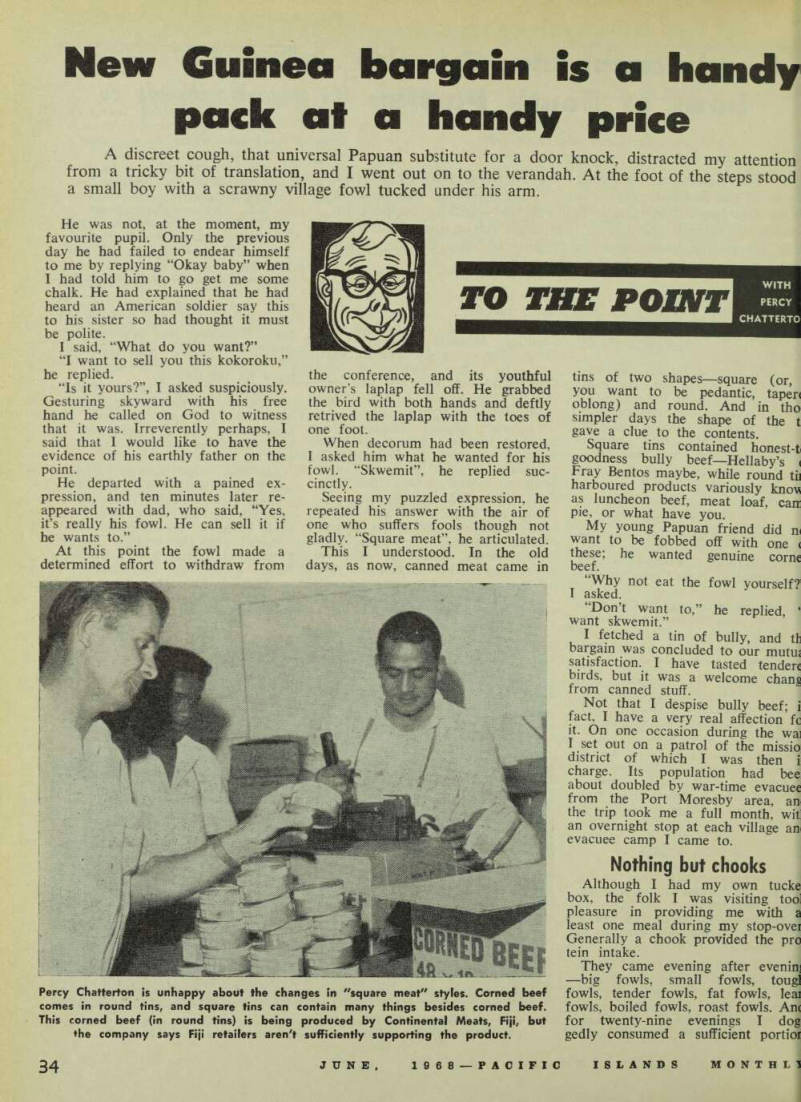
Percy Chatterton Is unhappy about the changes in "square meat" styles. Corned beef comes in round tins, and square tins can contain many things besides corned beef.
This corned beef (in round tins) is being produced by Continental Meats, Fiji, but the company says Fiji retailers aren't sufficiently supporting the product.
4/iter 29 days of chicken came jrried corned beef
poultry, tough or tender, to ensure at my kindly hosts’ feelings would >t be hurt. , . r On the 30th and last night of the p, the pastor’s wife came to me th an expression which suggested at she was the bearer of bad news.
“Misi,” she said, “we are very hamed. The soldiers have bought I our fowls, and we have nothing cook for you but a tin of corned ef ”
I assured her that I actually liked e stuff, and she went away looking ther more cheerful. It came at nset—curried, and with lashings coconut cream poured over it. A avenly meal! And never since that y have I been known to say an ikind word about bully beef.
Gone, alas, are the days when the stomer could rely on the shape of e tin as a clue to the contents, ren camp pic, that last unlovely sort of the indigent, comes to us asquarading in a square tin. Now ily the price is a clue.
Innocent days
Genuine corned beef, which we *re once able to buy for 1/- a tin, »w costs us round about 50 cents, aything at less than 40 cents will most certainly turn out to be a brication which has started out iwn the slippery slope that ends in mp pie.
I appeal to the canners of meat let us get back to those innocent, istful days when square meat was uare meat!
Most of our canned meat comes 3m Australia. I did recently see a i of Chinese corned beef on the elves of one of our self-service )res, but the price was not com titive. Nor is that of Fray Bentos, mch I have always associated in y mind with South America, but lich now comes to us from mzania.
It is quite otherwise with fish. One >nders why we should need to get ir fish from the far places of the rth anyway. There are fish galore the seas around Papua and New uinea, and one would have sup >sed that there might be potential r the establishment of a fish-can ng industry here.
However, our economic developers em to be too busy investigating e possibilities of pepper culture id the lip-stick plant to give it a ought. So we buy fish canned in
Japan, Canada, America, Norway, West Germany and other distant places.
For New Guineans looking for a cheap buy the formerly übiquitous herring has been displaced in popu larity by a creature described as a “mackerel pike”. I have often wondered whether such a fish really exists, or whether, together with the lively picture on the label, it is a piscatorial joke perpetrated by the ingenious Japanese who can it. But they must be making a lot of money out of it.
In 15 oz tins at 20 cents and 5 oz tins at 10 cents, it is cheap and by no means unpalatable, and is the prin ciple source of protein for most town dwellers. Neither Australia, Europe nor America seem to be able to produce anything to challenge its supremacy.
On the shelves of our self-service stores there are abundant stocks of canned salmon, so presumably some one buys it. Few Papuans could afford to do so, and if they could they might not like it.
Salmon or snake?
On one occasion during the war, a Papuan woman brought me a tin of best quality red salmon. She ex plained that an American soldier had given them some tins. They had opened one and decided from the appearance of its contents that it must be snake, so had fed it to their pig.
I happened to have on hand at the time some Australian army issue “salmon” (widely though perhaps quite unjustly suspected of
being shark). So I traded two tins of Aussie salmon for her one tin of American sockeye, and assured her that I would take any more that she could get on the same terms. She was pleased. So was I.
A recent newcomer to the shelves of our stores is canned cuttle-fish, Seeing that most Papuans do eat cuttle-fish, one would expect this line to be popular, but it doesn’t seem to have taken on very much, Food canners nowadays devote a lot of ingenuity to devising eye catching labels for their products. and I am one of the mugs who fall for a pretty label,
CuiUliny llttl© fish
Just a few days ago scan ning the shelves of a self-service store I fre qUenl, I spotted a tin whose label depicted a lot of tiny white fish swimming round tin against a , d and % reen background. My eye ® ht the B word “whitebait”, and the ‘in went into my basket. only when l gO , home did t notjce that what the label actually said was “Whitebait style tiny white fish”.
Actually, made into fritters they were quite good; but it was those cunning little fish swimming round the tin that caught me.
I doubt whether many Papuans are influenced in this way. On the contrary, they are conservative shop pers, sticking in the main to the products, brands and labels they have grown up with. Any manufac turer hoping to boost his sales by putting an old product into a bright new pack may well find his in genuity recoil on him. (Over)
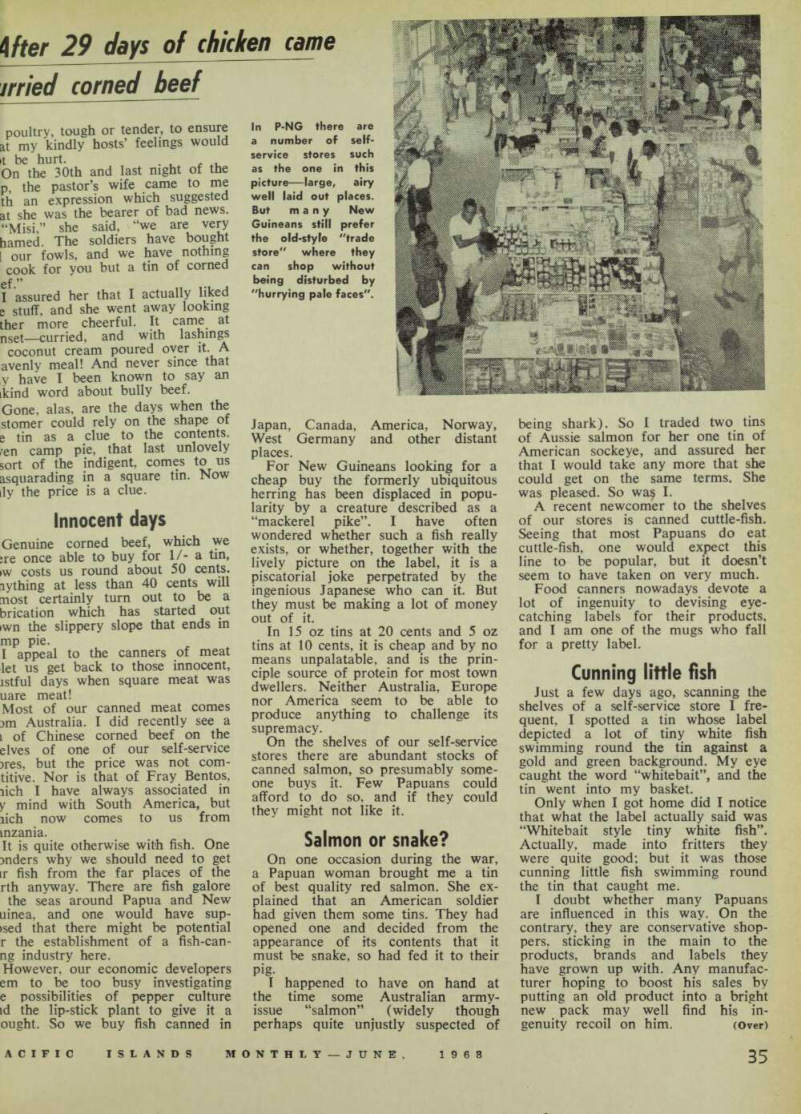
In P-NG there are a number of self service stores such as the one in this picture —large, airy well laid out places.
But many New Guineans still prefer the old-style "trade store" where they can shop without being disturbed by "hurrying pale faces".
Locals go for the small packs
“Hellaby” never became a com mon noun in Papua to quite the same extent as appears to have hap pened in Polynesia, but in the reverse direction “King Size” is widely used among Papuans for one particular brand of cigarette which happened to be first in the field in this class to go on sale here. And so faithful to it are some that I not infrequently have a Papuan caller politely decline my preferred packet and take out his own pack of “king size”.
The shopping habits of Papuans and New Guineans are largely deter ky their living conditions, and these condition them to preferring small packs to large ones.
Hand to mouth
Most are on low rates of pay, and towards the end of a pay period are living pretty much from hand to mouth. Of those who live in the towns, the majority have no fridges and have only limited storage space for food or anything else.
Then again, many are unmarried or have left their families in their home villages, and live in barrack type quarters from which they are absent all day. They have trouble in ensuring the safety of any posses sions and particularly of food, so
on their way home from work they buy just enough for an evening and a morning meal. This accounts for the popularity of “mackerel pike” in its Sandy 5 oz tins at an even 10 cents.
For people like these more small packs would be a boon—4, 5 or 6 oz tins of meat and fish and 1 lb (or thereabouts) packs of flour, sugar and rice, the latter pre ferable in cellulose bags, the necks of which can be secured by clips to keep out ants and other insects.
Cents, not pounds
I wrote “or thereabouts” because in fact Papuans are less interested in avoirdupois than in price. They are more interested in a pack which costs an exact multiple of 10 cents than in one which holds an exact number of ounces or pounds. They like to be able to slap down their 10 cent and 20 cent pieces on the counter and not have to worry with odd amounts.
Last but not least, the inventor of a small and really moisture-proof pack for salt will call down on his head the blessings of all territorians, New Guinean and expatriate alike.
Another aspect of Papuan shop ping habits is that of the kind of stores they like to shop in. In Port Moresby we now have a number of excellent self-service stores—large, airy, well laid out places. But as far as I have been able to observe they are not much patronised by indigenes, except by a few of the more highly sophisticated ones.
Hurrying pale-faces
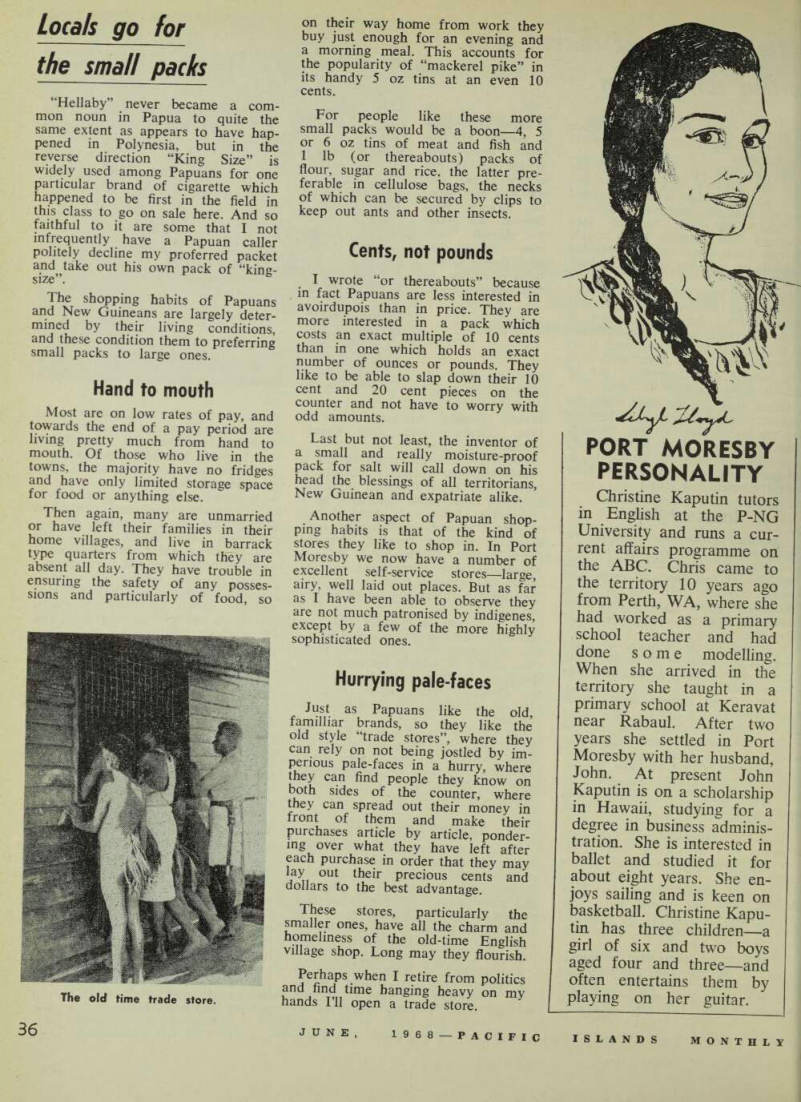
Just as Papuans like the old, familliar brands, so they like the old style “trade stores”, where they can rely on not being jostled by im perious pale-faces in a hurry, where they can find people they know on both sides of the counter, where they can spread out their money in front of them and make their purchases article by article, ponder ing over what they have left after each purchase in order that they may lay out their precious cents and dollars to the best advantage.
These stores, particularly the smaller ones, have all the charm and homeliness of the old-time English village shop. Long may they flourish.
Perhaps when I retire from politics and find time banging heavy on my hands I’ll open a trade store.
The old time trade store.