Guadalcanal may be rice
pp. 35-131 · Read in the full issue
bowl of South Pacific
By Ken Mcgregor
The Guadalcanal plains of the Solomons may be the rice >owl of the South Pacific in the 1970’5. Solomons businessman Cen Dalrymple-Hay firmly believes this—and in support he joints to the facts and figures behind the harvesting of the first ver large-scale commercial rice crop in the South Pacific, which
5 currently proceeding in the Solomons.
Ir. Hay is chairman of directors Guadalcanal Plains Ltd., the imons firm which has now proved commercial rice growing can be ;essful. ie said that if future harvesting t according to plans, the com y would be able to supply all rice required by the Solomons next year at a lower price to imon Islanders than current js for imported Australian rice. his would save the BSIP, which mporting about 3,600 tons of from Australia a year, an annual Drt bill of over $A500,000. uadalcanal Plains also has plans :xport its surplus rice to neigh ing territories, particularly the r Hebrides, New Caledonia and arvesting is currently being com ;d of some 2,300 acres of dry at Tetere, east of Honiara, on dalcanal, one of the bigger Solo- Islands. irectors of the company told in mid-May that they estimated i harvesting was finished in mid about 2,200 tons of polished would be produced. r. Hay said he had “no doubt” mon Islanders would buy and the rice, which had a shorter i and was easier to mix than previously grown.
10 tons a day
r. Hay said a rice mill, capable ■ocessing 10 tons of polished rice ay, was expected to arrive in iara from Japan in late May. idations for the mill had already laid. i said that two 270 ft long sheds, capable of holding 1,000 tons ice, were under completion at re and when the sheds and the were in operation, the corn hoped to cater for the Solo
mons’ rice supply at the rate of 300 tons a month.
Three young Australians, Mr.
Geoffrey Mitchell, 26, and Mr.
James McPherson, 26, both of NSW, and Mr. James Stirton, 21, of Queensland, supervised the rice seed ing for the current harvest, which began last December.
The men, assisted by up to 50 Solomon Islanders, worked 24 hours a day for periods in December to get the rice sown in time. Other Solomon Islands women have been employed to help harvest.
Attempts to grow rice in the Solo mons began in 1937, when a gov ernment agricultural officer, Mr.
Robert Johns, distributed hill rice seeds to village headmen on the island.
Few of the seeds grew and the project was a total failure.
In 1946-47, the BSIP Government
took over the American vegetable farm at Ilu, and experimented with rice. Machinery was imported from Australia, but the rice again failed on account of planting the wrong types for the tropics.
Three years later, Marist Brothers missionaries at Tenaru experimented with some rice seeds from the NG Sepik area. The rice grew, but in sects destroyed most of the small crop.
Mr. Hay, who “sat out” much of the Pacific War in the hills over looking Guadalcanal Plains as a coastwatcher, had always felt rice could be grown on the plains.
About 1953 he brought Mr. A.
Poggendorf, a rice expert from the NSW Agriculture Department, in conjunction with Mr. Peter Farley of an Australian company, Asso ciated Rural Industries, to Guadal
(Continued on p. 129)
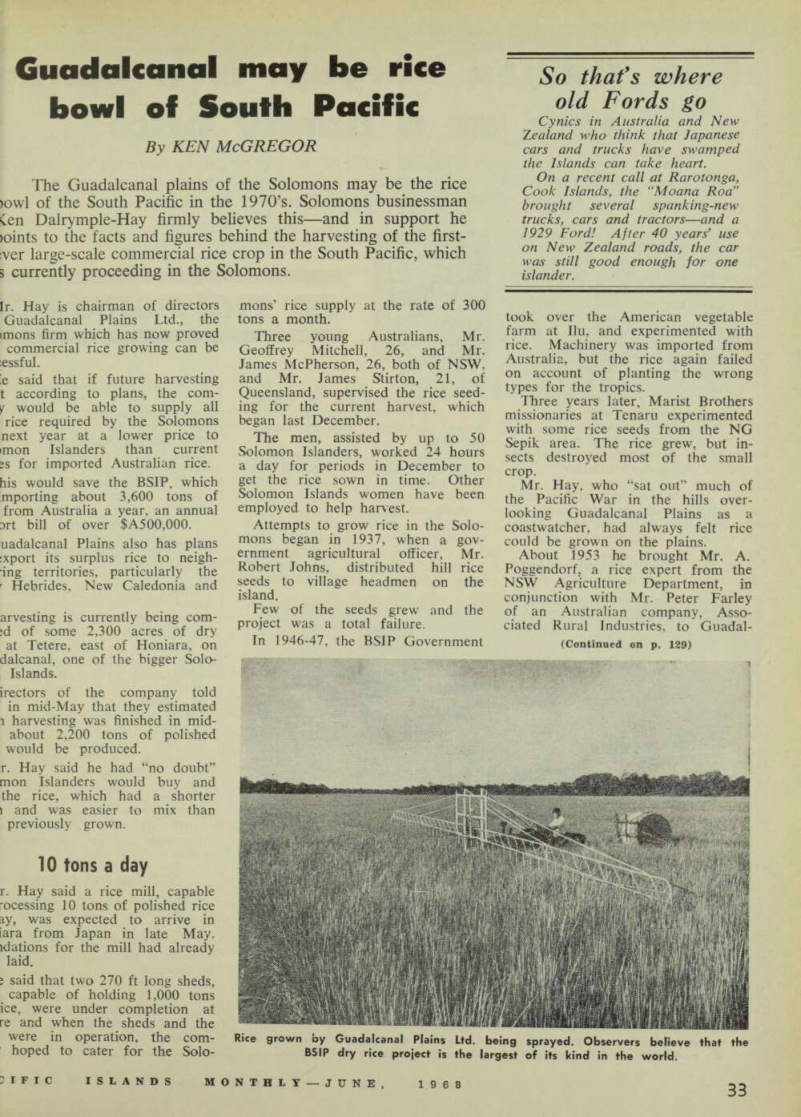
Rice grown by Guadalcanal Plains Ltd. being sprayed. Observers believe that the BSIP dry rice project is the largest of its kind in the world.
canal to look at rice prospects.
“I cannot tell you officially,” Mr.
Poggendorf told Mr. Hay, “because I have no time to make tests. But if you have ideas to grow rice, go ahead with it.”
Mr. Hay “went ahead with it”. In 1954 he bought the 600-acre Ilu farm, and with Dr. A. Ballantyne, an agriculture officer of the BSIP Gov
ernment, he planted half an acre of NG rice seed and irrigated it.
The rice gave a “terrific yield”.
Further experiments followed with different types of rice.
An expert from the Government Agricultural Department, BSIP, on an overseas trip, sent back seed from Dutch Guiana (now Surinam) in north-east South America, and Mr.
Hay later deveoped this variety as
Sml 40.
Experiments
For the next 11 years Mr. Hay experimented with no less than 147 varieties of rice at Ilu Farm. He re ceived a great deal of help from the International Rice Institute, Manila, in the Philippines, which is financed by the American institutes.
Ford and Rockefeller.
The institute helped develop an other variety, called IR 8, which has proved suitable on Guadalcanal.
Of the current crop, two-thirds of the rice is of the IR 8 variety, and one-third, the SML 40 variety.
In late May several Sydney rice exporters said orders for rice had been cancelled or lowered by im porting agencies in the Solomons who said they were buying cheaper rice locally.