Benign
p. 31 · Read in the full issue
A Brett Hilder Profile
Influence
IN
Fiji
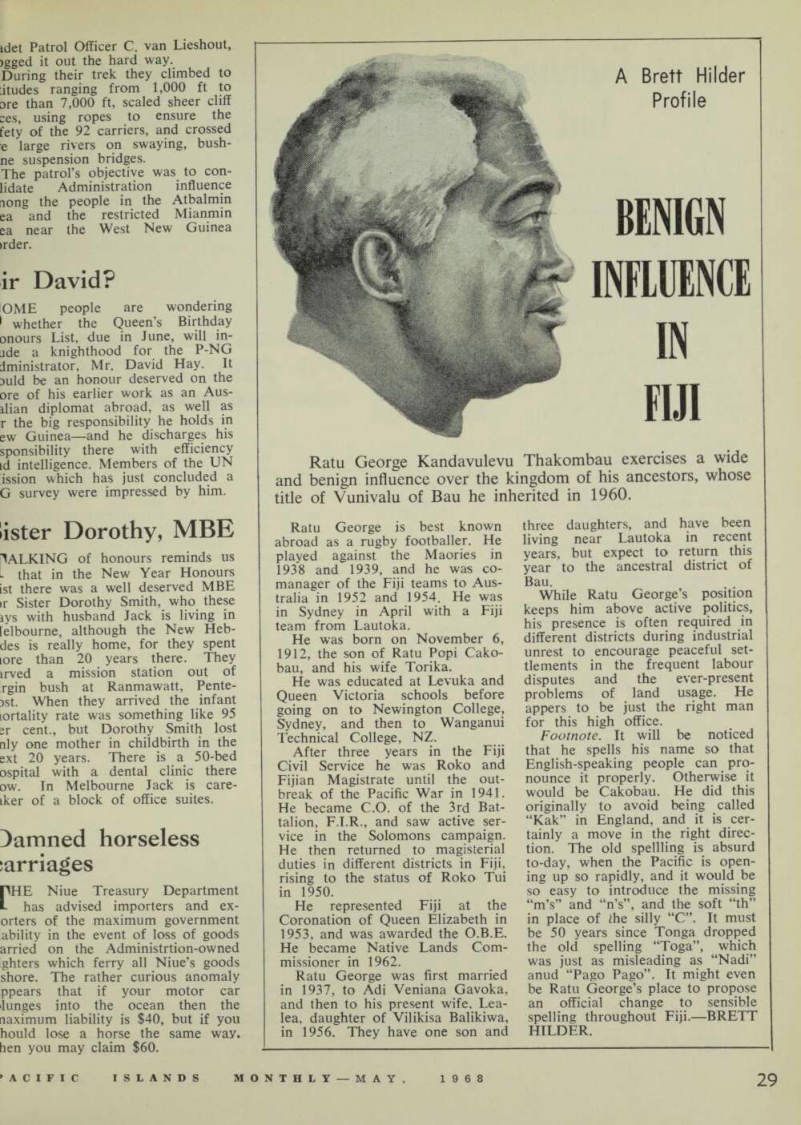
Ratu George Kandavulevu Thakombau exercises a wide and benign influence over the kingdom of his ancestors, whose title of Vunivalu of Bau he inherited in 1960.
Ratu George is best known abroad as a rugby footballer. He played against the Maories in 1938 and 1939, and he was comanager of the Fiji teams to Australia in 1952 and 1954. He was in Sydney in April with a Fiji team from Lautoka, He was born on November 6, 1912, the son of Ratu Popi Cakobau, and his wife Torika.
He was educated at Levuka and Queen Victoria schools before going on to Newington College, Sydney, and then to Wanganui Technical College, NZ.
After three years in the Fiji Civil Service he was Roko and Fijian Magistrate until the outbreak of the Pacific War in 1941.
He became C.O. of the 3rd Battalion, F.1.R., and saw active service in the Solomons campaign.
He then returned to magisterial duties in different districts in Fiji, rising to the status of Roko Tui in 1950.
He represented Fiji at the Coronation of Queen Elizabeth in 1953, and was awarded the 0.8. E.
He became Native Lands Commissioner in 1962.
Ratu George was first married in 1937, to Adi Veniana Gavoka, and then to his present wife. Lealea, daughter of Vilikisa Balikiwa, in 1956. They have one son and
three daughters, and have been living near Lautoka in recent years, but expect to return this year to the ancestral distnct of Bau. . .
While Ratu Georges position keeps him above active politics, his presence is often required in different districts during industrial unrest to encourage peaceful set tlements in the frequent labour disputes and the ever-present problems of land usage. He uppers to be just the right man for this high office.
Footnote. It will be noticed that he spells his name so that English-speaking people can pro nounce it properly. Otherwise it would be Cakobau. He did this originally to avoid being called “Kak” in England, and it is cer tainly a move in the right direc tion. The old spellling is absurd to-day, when the Pacific is open ing up so rapidly, and it would be so easy to introduce the missing “m’s” and “n’s”, and the soft “th” in place of the silly “C”. It must be 50 years since Tonga dropped the old spelling “Toga”, which was just as misleading as “Nadi” anud “Pago Pago”. It might even be Ratu George’s place to propose an official change to sensible spelling throughout Fiji,—BRETT