Tropicalities
pp. 30-31 · Read in the full issue
Ever since France took possession of Tahiti back in 1842, the truly French Frenchmen of that island have never been able to forgive the English navigator, Samuel Wallis, for discovering Tahiti eight months ahead of their own country man, Louis Antoine de Bougainville.
THUS it was no great surprise to us last year when the French did not get particularly excited about the fact that June 19, 1967, was the 200th anniversary of Wallis’ discov ery.
Nor did it surprise us when they announced round about that time that they planned to celebrate the bicentenary of Tahiti’s discovery this year —on the 200th anniversary of Bougainville’s arrival.
Well, the Bougainville anniversary —April 6—has now come and gone, and we must say that Tahiti did the old fellow proud, even if he was only second past the post to Tahiti.
At 9 a.m. on anniversary day, pro ceedings began with the unveiling at Bougainville’s anchorage at Hitiaa of a commemorative plaque on a huge rock that had been hauled from somewhere in the vicinity.
Park renamed
Two hours later, there was another ceremony on the Papeete waterfront when the park in which a monument to Bougainville stands (formerly called Parc Albert) was renamed Parc Bougainville and a brand-new street sign was unveiled.
Immediately after this ceremony, a group of muscular Tahitians took part in canoe and whaleboat races in Bougainville’s honour.
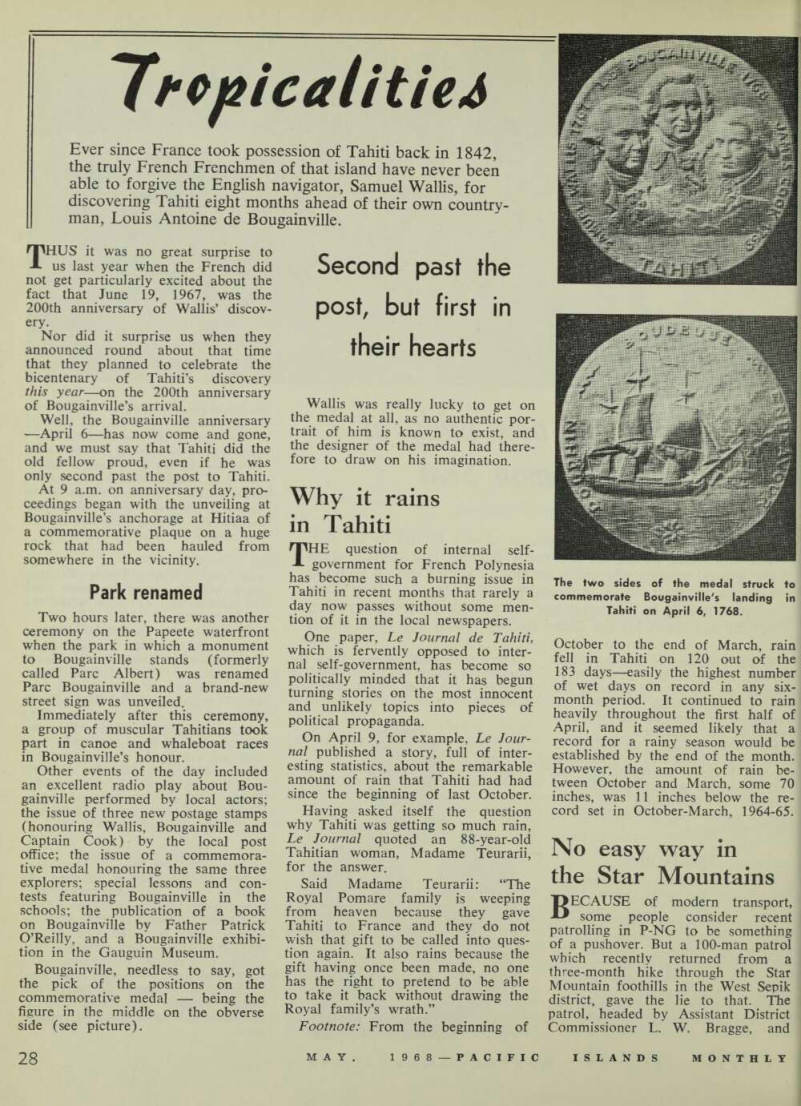
Other events of the day included an excellent radio play about Bou gainville performed by local actors; the issue of three new postage stamps (honouring Wallis, Bougainville and Captain Cook) by the local post office; the issue of a commemora tive medal honouring the same three explorers; special lessons and con tests featuring Bougainville in the schools; the publication of a book on Bougainville by Father Patrick O’Reilly, and a Bougainville exhibi tion in the Gauguin Museum.
Bougainville, needless to say, got the pick of the positions on the commemorative medal being the figure in the middle on the obverse side (see picture).
Second past the post, but first in their hearts
Wallis was really lucky to get on the medal at all, as no authentic por trait of him is known to exist, and the designer of the medal had there fore to draw on his imagination.
Why it rains
in Tahiti
THE question of internal self government for French Polynesia has become such a burning issue in Tahiti in recent months that rarely a day now passes without some men tion of it in the local newspapers.
One paper, Le Journal de Tahiti, which is fervently opposed to inter nal self-government, has become so politically minded that it has begun turning stories on the most innocent and unlikely topics into pieces of political propaganda.
On April 9, for example, Le Jour nal published a story, full of inter esting statistics, about the remarkable amount of rain that Tahiti had had since the beginning of last October.
Having asked itself the question why Tahiti was getting so much rain, Le Journal quoted an 88-year-old Tahitian woman, Madame Teurarii, for the answer.
Said Madame Teurarii: “The Royal Pomare family is weeping from heaven because they gave Tahiti to France and they do not wish that gift to be called into ques tion again. It also rains because the gift having once been made, no one has the right to pretend to be able to take it back without drawing the Royal family’s wrath.”
Footnote: From the beginning of
October to the end of March, rain fell in Tahiti on 120 out of the 183 days—easily the highest number of wet days on record in any six month period. It continued to rain heavily throughout the first half of April, and it seemed likely that a record for a rainy season would be established by the end of the month.
However, the amount of rain be tween October and March, some 70 inches, was 11 inches below the re cord set in October-March, 1964-65.
No easy way in
the Star Mountains
BECAUSE of modern transport, some people consider recent patrolling in P-NG to be something of a pushover. But a 100-man patrol which recently returned from a three-month hike through the Star Mountain foothills in the West Sepik district, gave the lie to that. The patrol, headed by Assistant District Commissioner L. W. Bragge, and
The two sides of the medal struck to commemorate Bougainville's landing in Tahiti on April 6, 1768.
idet Patrol Officer C. van Lieshout, jgged it out the hard way.
During their trek they climbed to itudes ranging from 1,000 ft to are than 7,000 ft, scaled sheer cliff ces, using ropes to ensure the fety of the 92 carriers, and crossed e large rivers on swaying, bush ne suspension bridges.
The patrol’s objective was to con lidate Administration influence long the people in the Atbalmin ea and the restricted Mianmin ea near the West New Guinea trder.
ir David?
OME people are wondering * whether the Queen’s Birthday onours List, due in June, will in ade a knighthood for the P-NG dministrator, Mr. David Hay. It luld be an honour deserved on the ore of his earlier work as an Aus alian diplomat abroad, as well as r the big responsibility he holds in ew Guinea —and he discharges his sponsibility there with efficiency id intelligence. Members of the UN ission which has just concluded a G survey were impressed by him.
lister Dorothy, MBE
TALKING of honours reminds us L that in the New Year Honours ist there was a well deserved MBE »r Sister Dorothy Smith, who these tys with husband Jack is living in lelbourne, although the New Heb des is really home, for they spent tore than 20 years there. They irved a mission station out of rgin bush at Ranmawatt, Pente ist. When they arrived the infant icrtality rate was something like 95 cent., but Dorothy Smith lost nly one mother in childbirth in the ext 20 years. There is a 50-bed ospital with a dental clinic there ow. In Melbourne Jack is care iker of a block of office suites.
damned horseless
sarriages
CHE Niue Treasury Department has advised importers and ex orters of the maximum government ability in the event of loss of goods arried on the Administrtion-owned ghters which ferry all Niue’s goods shore. The rather curious anomaly ppears that if your motor car lunges into the ocean then the naximum liability is $4O, but if you hould lose a horse the same way. hen you may claim $6O.