New Guinea's big towns are expensive,
pp. 32-34 · Read in the full issue
but also they're necessary
I was recently shown a photograph taken in Port Moresby in the early 1920’5. It depicted the hotel at the top of Musgrave Street known at that time as the “top pub”, to distinguish it from the “bottom pub” further down the street. The photographer had waited for a moment when one of the very few cars the town then boasted was passing—an early Chev tourer by the look of it and this with the old-fashioned single storey verandah’d hotel behind it gave it the appearance of a still from an early silent movie.
The top pub was long ago replaced by the “Papua”, and the only build ing from that period still reasonably intact and recognisable is the Ela United Church, in Douglas Street, built in the 1890’s by the London Missionary Society for the few dozen Europeans who then made up Moresby’s expatriate population.
Although it has had a few bits and pieces added to it over the years, it still retains the appearance which it exhibits in early photographs.
Up on the steep slope on the opposite side of Douglas Street and just below the new Anglican Church there are some other survivals of pre war days.
Now, as then, they are occupied as Government offices, but their former broad open verandahs have been en closed to provide more office space, and the lofty inner rooms, once so cool, so pleasant, and so conducive to the leisurely transaction of busi ness, are now lit by fluorescent light ing and cooled by fans.
As it used to be
But it is not hard for an old-timer to stand on what was once the verandah of the Registrar-General’s office, and mentally strip off the ex crescences and see the building as it used to be.
Lord Casey has recently welcomed the reappearance of the verandah in Australian outback architecture. It would be wonderful to see it re appear in New Guinea.
For many years my wife and I lived in a house which had a 10foot verandah all round it. It was built in 1902.
Today, of course, the cost of such a house would be prohibitive to any but the very wealthy.
In the Port Moresby of the 1920’s there were only about 400 Europeans, and nearly all of them lived within easy walking distance of their places of work in the town. Lawes Road was a bridle track.
At Koki there was the gaol; and
To The Point
With
Percy
Chatterton
a small colony of mixed-race folk extended from there to Badili. Be yond the three-mile hill, just wide enough for two cars to pass, were the wide open spaces.
A film actress of that period claimed, on her return to wherever she came from, that she had met natives who had never before seen a white woman. As she never got further out of Moresby than the top of the three-mile hill, this claim was probably a little exaggerated; but in those days film actresses were doomed to silence on the silver screen, and it was only fair that they should be allowed a little latitude off it.
However, it was true that one could drive all the way from that point to Sapphire Creek without sighting more than two or three houses. At Sapphire Creek the road ended, and the adventurous rode up the range on horseback to view the wonders of Rouna Falls.
There was a pub at Rouna, but n< Moresbyite thought it worth makinj the trip merely to present himsel; at its bar on Sunday afternoon as £ bona-fide traveller.
It was the suddenness rather thai the extent of the expansion of For Moresby that caught us unpreparec and was responsible for many o] our present-day problems.
Heavily outnumbered
The European population of post war Moresby sky-rocketed to ter times its pre-war figure, and, with the consequent increase in job oppor tunities, there came an even more spectacular increase in the immigrant indigenous population, so that where as in pre-war Papua the immigrant population was a small fraction oi that of the local villages, the situa tion was now reversed.
The Motu and Koitapu people,
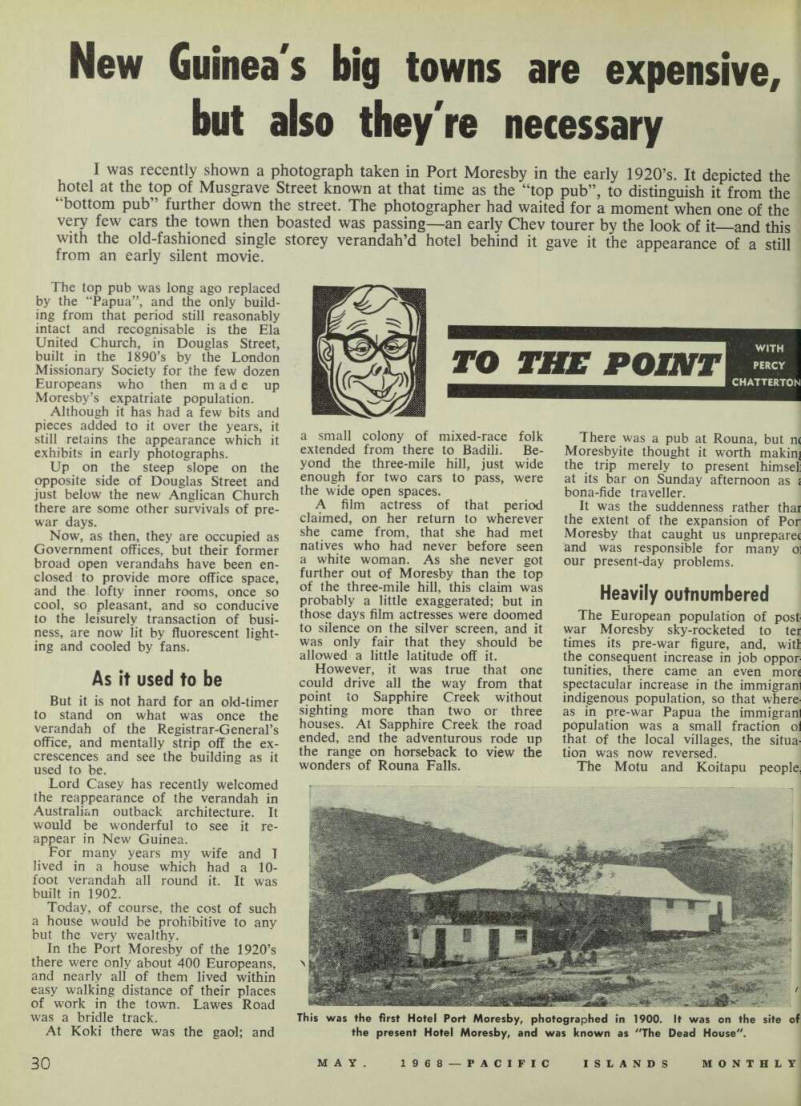
This was the first Hotel Port Moresby, photographed in 1900. It was on the site of the present Hotel Moresby, and was known as "The Dead House".
/hose great-grandfathers owned all
hey surveyed, are now heavily out tumbered by the “foreign natives” -to use a phrase which I detest, Ithough, oddly enough, the people o whom it is applied don’t seem to nind it.
These folk come from every part >f Papua and New Guinea. Those rom the Gulf of Papua are in the najority, but there are very large lumbers from the Goilala hinterland if the Central District, and it is said hat, of the total of 30,000, 2,000 ire from the Highlands.
Not interested
Some live in quarters provided by employers (not necessarily their own ;mployers), others rent houses from he Administration; a few have built heir own houses on blocks to which hey have secured a title, while 8,000 ire shanty-dwellers squatting on Vlotu- or Koitapu-owned land.
Private enterprise has not so far Deen interested in speculative building, and the size of the problem has been beyond the ability of the Adminis tration to cope with effectively.
So the recent establishment of a Housing Commission to take over the responsibilities previously handled by the Treasury Department is to be welcomed. A full-time Commissioner and four part-time Associate Com missioners have been appointed. One of the latter is a well-known and forthright New Guinean, Thomas Tobunbun, of Rabaul. Of the other three, one represents the Treasury and two private enterprise.
A good set-up, though one feels that private enterprise might have been satisfied with one representative and that the other place might profit ably have gone to a social worker with understanding of the problems
of the people who are going to live in the houses the commission is go ing to build.
Housing, of course, is only one of the problems being encountered in rapidly expanding Port Moresby.
There are the problems of essential services, roads, footpaths, recrea tional and parking areas, and so on.
And there are ever-increasing traffic problems in a town where many of the roads are hilly and winding.
The recent extension of the town boundaries and the establishment of new suburbs intensifies these problems and underlines the need for rapid progress towards urban local govern ment.
Perhaps the toughest of Moresby’s problems is that of convincing a rurally minded House of Assembly that in a country striving towards a viable cash economy towns such as Port Moresby, Lae and Rabaul, are both necessary and expensive.
So long as the economy of New Guinea was a subsistence one, towns were not necessary, and did not in fact emerge. Aside from a bit of barter trade, each village was self sufficient, and few village popula tions exceeded a thousand.
No police, no law courts
When the population of a village reached this level, the tendency was for a part of it to hive off and estab lish a new village. Perhaps at this level the problems of sanitation be came insuperable. Or perhaps the difficulty of maintaining law and order in a large community with no police force and no law courts got on top of them.
It is bard for rural folk to realise that when they switch over from growing things to eat to growing things to sell, they are embarking on
a new way of life which makes ports and the towns which grow up round them a necessity.
Perhaps some of the resentment towards Port Moresby so often evidenced in the House of Assembly arises from a feeling that, while stores and wharfs and other mani festations of commerce and industry may be necessary, the teeming hordes of public servants are not. This is
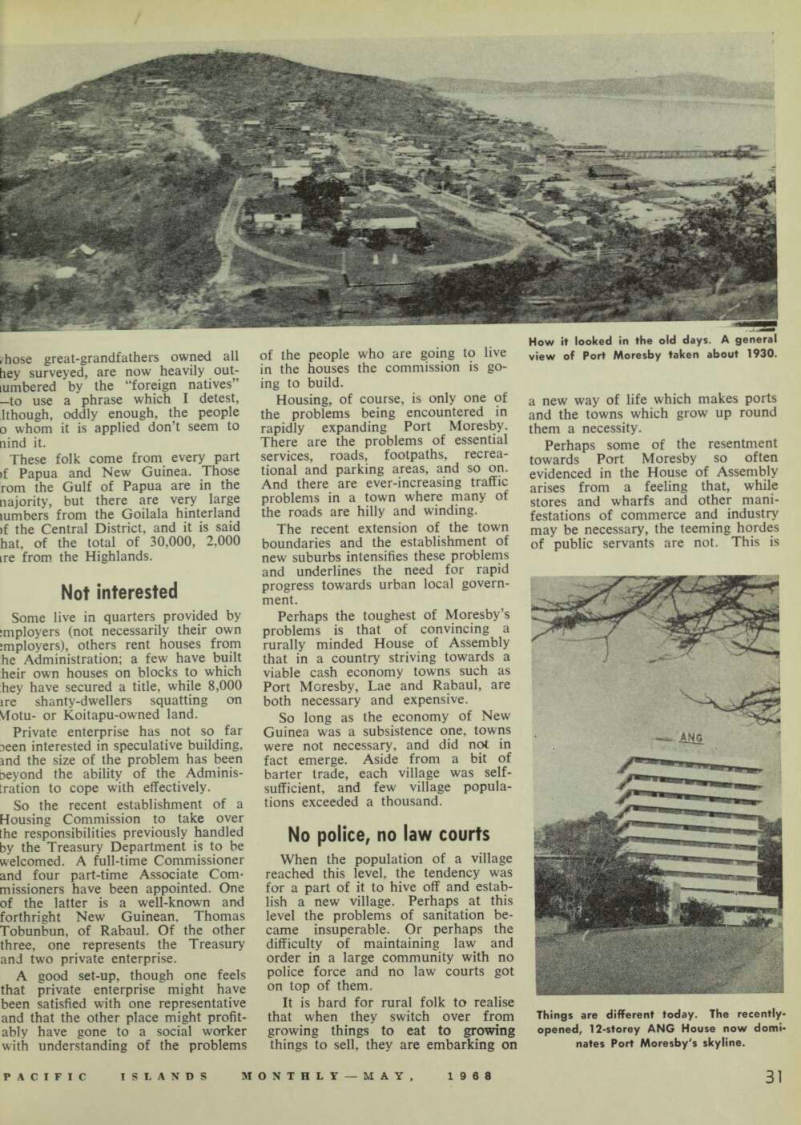
How it looked In the old days. A general view of Port Moresby taken about 1930.
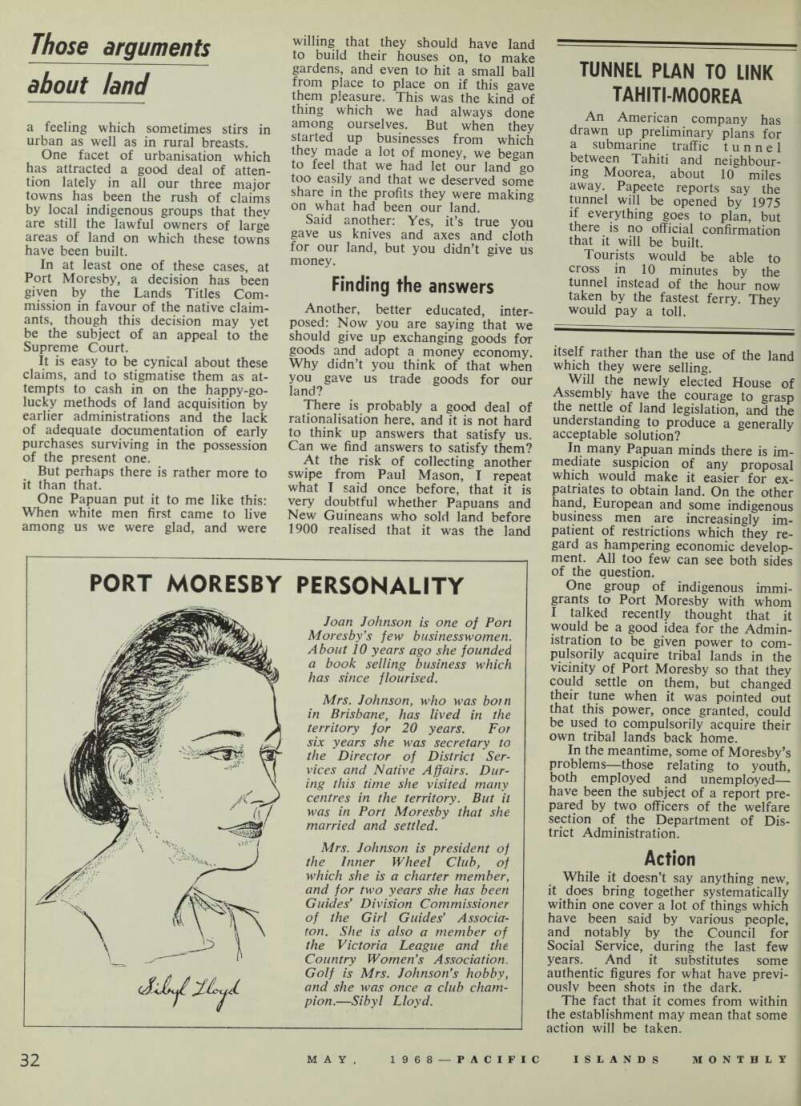
Things are different today. The recently opened, 12-storey ANG House now domi nates Port Moresby's skyline.
Those arguments about land
a feeling which sometimes stirs in urban as well as in rural breasts.
One facet of urbanisation which has attracted a good deal of atten tion lately in all our three major towns has been the rush of claims by local indigenous groups that they are still the lawful owners of large areas of land on which these towns have been built.
In at least one of these cases, at Port Moresby, a decision has been given by the Lands Titles Com mission in favour of the native claim ants, though this decision may yet be the subject of an appeal to the Supreme Court.
It is easy to be cynical about these claims, and to stigmatise them as at tempts to cash in on the happy-go lucky methods of land acquisition by earlier administrations and the lack of adequate documentation of early purchases surviving in the possession of the present one.
But perhaps there is rather more to it than that.
One Papuan put it to me like this: When white men first came to live among us we were glad, and were
willing that they should have land to build their houses on, to make gardens, and even to hit a small ball from place to place on if this gave them pleasure. This was the kind of thing which we had always done among ourselves. But when they started up businesses from which they made a lot of money, we began to feel that we had let our land go too easily and that we deserved some share in the profits they were making on what had been our land.
Said another: Yes, it’s true you gave us knives and axes and cloth for our land, but you didn’t give us money.
Finding the answers
Another, better educated, inter posed: Now you are saying that we should give up exchanging goods for goods and adopt a money economy.
Why didn’t you think of that when you gave us trade goods for our land?
There is probably a good deal of rationalisation here, and it is not hard to think up answers that satisfy us.
Can we find answers to satisfy them?
At the risk of collecting another swipe from Paul Mason, I repeat what I said once before, that it is very doubtful whether Papuans and New Guineans who sold land before 1900 realised that it was the land
itself rather than the use of the land which they were selling.
Will the newly elected House of Assembly have the courage to grasp the nettle of land legislation, and the understanding to produce a generally acceptable solution?
In many Papuan minds there is im mediate suspicion of any proposal which would make it easier for ex patriates to obtain land. On the other hand, European and some indigenous business men are increasingly im patient of restrictions which they re gard as hampering economic develop ment. All too few can see both sides of the question.
One group of indigenous immi grants to Port Moresby with whom I talked recently thought that it would be a good idea for the Admin istration to be given power to com pulsorily acquire tribal lands in the vicinity of Port Moresby so that they could settle on them, but changed their tune when it was pointed out that this power, once granted, could be used to compulsorily acquire their own tribal lands back home.
In the meantime, some of Moresby’s problems—those relating to youth, both employed and unemployed— have been the subject of a report pre pared by two officers of the welfare section of the Department of Dis trict Administration.
Action
While it doesn’t say anything new, it does bring together systematically within one cover a lot of things which have been said by various people, and notably by the Council for Social Service, during the last few years. And it substitutes some authentic figures for what have previ ously been shots in the dark.
The fact that it comes from within the establishment may mean that some action will be taken.