Cabinet Minister Slates
pp. 61-65 · Read in the full issue



Disillusionment since self-government
Own Government's
Performance In Cook Is.
After 2T years of internal self-government, the Cook Islands Government has carried out virtually none of the promises in its election platform, and the country is now probably worse off than it was before under New Zealand control.
This is the opinion of the Cook islands Minister for Education, Mr.
Mana Strickland, who delivered a 3aper on “Colonialism and Selfgovernment, Exemplified by Events n the Cook Islands” at the 40th \NZAAS congress in Christchurch, Vew Zealand, in January.
Mr. Strickland said that the Cook slands Government had made no leadway towards laying down a con- :rete development plan for his ountry, and certainly not a com- (rehensive economic development dan - “Our country,” he went on, “is ileedmg from the constant loss of ts life-blood—the young and indiligent youth who still emigrate beause of lack of satisfactory opporiimties locally and from disillusionien *- ,
Top heavy finances
Our constitution still does not give s a complete and firm grasp on our iternal affairs. Our finances are top eavy against us. Our local governlent, agriculture, local industries, ical shipping, overseas marketing, 3-operatives, land laws and social ;rvices are either limp or are not Tectively directed.
We have neither internal air serces nor a policy set for tourism. ur policy for making our public ;rvice „ our very own is still a • , . , . .
Mr. Strickland quoted to the con- -ess various platforms from the P° llcy * nd /hen denbed what if anything, had been )ne to implement them.
He said that the Premier, Mr Ibert Henry, had often spoken of e administration s desire to reduce ; need for financial assistance from ew Zealand. However, these were •nly words. No practical solution id been applied to achieve this end.
Under self-government, Mr. Stricknd said, the Cook Islands Govern-
ment had acquired as a going con cern an expansive “welfare state.”
It was continuing to expand its social services “quite beyond local capacity to finance and operate without con siderable external assistance.”
“So far,” Mr. Strickland said, “no facilities have been provided to the people of the Cook Islands to in vest money in their government, although schemes have been proposed for it.
“Nowhere in the requests for financial assistance to the New Zea land Government has a mention been made on the need of a marine biologist to examine and report on the potentialities of our marine shelves, and lagoons; nor of the need to get a team of geophysical sur veyors to investigate the strata of our volcanic atolls and their approaches.
“We may possess easily accessible valuable natural resources, but we appear not interested to find out about them ”
Inral rnimrilc LUtdi tuuntilS Mr. Strickland said that plans to give local communities increased opportunities to take part in govern ment and to run their own affairs had “limped” because of serious errors and omissions in legislation The Rarotonga Island Council had not been replaced by new district councils, although these were created.
Instead, some of the functions of local governments had been taken over by the central government.
Nothing had been done towards the establishment of local courts and no district had been brought in to play a role in the solution of land problems, Referring to agriculture Mr Strickland said that no overall im provement in the production of the main crops, citrus and copra, was possible while nothing new was done about marketing, Nothing, he said, had been achieved
to bring the price paid to Cook Islands copra growers to the same level as that paid to Western Samoan growers by the same buyer in New Zealand. Meanwhile, some growers in the northern atolls could not average an income of five cents a day. Yet there was considerable scope for increasing copra yields in those atolls.
Education
Mr. Strickland said that in educa tion the government’s policy was still that of its predecessor—to equip children so that they would leave their family for work in New Zea land.
Yet there was sufficient land for “more than one project to involve a good number of our youth” and there were “over 100,000 acres of mostly excellent lagoons bounded by 250 miles of reef around our islands to sustain more than one fishery pro ject, again capable of satisfactorily occupying many of our youth.”
Co-operatives
Mr. Strickland said that despite the new government’s promise to “give every encouragement to soundly based projects sponsored by the co operative movement”, it repeated the practice of its predecessor of en couraging competition against the “principal sectors of development of the movement”.
“The one help which the govern ment provided for the movement, a legacy from the previous one, was the audit and advisory services of the Department of Co-operatives,”
Mr. Strickland said.
“However, it is sad to state that despite the fact that about half the
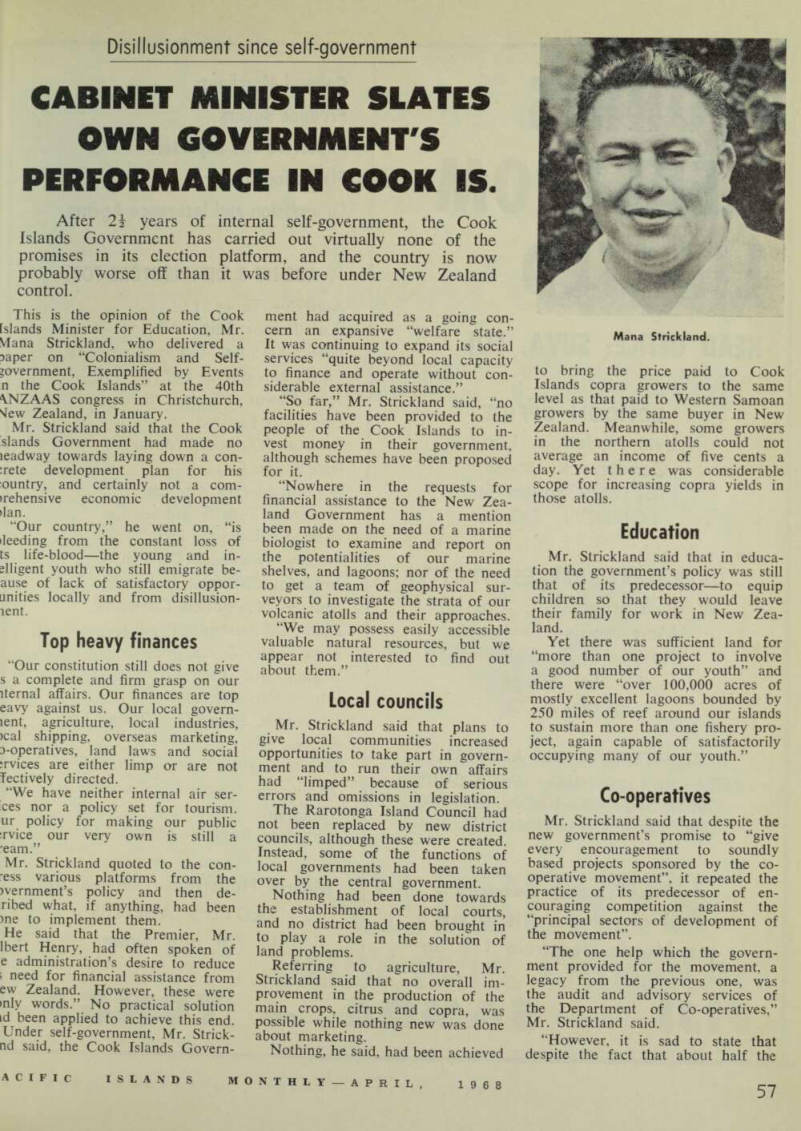
Mana Strickland.
total expenditure of the department went to salaries, etc., of two imported officers, audits and reports to com mittees of societies are even now from about one to two calendar years in arrears of the particular time on which actual transactions took place.”
Mr. Strickland said that the co operative movement in the Cook Islands was not allowed to have its own co-operatives council to act as the connecting link between the now scattered co-operatives, particularly in matters of co-operative education, staff training supervision and democratic representation.
Mr. Strickland said that although it was a plank of the government’s policy that the people should have the fullest confidence in the land system and its administration by the Land Court, the court still did not have the people’s fullest confidence.
“Apart from the general feeling prevailing in Rarotonga and some other islands, there are islands that do not allow the Land Court to have anything to do with their land matters,” he said.
Referring to education, Mr. Strick land said that children were still free .o leave school in the Cook Islands at the age of 15 “even if many of hem have hardly begun their secondary schooling”.
Big increase in prices
He went on: “While there is a ?reat need to increase our primary reduction . . . compulsory education should continue for your people who :annot prove that they are usefully accupied up to the age of 18.
“Land development schemes, narine development schemes, voca ional training workshops, etc., all hese could materialise under such a suggested scheme.”
Mr. Strickland criticised the present ystem of price control in the Cook slands, which, he said, was in the lands of a Price Tribunal consisting )f a busy public servant, the manager >f the most influential firm in the ;roup, and a private elderly local >erson.
He added: “It is estimated that the ost of living of the basic worker in the Cooks] has risen by about 3-1/3 per cent, from the date of elf-government up to and including he change over in currency.
“Devaluation effects are, in the neantime, not visible, but if no
better measures are taken, the cost of living will rise to new heights.”
Mr. Strickland said that little had been done to implement the present and previous governments’ policies of replacing imported public servants with Cook Islands public servants.
Less had been done in government departments to see that imported officers gracefully accepted the fact that it was their moral duty to pass on to their assistants as much of their knowledge and experience as they could within the period of their term.
Internal air services
On the question of the ratio be tween the average pay of local officers and imported ones, no appreciable move had been made to reduce the gap.
Mr. Strickland said that the gov ernment had not lived up to its promise to investigate the possibility of establishing an internal air service.
Although more than one island prepared their airstrip for the purpose, and although more than one offer has been made to government, no action has yet been taken,” he >aid, “though the need for this service, particularly for mercy flights, is great and urgent because of the termination of services by the Laucala Bay oase”.