Despite appearances, there's plenty
pp. 54-56 · Read in the full issue
of self-help in New Guinea
These are days in which it is fashionable to sneer at the welfare state, and in Papua-New Guinea it is not uncommon to hear voices, sometimes the voices of Europeans whose jobs carry entitlement to quite generous “perks”, raised against the demoralising practice of giving “hand outs” to the indigenous population.
ris presumably with the worthy object of avoiding demoralising Papuans and New Guineans in this way that the Administration with holds from its indigenous public servants the rent allowances it gives to its expatriate ones, while at least one department store denies to its indigenous employees the discount on their personal purchases enjoyed by its European staff.
Actually the area of completely free hand-outs is steadily dwindling.
Parents are now called upon to make a contribution towards the cost of their children’s education, and Papuans and New Guineans, other than children, are charged for treat ment, whether as out-patients or in patients, in our major hospitals.
Admittedly the actual amounts charged are small, but they are not insignificant in relation to wage levels.
Still the demands that the Admini stration should provide this or that or the other continue to flow in from all sides.
Even the visiting UN Mission has been bombarded with them—more
To The Point
With
Percy
Chatterton
roads, more bridges, more airstrips, more schools, more aid-posts and so on.
Amidst this chorus it is always pleasing to hear of groups of people, large and small, who are trying to do things for themselves.
Highlanders at work
The most spectacular of these do it-yourself efforts have occurred in the Highlands, where they have the numbers required for staging spectacles and the physical vigour often lacking in the more enervating climate of the lowlands.
Up there, men, women, and even children, have achieved remarkable
feats of road building with picks and shovels, and even on occasion with digging sticks and bare hands.
A good deal more of this do-it yourself road building could be done if the Administration was able to give more help in surveying the routes for such roads to follow.
Within what has been for the past four years my parliamentary con stituency there is an upland area where English potatoes and other cool climate vegetables can be grown.
It is nearer to the Port Moresby market than any other comparable area.
Although it is sparsely populated as compared with the Highlands, the people who live there have repeatedly expressed their willingness to get cracking on a do-it-yourself road which might ultimately join up with the professionally constructed one which the Administration is steadily pushing out from Port Moresby in that direction. But they need expert advice as to the best route for such a road to follow.
Appeals for this sort of help come from all over the territory; un fortunately the Administration is always chronically short of surveyors.
But the Institute of Higher Technical Education is now providing a course in surveying, so in a few years there should be an outflow of indigenous surveyors to catch up with this shortage. It may then be possible to give the do-it-yourself enthusiasts the help they need.
The professional road builder may look down his nose at the result, but it seems clear that many of the less economically promising parts of the
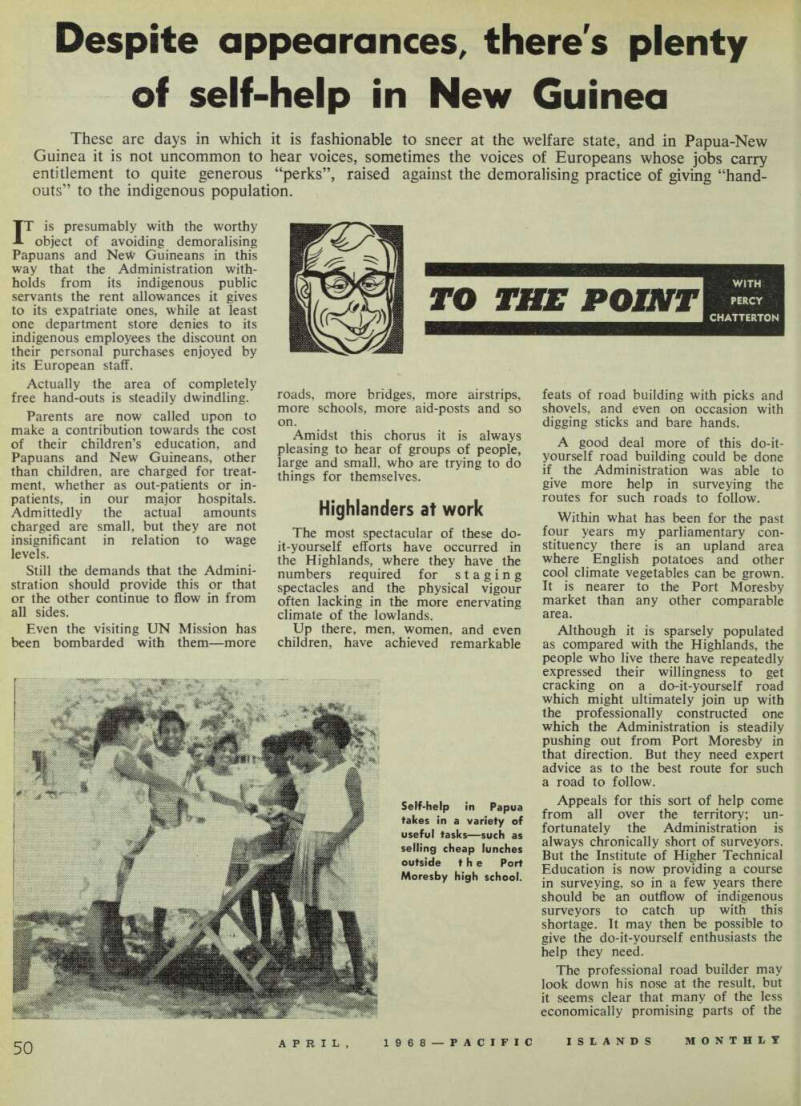
Self-help in Papua takes in a variety of useful tasks—such as selling cheap lunches outside the Port Moresby high school.
territory will never be opened up at all unless they are opened up on do-it-yourself lines.
Projects such as road building call for sustained effort by large groups of people. But there are less ambitious projects which quite small groups of people can undertake.
The word “drop-out” has been much bandied about in the territory of late.
It refers to school pupils who, after completing the primary course, fail to qualify for secondary education, as well as to those who fall by the wayside even before they reach the top of the primary school.
Smaller undertakings
It is recognised that these young people represent both an educational and a social problem, and possibly a potential political hazard.
Some years ago, a group of girls who fell into this category ap proached the Welfare Officer in charge of the Kaugere Community Centre in Port Moresby. This officer, Mrs. Thelma Price, since awarded a well deserved MBE, suggested that they might set themselves up in business to provide cheap lunches for pupils attending the neighbouring schools.
This they did, calling themselves modestly “the School Lunch Group”.
They prepared sandwiches, meat pies and fruit drinks, and sold them outside the schools at lunch time.
Proceeds were banked, and after bills had been paid the profits were shared.
At first they needed a good deal of help from the staff of the centre in ordering supplies, banking pro ceeds, and working out a fair alloca tion of profits. But they soon learned to handle these matters themselves.
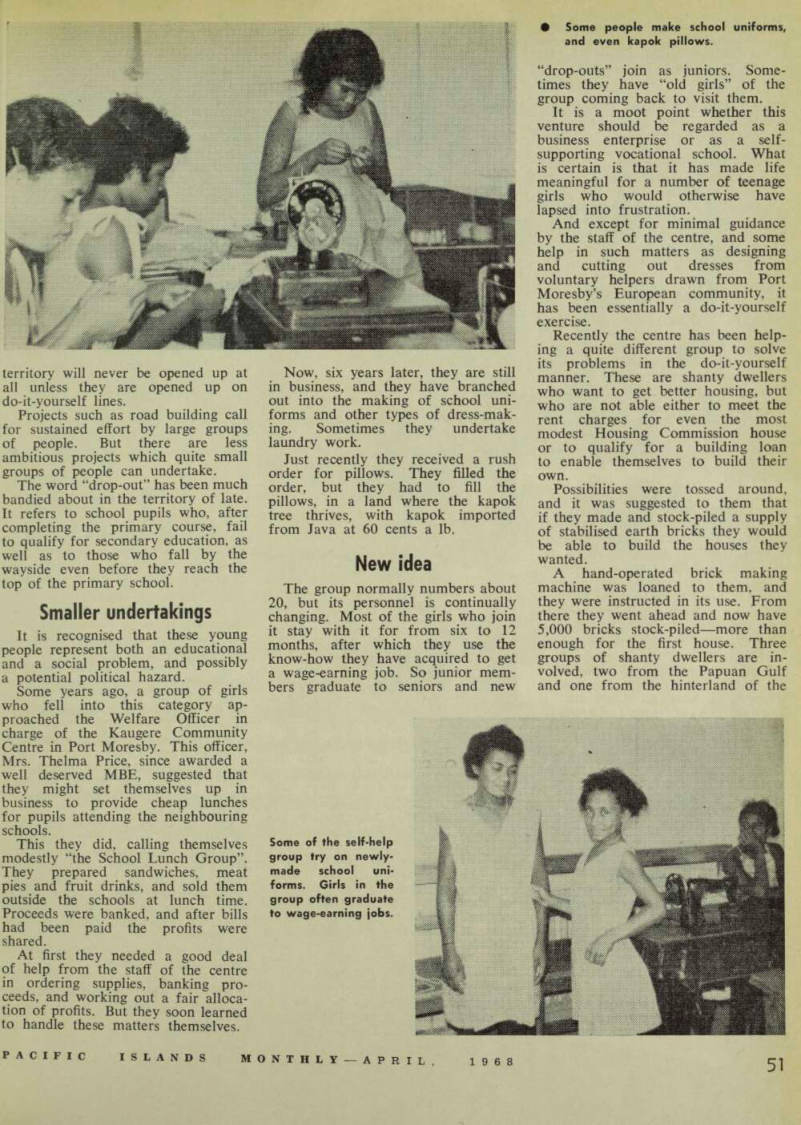
Now, six years later, they are still in business, and they have branched out into the making of school uni forms and other types of dress-mak ing. Sometimes they undertake laundry work.
Just recently they received a rush order for pillows. They filled the order, but they had to fill the pillows, in a land where the kapok tree thrives, with kapok imported from Java at 60 cents a lb.
New idea
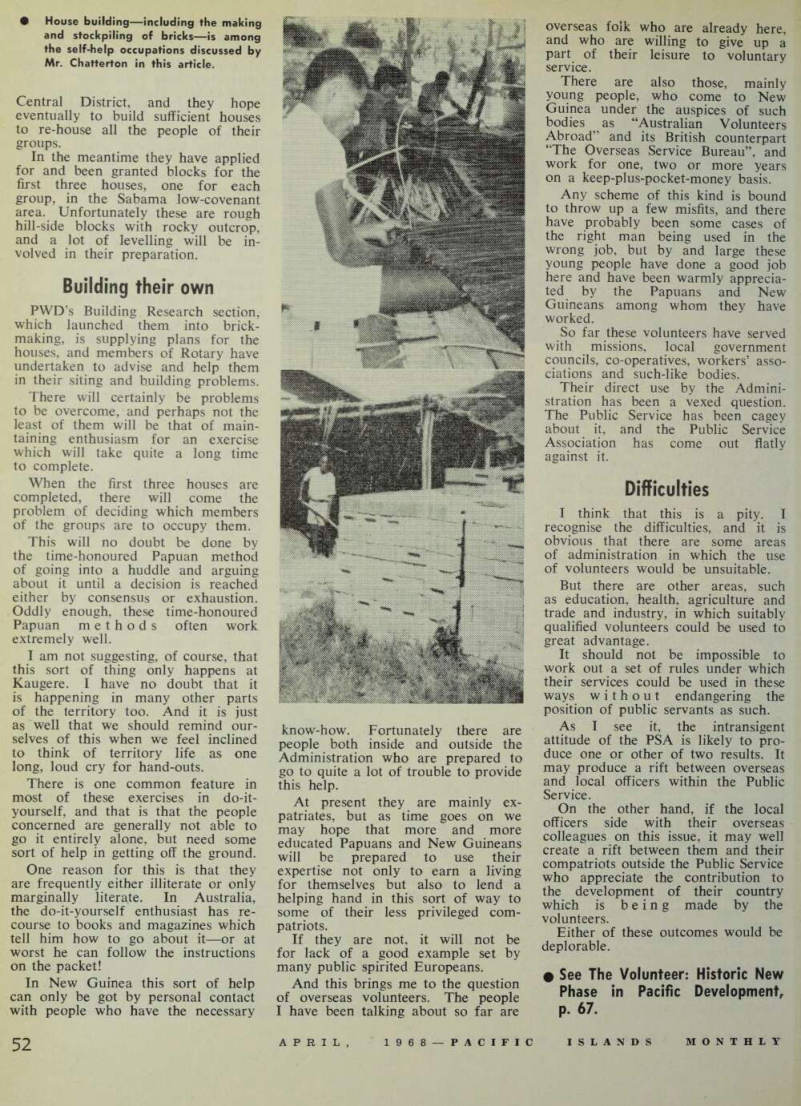
The group normally numbers about 20, but its personnel is continually changing. Most of the girls who join it stay with it for from six to 12 months, after which they use the know-how they have acquired to get a wage-earning job. So junior mem bers graduate to seniors and new
“drop-outs” join as juniors. Some times they have “old girls” of the group coming back to visit them.
It is a moot point whether this venture should be regarded as a business enterprise or as a self supporting vocational school. What is certain is that it has made life meaningful for a number of teenage girls who would otherwise have lapsed into frustration.
And except for minimal guidance by the staff of the centre, and some help in such matters as designing and cutting out dresses from voluntary helpers drawn from Port Moresby’s European community, it has been essentially a do-it-yourself exercise.
Recently the centre has been help ing a quite different group to solve its problems in the do-it-yourself manner. These are shanty dwellers who want to get better housing, but who are not able either to meet the rent charges for even the most modest Housing Commission house or to qualify for a building loan to enable themselves to build their own.
Possibilities were tossed around, and it was suggested to them that if they made and stock-piled a supply of stabilised earth bricks they would be able to build the houses they wanted.
A hand-operated brick making machine was loaned to them, and they were instructed in its use. From there they went ahead and now have 5,000 bricks stock-piled—more than enough for the first house. Three groups of shanty dwellers are in volved, two from the Papuan Gulf and one from the hinterland of the
Some of the self-help group try on newly made school uni forms. Girls in the group often graduate to wage-earning jobs.
• Some people make school uniforms, and even kapok pillows.
Central District, and they hope eventually to build sufficient houses to re-house all the people of their groups.
In the meantime they have applied for and been granted blocks for the first three houses, one for each group, in the Sabama low-covenant area. Unfortunately these are rough hill-side blocks with rocky outcrop, and a lot of levelling will be in volved in their preparation.
Building their own
PWD’s Building Research section, which launched them into brick making, is supplying plans for the houses, and members of Rotary have undertaken to advise and help them in their siting and building problems.
There will certainly be problems to be overcome, and perhaps not the least of them will be that of main taining enthusiasm for an exercise which will take quite a long time to complete.
When the first three houses are completed, there will come the problem of deciding which members of the groups are to occupy them.
This will no doubt be done by the time-honoured Papuan method of going into a huddle and arguing about it until a decision is reached either by consensus or exhaustion.
Oddly enough, these time-honoured Papuan methods often work extremely well.
I am not suggesting, of course, that this sort of thing only happens at Kaugere. I have no doubt that it is happening in many other parts of the territory too. And it is just as well that we should remind our selves of this when we feel inclined to think of territory life as one long, loud cry for hand-outs.
There is one common feature in most of these exercises in do-it yourself, and that is that the people concerned are generally not able to go it entirely alone, but need some sort of help in getting off the ground.
One reason for this is that they are frequently either illiterate or only marginally literate. In Australia, the do-it-yourself enthusiast has re course to books and magazines which tell him how to go about it—or at worst he can follow the instructions on the packet!
In New Guinea this sort of help can only be got by personal contact with people who have the necessary
know-how. Fortunately there are people both inside and outside the Administration who are prepared to go to quite a lot of trouble to provide this help.
At present they are mainly ex patriates, but as time goes on we may hope that more and more educated Papuans and New Guineans will be prepared to use their expertise not only to earn a living for themselves but also to lend a helping hand in this sort of way to some of their less privileged com patriots.
If they are not, it will not be for lack of a good example set by many public spirited Europeans.
And this brings me to the question of overseas volunteers. The people I have been talking about so far are
overseas folk who are already here, and who are willing to give up a part of their leisure to voluntary service.
There are also those, mainly young people, who come to New Guinea under the auspices of such bodies as “Australian Volunteers Abroad” and its British counterpart “The Overseas Service Bureau”, and work for one, two or more years on a keep-plus-pocket-money basis.
Any scheme of this kind is bound to throw up a few misfits, and there have probably been some cases of the right man being used in the wrong job, but by and large these young people have done a good job here and have been warmly apprecia ted by the Papuans and New Guineans among whom they have worked.
So far these volunteers have served with missions, local government councils, co-operatives, workers’ asso ciations and such-like bodies.
Their direct use by the Admini stration has been a vexed question.
The Public Service has been cagey about it, and the Public Service Association has come out flatly against it.
Difficulties
I think that this is a pity. 1 recognise the difficulties, and it is obvious that there are some areas of administration in which the use of volunteers would be unsuitable.
But there are other areas, such as education, health, agriculture and trade and industry, in which suitably qualified volunteers could be used to great advantage.
It should not be impossible to work out a set of rules under which their services could be used in these ways without endangering the position of public servants as such.
As I see it, the intransigent attitude of the PSA is likely to pro duce one or other of two results. It may produce a rift between overseas and local officers within the Public Service.
On the other hand, if the local officers side with their overseas colleagues on this issue, it may well create a rift between them and their compatriots outside the Public Service who appreciate the contribution to the development of their country which is being made by the volunteers.
Either of these outcomes would be deplorable.
• See The Volunteer; Historic New Phase in Pacific Development, p. 67.
• House building—including the making and stockpiling of bricks —is among the self-help occupations discussed by Mr. Chatterton in this article.