(If They're Not Kiaps Or Cultists)
pp. 25-27 · Read in the full issue
Ng Electors Like Younger Politicians
From a Port Moresby correspondent March 22 During the second week of March the polling teams, like Gray’s ploughmen, were home ward plodding their weary way, after a strenuous month of vote collecting. Some of the candi dates had been doing quite a bit of plodding too, while others, more affluent, had been hopping along in light planes or helicopters ahead of the polling teams. Still others (and I am not sure that these were really the lucky ones) had had nothing to do after the first week but sit down and bite their nails while waiting for the counting of votes to start.
Counting began at 6 p.m. on l6. The counting of primary )tes is now completed, and the re ilts have been posted in the central lly-room at Port Moresby. Now Hows a further week during hich absentee and postal votes will ; reaching their destinations.
These will be opened and counted i March 30, and then will follow week or more of preference vote muting before we shall finally know r sure who’s in and who’s out. So me candidates have quite a bit of til biting to do yet.
To date only the four candidates ho were unopposed have been de ared to be members of the new ouse. But in about a quarter of e 84 electorates there can be no rious doubt about the result.
These are those in which there ere only two candidates, and those which one candidate has a clear ajority over the combined votes of I his opponents.
Barrett out
Among the regional electorates, Roy shton has a substantial majority 'er Don Barrett in East and West ew Britain, Dennis Buchanan has :feated his two opponents in the astern Highlands, and Tony Voutas is wrested the Morobe seat from ex >eaker Home Niall. Ron Neville outhern Highlands) and Joe Langro Sepik) were elected unopposed.
The remaining ten regional seats vait a decision on preferences.
Of the 69 open electorates, the re- It is certain or practically certain 20. Of these, five seats will be dd by Europeans and 15 by New uineans.
In a number of other cases the dications as to who will be elected e fairly strong; but prediction is Hind to be an uncertain business a system under which the in cating of preferences is optional.
Until the ballot boxes are re
opened for preference counting, no one can tell how many preference votes there will be.
However, even at this stage there are some general trends emerging. It looks as if there will again be a solid phalanx of members from the Highlands who will join Kaibelt Diria (re-elected for Wahgi) in his oft repeated plea of “Easy easy”.
To call these Highlands members conservatives is perhaps misleading, but they certainly believe in making haste slowly.
On the coast and in the islands it may be different. It looks as if there will be a swing to younger and better educated members, though it won’t assume landslide proportions.
In the Kerema electorate, for example, war veteran Gabriel Ehava Karava has been ousted by a young co-operative officer, Tore Lokoloko,
whose travels overseas have included a visit to India.
It’s not been a good election for ex-kiaps. (Native Affairs officers), True, Ron Neville has been re turned unopposed for the Southern Highlands Regional, and ex-PO Warren Dutton has won the North Fly seat.
No g 00( f or cultlStS 3 But Horrie Niall and Barry Holloway have both suffered defeat, Graham Pople’s chances of re-election appear slim, and Keith McCarthy has failed to bring off his meta morphosis from official to elected member.
It’s not been a good election for cultists either, Hahalis Welfare Society’s Francis Hagai has been defeated in North Bougainville; Tommy Kabu, who,
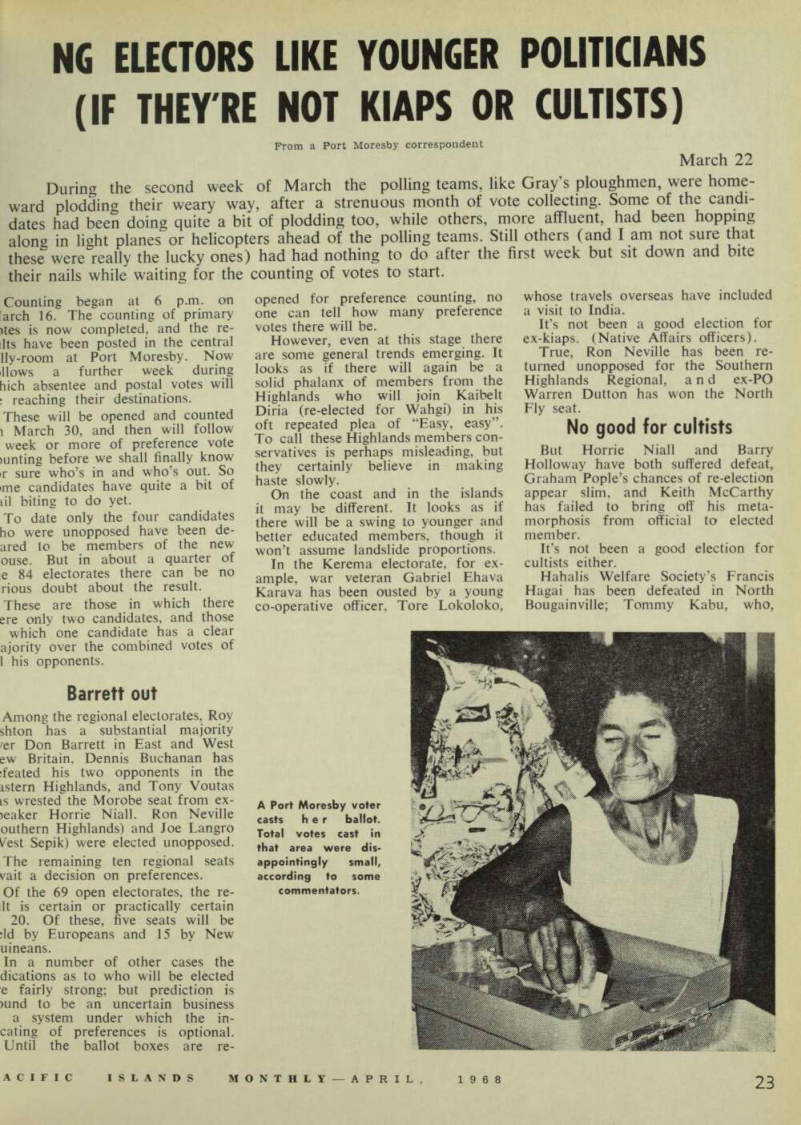
A Port Moresby voter casts her ballot.
Total votes cast in that area were dis
appointingly small,
according to some commentators.
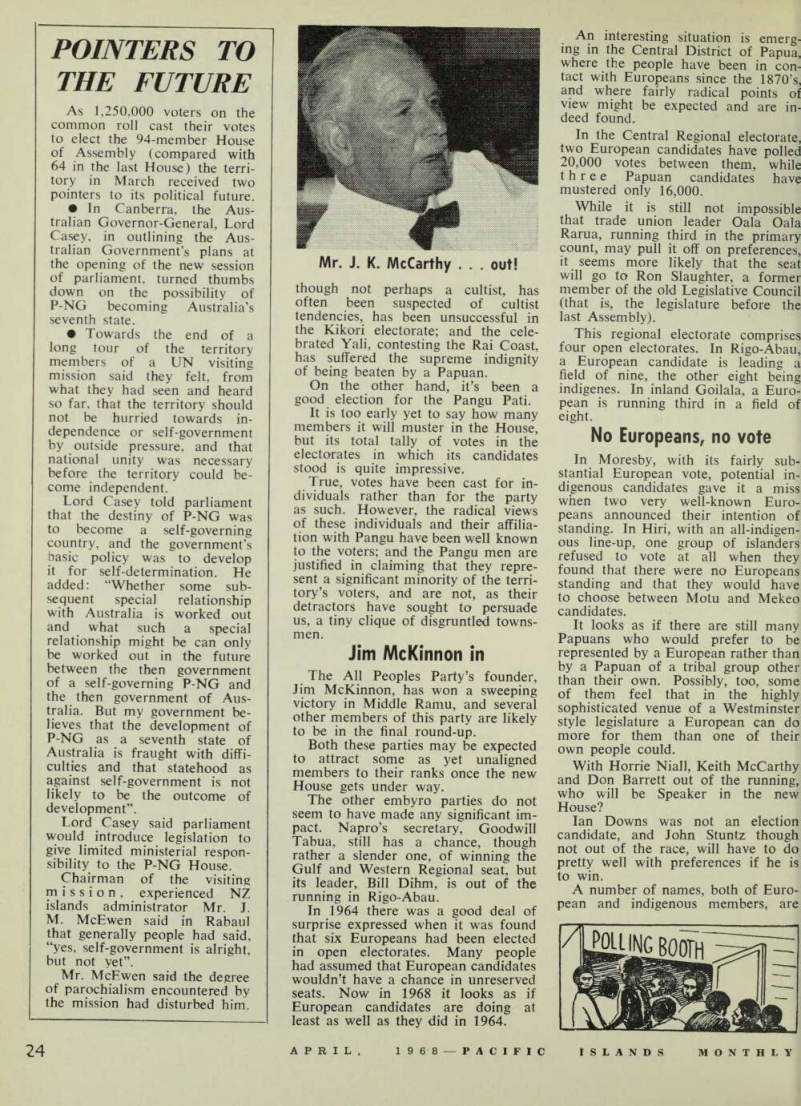
though not perhaps a cultist, has often been suspected of cultist tendencies, has been unsuccessful in the Kikori electorate; and the cele brated Yali, contesting the Rai Coast, has suffered the supreme indignity of being beaten by a Papuan.
On the other hand, it’s been a good election for the Pangu Pati.
It is 100 early yet to say how many members it will muster in the House, but its total tally of votes in the electorates in which its candidates stood is quite impressive.
True, votes have been cast for in dividuals rather than for the party as such. However, the radical views of these individuals and their affilia tion with Pangu have been well known to the voters; and the Pangu men are justified in claiming that they repre sent a significant minority of the terri tory’s voters, and are not, as their detractors have sought to persuade us, a tiny clique of disgruntled towns men.
Jim McKinnon in
The All Peoples Party’s founder, Jim McKinnon, has won a sweeping victory in Middle Ramu, and several other members of this party are likely to be in the final round-up.
Both these parties may be expected to attract some as yet unaligned members to their ranks once the new House gets under way.
The other embyro parties do not seem to have made any significant im pact. Napro’s secretary, Goodwill Tabua, still has a chance, though rather a slender one, of winning the Gulf and Western Regional seat, but its leader, Bill Dihm, is out of the running in Rigo-Abau.
In 1964 there was a good deal of surprise expressed when it was found that six Europeans had been elected in open electorates. Many people had assumed that European candidates wouldn’t have a chance in unreserved seats. Now in 1968 it looks as if European candidates are doing at least as well as they did in 1964.
An interesting situation is emerg ing in the Central District of Papua, where the people have been in con tact with Europeans since the 1870’s, and where fairly radical points of view might be expected and are in deed found.
In the Central Regional electorate, two European candidates have polled 20,000 votes between them, while three Papuan candidates have mustered only 16,000.
While it is still not impossible that trade union leader Oala Gala Rarua, running third in the primary count, may pull it off on preferences, it seems more likely that the seat will go to Ron Slaughter, a former member of the old Legislative Council (that is, the legislature before the last Assembly).
This regional electorate comprises four open electorates. In Rigo-Abau, a European candidate is leading a field of nine, the other eight being indigenes. In inland Goilala, a Euro pean is running third in a field of eight.
No Europeans, no vote
In Moresby, with its fairly sub stantial European vote, potential in digenous candidates gave it a miss when two very well-known Euro peans announced their intention of standing. In Hiri, with an all-indigen ous line-up, one group of islanders refused to vote at all when they found that there were no Europeans standing and that they would have to choose between Motu and Mekeo candidates.
It looks as if there are still many Papuans who would prefer to be represented by a European rather than by a Papuan of a tribal group other than their own. Possibly, too, some of them feel that in the highly sophisticated venue of a Westminster style legislature a European can do more for them than one of their own people could.
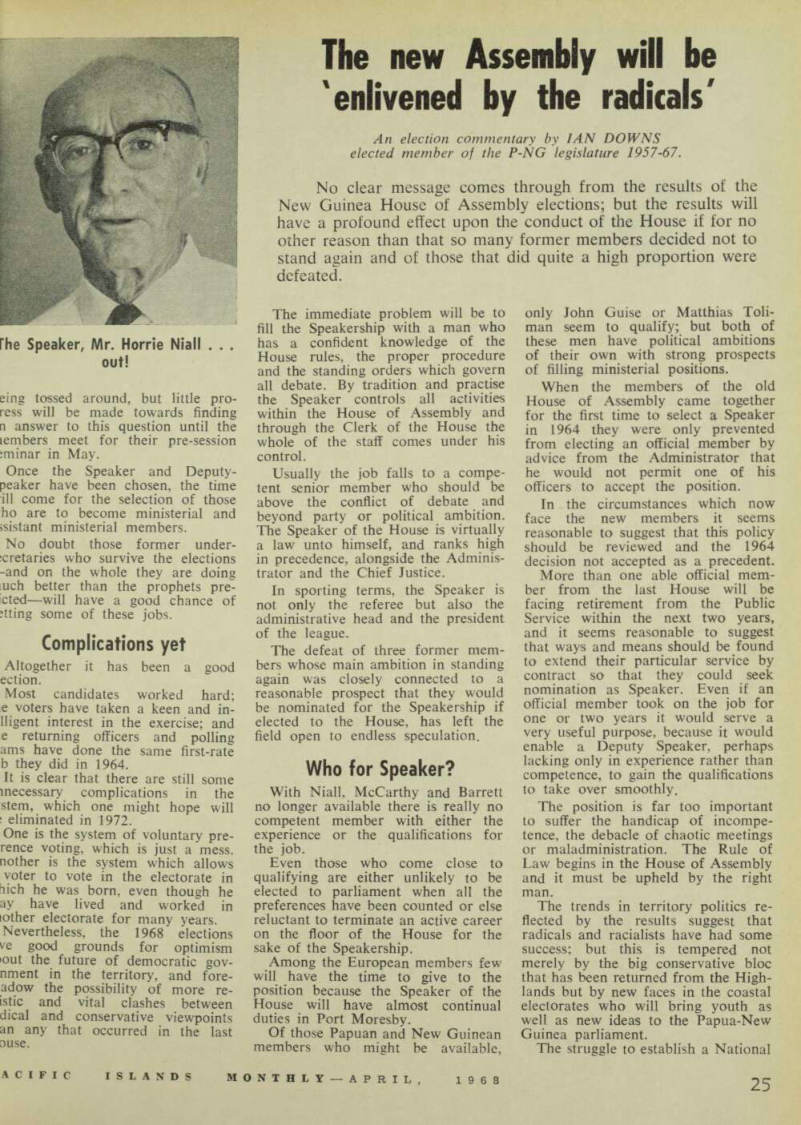
With Home Niall, Keith McCarthy and Don Barrett out of the running, who will be Speaker in the new House? lan Downs was not an election candidate, and John Stuntz though not out of the race, will have to do pretty well with preferences if he is to win.
A number of names, both of Euro pean and indigenous members, are
Mr. J. K. McCarthy . . . out!
eing tossed around, but little pro ress will be made towards finding n answer to this question until the icmbers meet for their pre-session ;minar in May.
Once the Speaker and Deputy peaker have been chosen, the time ill come for the selection of those ho are to become ministerial and jsistant ministerial members.
No doubt those former under :cretaries who survive the elections -and on the whole they are doing iuch better than the prophets pre dated—will have a good chance of ;tting some of these jobs.
Complications yet
Altogether it has been a good ection.
Most candidates worked hard; e voters have taken a keen and in lligent interest in the exercise; and e returning officers and polling ams have done the same first-rate b they did in 1964.
It is clear that there are still some mecessary complications in the stem, which one might hope will i eliminated in 1972.
One is the system of voluntary pre rence voting, which is just a mess, nother is the system which allows voter to vote in the electorate in tiich he was born, even though he ay have lived and worked in (other electorate for many years.
Nevertheless, the 1968 elections ve good grounds for optimism iout the future of democratic gov nment in the territory, and fore adow the possibility of more re istic and vital clashes between dical and conservative viewpoints an any that occurred in the last ouse.
The Speaker, Mr. Horrie Niall . . . out!