Death Of
pp. 24-139 · Read in the full issue
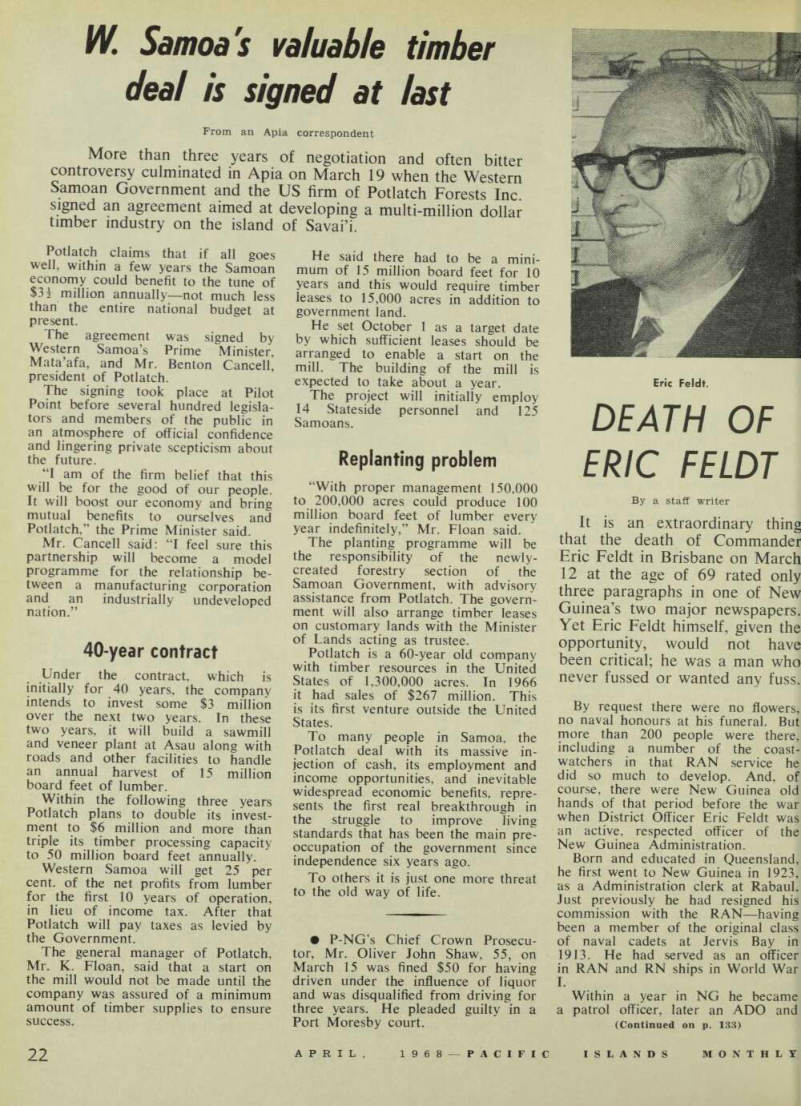
Eric Feldt
By a staff writer
It is an extraordinary thing that the death of Commander Eric Feldt in Brisbane on March 12 at the age of 69 rated only three paragraphs in one of New Guinea’s two major newspapers.
Yet Eric Feldt himself, given the opportunity, would not have been critical; he was a man who never fussed or wanted any fuss.
By request there were no flowers, no naval honours at his funeral. But more than 200 people were there, including a number of the coast watchers in that RAN service he did so much to develop. And, of course, there were New Guinea old hands of that period before the war when District Officer Eric Feldt was an active, respected officer of the New Guinea Administration.
Born and educated in Queensland, he first went to New Guinea in 1923, as a Administration clerk at Rabaul.
Just previously he had resigned his commission with the RAN—having been a member of the original class of naval cadets at Jervis Bay in 1913. He had served as an officer in RAN and RN ships in World War I.
Within a year in NG he became a patrol officer, later an ADO and
(Continued on p. 133)
Eric Feldt.
finally in 1932 District Officer. One of his patrol jobs was to arrest, in 1931, the Kukukuku killers of German prospector Helmuth Baum.
He later became Morobe mining warden.
In 1939, with the Pacific War on the horizon, Eric Feldt was mobilised by the Navy and appointed Staff Officer (Intelligence) Port Moresby with the operational control of what became the famous coastwatcher net work of reporting stations, using civilians experienced in the area for surveillance. The detailed establish ment of the service had been done by Walter Brooksbank. Eric Feldt’s task was to extend the system from the Australian coast into P-NG and the Solomons, by selecting men and placing teleradios.
As Lt.-Commander G. H. Hill said in the foreword to Eric Feldt’s cele brated history, The Coast Watchers (which has appeared in three separate editions since the first one in 1946), the Islands service was “a monument to the efficiency with which Eric Feldt carried out his task. He was the man for the job and he did it in a way that none could have bettered. Himself an islander ... he knew the islanders Government official and planter alike—and was well-known and trusted by them. . . .
“He was, among other things, the link between the Director of Naval Intelligence on the one hand and the Island coastwatching personnel on th e S!£r er ’ They ’ lowing him, took the DNI and the Navy on trust be
cause of him. It was his personality, plus the Navy as represented by him, that caused Island coastwatching personnel who later rendered invalu able service as naval officers from behind the enemy lines, voluntarily to remain in Japanese-occupied territory when they could have been evacua ted, risking capture and death as civilian ‘spies’ at a time when they had no service status.”
The coastwatchers, among other things, allowed the Americans to retain Guadalcanal and Tulagi. For his work Eric Feldt was awarded the
Obe.
He retired because of his health in 1945 and lived in Brisbane, Despite his illness he never believed that retirement meant a man had to go to seed—and he deliberately made his retirement a busy one.
He also continued with his interest in territory affairs. Something he read in a book last year spurred him to write a long article in PIM last May defending many of the actions of the pre-war New Guinea admini stration. Some current opinions, he felt, were “less than just”. He pointed out, for instance, that the New Guinea administration had got no thanks for preventing a decline in New Guinea’s population at a time when other Pacific areas were under going a decline, He was a graceful writer, and a clear thinker. He was a sincere competent, fair-minded, reliable! kindly man, who made so many solid friends because he himself was one. His fine memorial is his New Guinea work, both as a pioneering civilian administrator and as a naval commander of great resourcefulness.