Tasmans
pp. 87-89 · Read in the full issue
Spotlight On The
Mortlocks And
By a Staff Writer
A report from Port Moresby in December that restrictions have been placed on visitors to the Mortlock and Tasman Islands has pushed into the limelight two small New Guinea atolls that rarely figure in the news.
The two atolls are the eastern most parcels of land in Papua-New Guinea. Mortlock Island, whose native name is Tauu, consists of about 20 islets 150 miles north-east of Bougainville. Tasman Island, or Nukumanu, consists of some 40 islets about 200 miles east of the Mortlocks, and about 36 miles due north of Ontong Java in the British Solomon Islands Protectorate.
The two atolls passed into Euro pean hands 86 years ago for about eight axes and 20 lb of tobacco. The famous “Queen” Emma once gave the Mortlocks away as a wedding present.
The atolls are now tabu for Euro pean and other travellers because the 750 islanders who are of Polynesian origin, have not developed immunity to common respiratory infections and other sicknesses such as bowel and venereal diseases.
Announcing the restrictions, the P-NG Administrator, Mr. David Hay, said normal trade and bona-fide visitors could still visit the groups provided they had medical inspec tions beforehand. He could not say
when the travel restrictions would be lifted.
The restrictions followed reports that copper workers from Bougain ville had planned to visit the islands for a holiday.
The two atolls have been known to Europeans for more than 300 years.
Discovered by Dutch
The Mortlocks were discovered in June, 1616, by the Dutch explorers Le Maire and Schouten, and were named Marcken after a town in Holland. They were sighted by Tasman on March 24, 1643—shortly after he had discovered the Tasman Islands—and were recognised by him as Marcken.
In 1795 Captain Mortlock of the ship Young William sighted them, and named them Hunter’s Islands in the mistaken belief that they were the “seven islands” sighted by Cap tain Hunter from the Waaksamheyd on May 18, 1791.
The Russian hydrographer Krusen stern discovered this mistake some 30 years later and gave the group the
name Mortlock on his chart pub lished in 1824.
At times since then the Mortlocks have also been called the Marquen, Marqueen, Massacre Islands besides their native name, Tauu.
In the middle of last century, the entire crew of a whaler was reported to have been killed by the then numerous Mortlock Islanders.
Apart from this episode, neither the Tasman nor the Mortlock Islanders seem to have had much contact with Europeans until “Queen”
Emma Forsayth arrived from Samoa and began building up her empire in the scattered New Guinea islands.
In 1881, the chief of the Mortlocks sold his islands to her for four axes and 10 lb of tobacco. Queen Emma bought the Tasman Islands for a similar sum about the same time, together with the Fead, Nissan and Carteret Groups.
The coconut-growing pioneer R. H.
R. Parkinson, who was a firm friend of Queen Emma, visited both groups in the 1880’s and helped establish commercial coconut grow-
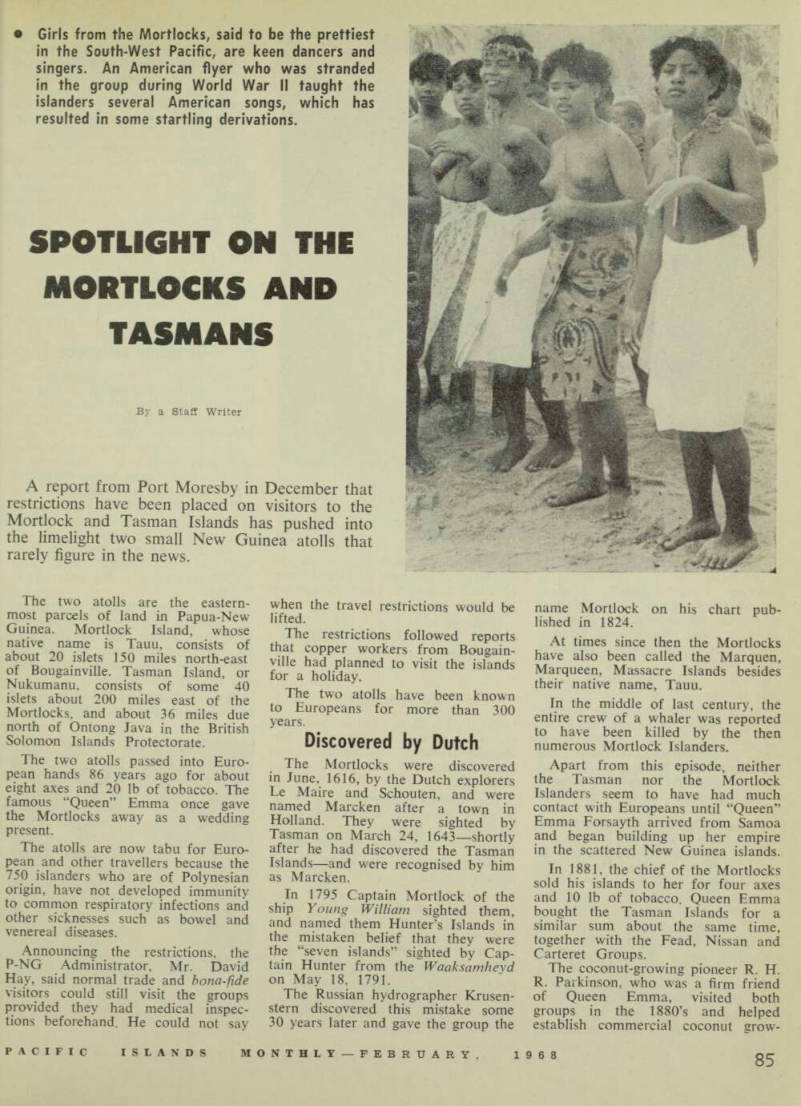
• Girls from the Mortlocks, said to be the prettiest in the South-West Pacific, are keen dancers and singers. An American flyer who was stranded in the group during World War II taught the islanders several American songs, which has resulted in some startling derivations.
ing. Coconuts were already growing at the time.
Willie Coe, Emma’s brother, arrived from Samoa in 1890. Sent to oversee his sister’s island planta tions, he, more than anyone, brought the Mortlock and Tasman Islanders under control.
Trochus and tortoiseshell were collected as well as copra.
Queen Emma sent a large number of New Irelanders to the Mortlocks to boost the falling population and work as labourers. Many of the newcomers took local girls for their mates. When the local males pro tested, Emma’s traders protected them.
About 1891, an Englishman, Joseph Highley, who was one of Queen Emma’s accountants, married one of Emma’s sisters, who had also arrived from Samoa.
Queen Emma gave the pair the Mortlocks as a wedding gift.
The newly-weds settled in the Mortlocks. But Highley, who was dependent on a regular supply of drugs for a serious ailment, died in 1894 when a prolonged interruption to shipping services from Kokopo prevented his drugs from arriving.
He is buried in the Mortlocks.
His tombstone reads. “Sacred to the memory of Joseph Highley, born Halifax, England. Died November 19, 1894, aged 48”.
Highley’s widow, who became Mrs.
Calder when she re-married, ap parently stayed on in the Mortlocks for the next 20 years.
Resentment
But little is known of the Mortlocks at that period, except that the islanders gained a reputation for aggressiveness and resentment against outsiders.
The New Irelanders were the cause of much ill-feeling; while there were complaints to the German centre at Kokopo in 1907 that the Mortlock Islanders refused to allow Euro peans to settle.
After World War I, both the Mortlocks and the Tasmans, being part of the former German territory of New Guinea, were taken over by the Australian Expropriation Board.
Both Highley’s widow. Mrs.
Calder, and Highley’s daughter, Frances (who had married a German medical officer, Dr. Bruno Kroening), claimed possession of the Mortlocks.
The board awarded half of the property to Mrs. Calder, who died in 1931 in the Mortlocks from injuries she received when dynamite she was handling for killing fish exploded. Mrs. Kroening, living at Kieta, Bougainville, then inherited Mrs. Calder’s Mortlock interests.
A former plantation inspector of the board, Mr. J. E. (Jock) Goodson, bought the other half of the property for £3,684 in 1927.
Goodson sells out
For the next 9 years. Mr. Goodson lived in the Mortlocks, sailing to Rabaul every few months in his at tractive ketch, Marqueen, to sell copra and buy supplies.
But low copra prices and other difficulties forced Mr. Goodson to sell out in 1936 to Burns Philp and Company Ltd., which ran the pro perty for the next 30 years.
Meanwhile, the Tasman Island plantation had been put up for sale by the Expropriation Board in 1927, and had been bought, with some 33,000 coconut trees, by a Mr. J. E.
Davies.
During World War 11, the Japan ese bombed the coconut groves on both the Tasmans and the Mortlocks on two occasions for no apparent reason. But little damage was done and no one was injured.
When Burns Philp relinquished its interest in the Mortlocks in 1966,
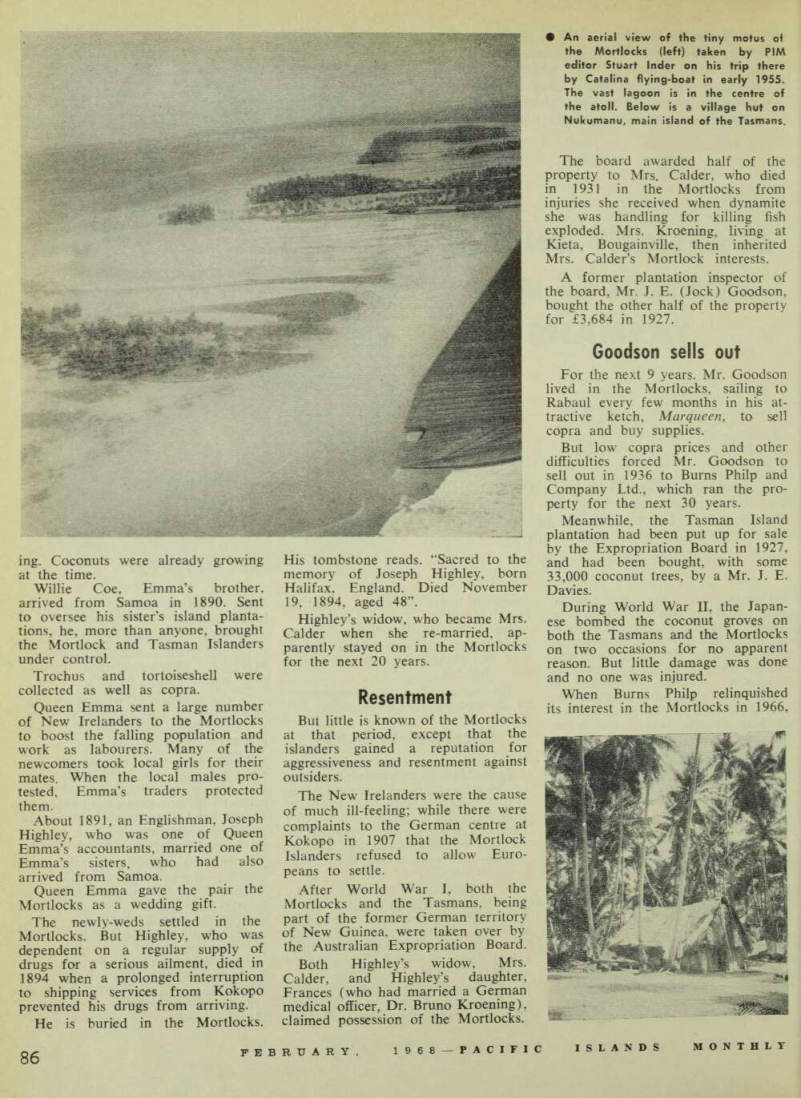
• An aerial view of the tiny motus of the Mortlocks (left) taken by PIM editor Stuart Inder on his trip there by Catalina flying-boat in early 1955.
The vast lagoon is in the centre of the atoll. Below is a village hut on Nukumanu, main island of the Tasmans.
Mrs. Kroening, who had lived on Bougainville since the early 1920’5, except for the war, still has her interest in the property which had once belonged to her father and mother. Mrs. Kroening, who is now in her 70’s, is working the plantation in association with the islanders.
Meanwhile, European interests in the Tasman Islands have lapsed, and the Tasman Islanders now handle their own copra and sell it to a Chinese trader from Buka Passage who maintains a well-stocked store in the Tasmans.
The Mortlock Islanders, who number about 450, were described by an official visitor a couple of years ago as industrious and skilled at carving and weaving.
They make model Polynesian-style canoes, wooden hooks for deep-sea fishing, ingenious shark lures, and looms for weaving cloth. These activities bring them in a substantial income.
Indolent
The Mortlock Islanders have close relations with the people of Nuguria about 200 miles to the north-west, and a number of marriages have taken place between the people of the two islands.
To make the large canoes they need for their ocean voyages, the Mortlock Islanders use logs which drift to their island from Bougain ville and other islands to the west.
Mortlock girls have been described as the prettiest in Melanesia. They have light-brown skins, not the black skins of the Solomon Islanders, and are very good dancers and singers.
An American flyer, stranded there in World War 11, taught them many American songs.
The Tasman Islanders, who total 200-odd, are said to be more indolent than the Mortlock Islanders and not such good craftsmen, although they are of the same racial type.
By inter-marriage over many generations, the Tasman Islanders have built up a close relationship with some families of Ontong Java, 36 miles away in the BSIP.
One of their main interests, apart from local affairs, is to exchange visits with the people of Ontong Java and trade with them.