Magazine Section
pp. 83-86 · Read in the full issue
Pacific Islands Monthly
When it comes to making string, the Nauruans are world champs.
• With her husband, who eventually became British Resident Commissioner in the Gilbert and Ellice Islands Colony, Mrs. Honor Maude, now of Canberra, lived in the GEIC for a total of 15 years between 1929 and 1948. While in that part of the Pacific, she took the opportunity of investigating the Nauruans' remark able skill in the making of string figures. A book by her on the subject is to be published soon by the South Australian Public Library Board.
By Honor Maude
It is a surprising fact, and one little known to Europeans, that the most widespread recrea tion in the world is not football or tennis, or any of the games played by us, but the making of string figures, commonly called cat’s cradles. In these, patterns are made on the hands with a closed loop of string.
Even among Europeans it was once a popular pastime, and indeed today most children can make a few simple patterns. But elsewhere its devotees are numbered in millions—men and women, young and old—in Asia, Africa, America, among the Eskimos, in Australia, New Zealand, and throughout the islands of the Pacific.
What is even more surprising, however, is to find that with all the competition from the major centres of population, the prize for being the most expert string figure makers in the world must be given to the never more than 2,000 people of the island of Nauru. It is rather as if Niue was to win the Davis Cup.
Yet the Nauruans, according to their own traditions, have been in venting and playing with string figures for only a hundred years, whereas in other communities the art is as old as their ancestral legends.
First figure
The originators of string figure making on Nauru were said to be Derangabua and Anako. (The great grandchildren of one of them were alive in 1937).
They both lived in the Buada dis trict, close to the inland lagoon, and Derangabua would show his patterns to anyone who was interested.
The first figure was a simple one, well-known in other parts of the Pacific, and was probably introduced to Nauru by Gilbertese drift voyagers.
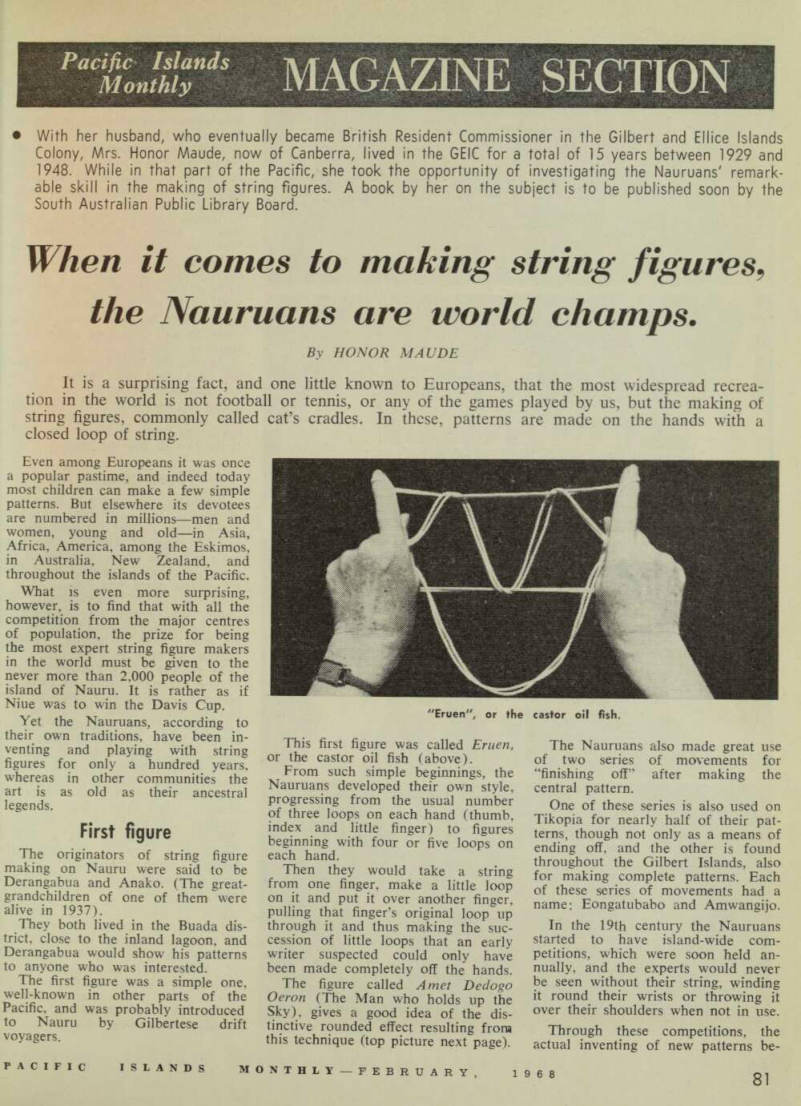
This first figure was called Eruen, or the castor oil fish (above).
From such simple beginnings, the Nauruans developed their own style, progressing from the usual number of three loops on each hand (thumb, index and little finger) to figures beginning with four or five loops on each hand.
Then they would take a string from one finger, make a little loop on it and put it over another finger, pulling that finger’s original loop up through it and thus making the suc cession of little loops that an early writer suspected could only have been made completely off the hands.
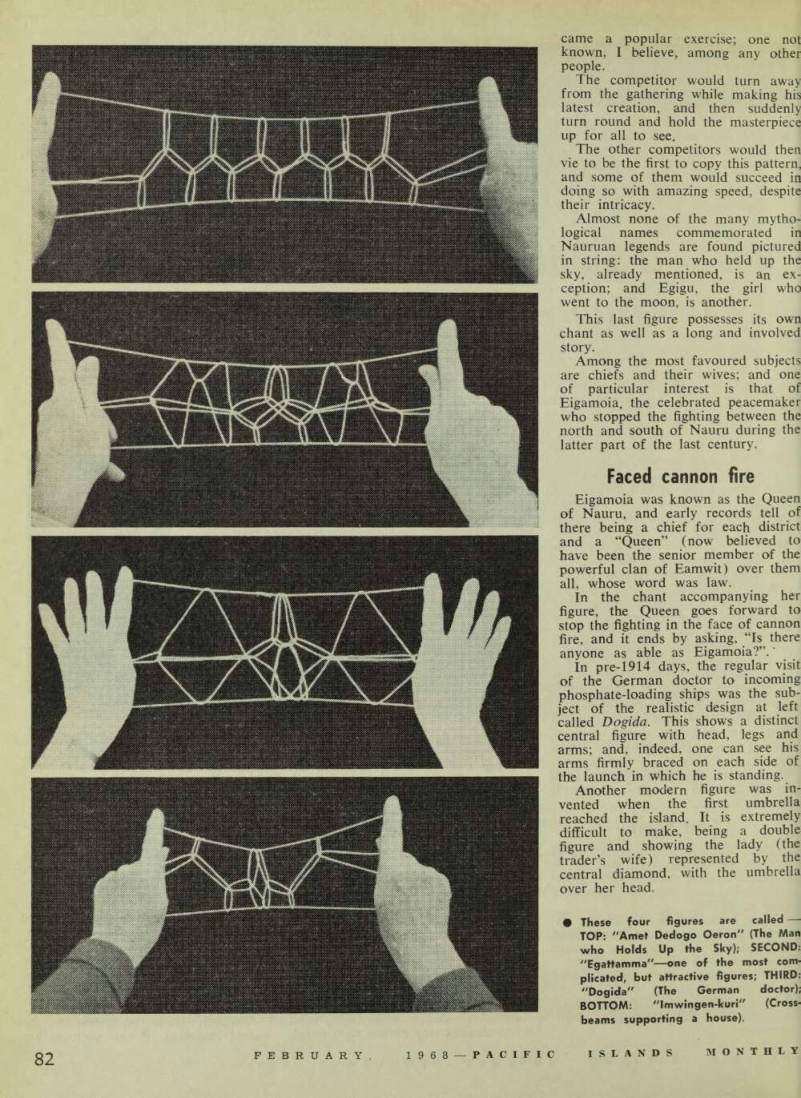
The figure called Amet Dedogo Oeron (The Man who holds up the Sky), gives a good idea of the dis tinctive rounded effect resulting from this technique (top picture next page).
The Nauruans also made great use of two series of movements for “finishing off” after making the central pattern.
One of these series is also used on Tikopia for nearly half of their pat terns, though not only as a means of ending off, and the other is found throughout the Gilbert Islands, also for making complete patterns. Each of these series of movements had a name: Eongatubabo and Amwangijo.
In the 19th century the Nauruans started to have island-wide com petitions, which were soon held an nually, and the experts would never be seen without their string, winding it round their wrists or throwing it over their shoulders when not in use.
Through these competitions, the actual inventing of new patterns be-
"Eruen", or the castor oil fish.
came a popular exercise; one not known, I believe, among any other people.
The competitor would turn away from the gathering while making his latest creation, and then suddenly turn round and hold the masterpiece up for all to see.
The other competitors would then vie to be the first to copy this pattern, and some of them would succeed in doing so with amazing speed, despite their intricacy.
Almost none of the many mytho logical names commemorated in Nauruan legends are found pictured in string: the man who held up the sky, already mentioned, is an ex ception; and Egigu, the girl who went to the moon, is another.
This last figure possesses its own chant as well as a long and involved story.
Among the most favoured subjects are chiefs and their wives; and one of particular interest is that of Eigamoia, the celebrated peacemaker who stopped the fighting between the north and south of Nauru during the latter part of the last century.
Faced cannon fire
Eigamoia was known as the Queen of Nauru, and early records tell of there being a chief for each district and a “Queen” (now believed to have been the senior member of the powerful clan of Eamwit) over them all, whose word was law.
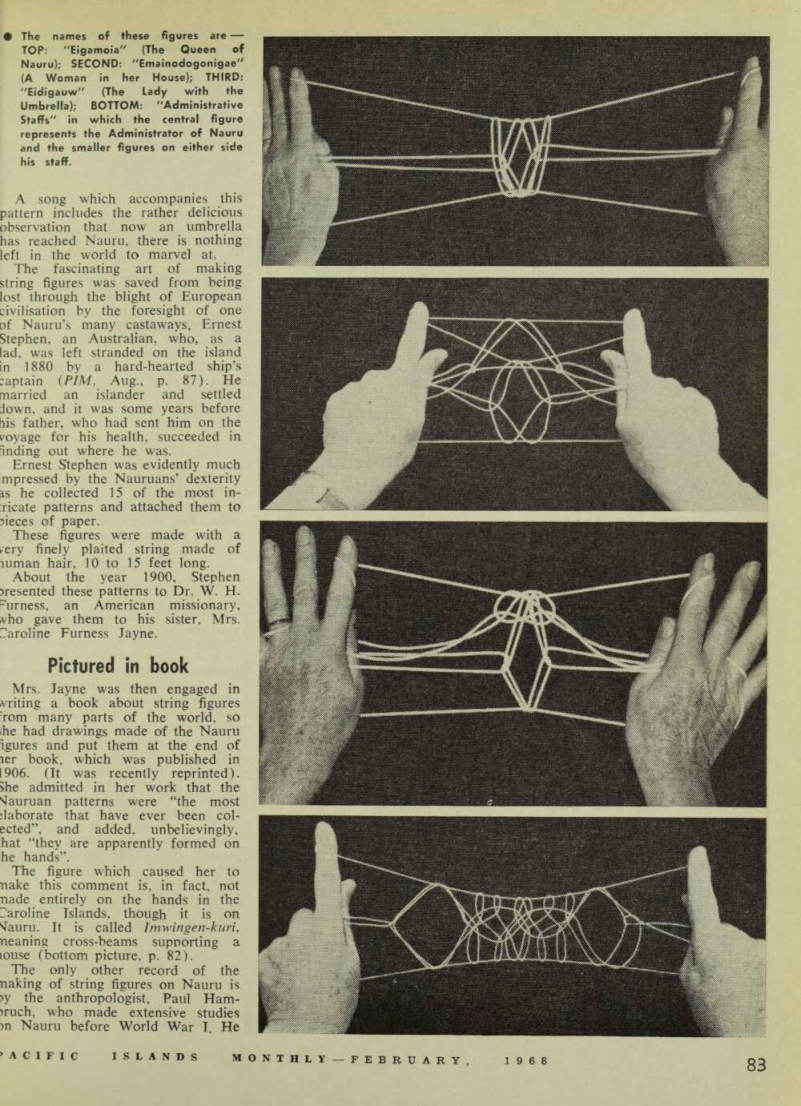
In the chant accompanying her figure, the Queen goes forward to stop the fighting in the face of cannon fire, and it ends by asking, “Is there anyone as able as Eigamoia?”. ‘ In pre-1914 days, the regular visit of the German doctor to incoming phosphate-loading ships was the sub ject of the realistic design at left called Dogida. This shows a distinct central figure with head, legs and arms; and, indeed, one can see his arms firmly braced on each side of the launch in which he is standing.
Another modern figure was in vented when the first umbrella reached the island. It is extremely difficult to make, being a double figure and showing the lady (the trader’s wife) represented by the central diamond, with the umbrella over her head.
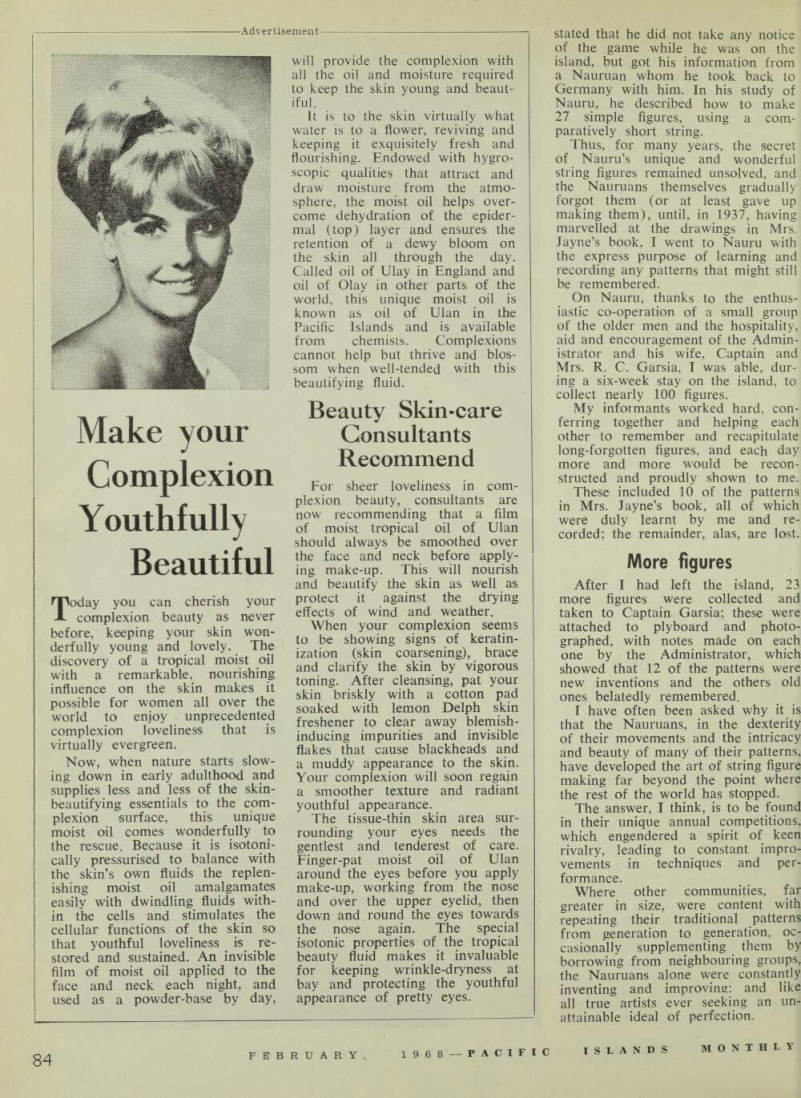
• These four figures are called TOP: "Amet Dedogo Oeron" (The Man who Holds Up the Sky); SECOND: "Egattamma"—one of the most com plicated, but attractive figures; THIRD: "Dogida" (The German doctor); BOTTOM: "Imwingen-kuri" (Cross beams supporting a house).
A song which accompanies this pattern includes the rather delicious observation that now an umbrella has reached Nauru, there is nothing left in the world to marvel at.
The fascinating art of making string figures was saved from being lost through the blight of European civilisation by the foresight of one of Nauru’s many castaways, Ernest Stephen, an Australian, who, as a lad, was left stranded on the island in 1880 by a hard-hearted ship’s captain ( PIM, Aug., p. 87). He married an islander and settled down, and it was some years before bis father, who had sent him on the voyage for his health, succeeded in finding out where he was.
Ernest Stephen was evidently much mpressed by the Nauruans’ dexterity as he collected 15 of the most in dicate patterns and attached them to pieces of paper.
These figures were made with a very finely plaited string made of luman hair, 10 to 15 feet long.
About the year 1900, Stephen these patterns to Dr. W. H. -urness, an American missionary, vho gave them to his sister, Mrs.
Caroline Furness Jayne.
Pictured in book
Mrs. Jayne was then engaged in vriting a book about string figures fom many parts of the world, so ;he had drawings made of the Nauru figures and put them at the end of ier book, which was published in 1906. (It was recently reprinted).
She admitted in her work that the Nauruan patterns were “the most daborate that have ever been col ected”, and added, unbelievingly, hat “they are apparently formed on he hands”.
The figure which caused her to nake this comment is, in fact, not nade entirely on the hands in the Caroline Islands, though it is on •'Jauru. It is called Imwingen-kuri, neaning cross-beams supporting a louse (bottom picture, p. 82).
The only other record of the naking of string figures on Nauru is >y the anthropologist, Paul Ham >ruch, who made extensive studies )n Nauru before World War I. He
• The names of these figures are TOP: "Eigamoia" (The Queen of Nauru); SECOND: "Emainodogonigae" (A Woman in her House); THIRD: "Eidigauw" (The Lady with the Umbrella); BOTTOM: "Administrative Staffs" in which the central figure represents the Administrator of Nauru and the smaller figures on either side his staff.
stated that he did not take any notice of the game while he was on the island, but got his information from a Nauruan whom he took back to Germany with him. In his study of Nauru, he described how to make 27 simple figures, using a com paratively short string.
Thus, for many years, the secret of Nauru’s unique and wonderful string figures remained unsolved, and the Nauruans themselves gradually forgot them (or at least gave up making them), until, in 1937, having marvelled at the drawings in Mrs.
Jayne’s book, I went to Nauru with the express purpose of learning and recording any patterns that might still be remembered.
On Nauru, thanks to the enthus iastic co-operation of a small group of the older men and the hospitality, aid and encouragement of the Admin istrator and his wife, Captain and Mrs. R. C. Garsia, I was able, dur ing a six-week stay on the island, to collect nearly 100 figures.
My informants worked hard, con ferring together and helping each other to remember and recapitulate long-forgotten figures, and each day more and more would be recon structed and proudly shown to me.
These included 10 of the patterns in Mrs. Jayne’s book, all of which were duly learnt by me and re corded; the remainder, alas, are lost.
More figures
After I had left the island, 23 more figures were collected and taken to Captain Garsia; these were attached to plyboard and photo graphed, with notes made on each one by the Administrator, which showed that 12 of the patterns were new inventions and the others old ones belatedly remembered.
I have often been asked why it is that the Nauruans, in the dexterity of their movements and the intricacy and beauty of many of their patterns, have developed the art of string figure making far beyond the point where the rest of the world has stopped.
The answer, I think, is to be found in their unique annual competitions, which engendered a spirit of keen rivalry, leading to constant impro vements in techniques and per formance.
Where other communities, far greater in size, were content with repeating their traditional patterns from generation to generation, oc casionally supplementing them by borrowing from neighbouring groups, the Nauruans alone were constantly inventing and improving: and like all true artists ever seeking an un attainable ideal of perfection.