Won't Reach
pp. 76-77 · Read in the full issue

Long Arm Of
Fiji Law
So Far Now
Employers in Fiji using Fijian
men between the age of 18 and 60 heaved a sigh of relief at the news that methods of extracting provincial taxes to finance the Fijian Administration are soon to be altered.
Defaulters are no longer to be treated as criminals and liable to be tossed in gaol if they cannot cough up the money when the long arm of the provincial constable grasps their shoulder. Future procedure is to be the same as the general Fiji law for the recovery of debts. The province to whom taxes are owed will have to sue the defaulter, and, if payment is not made, it will have power to seize his personal goods to realise money owing.
Provincial taxation is levied on Fijians over and above the normal basic tax and income tax levied by the central government. It is cal culated annually by each province to cover its budget, and used mainly for minor public works and admin istrative charges, including the Fijian judiciary (which, it has also been announced, will progressively disap pear from the Fiji scene in the next 12 months).
Hauled off in the night
Employers in Fiji are well aware of the inconveniences for everybody of the present method of provincial tax collection. Their early morning roll-calls often reveal absentees who have been hauled off in the night by the constable for not having paid a minor sum (rarely in any one year does the tax total more than £6 a head).
At other times the employer can see trouble coming in the shape of a provincial constable hovering in the background, waving a blue chit at some unfortunate employee who is hopping from one foot to another.
On such occasions it generally needs an advance of wages if the man is to be spared a week or so of prison diet.
The system of gaoling defaulters does not help the province either, for once a sentence is served the debt is wiped out.
There is also to be a different system of rating to realise revenue for provinces. It’s been recognised that the equal division of money to finance a provincial budget among all eligible males is unfair as the poor are asked to pay as much as the rich.
Liability is to be related to the ability to pay and also to the amount and quality of land which Fijians own in their respective provinces.
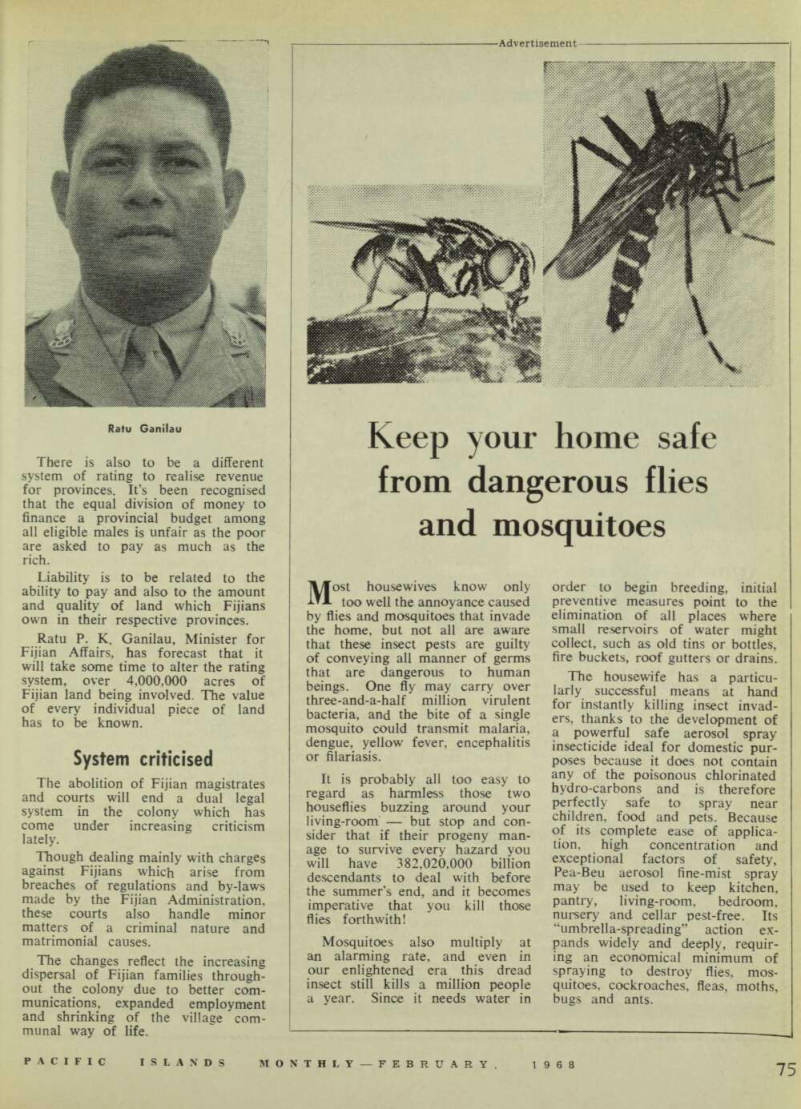
Ratu P. K. Ganilau, Minister for Fijian Affairs, has forecast that it will take some time to alter the rating system, over 4,000,000 acres of Fijian land being involved. The value of every individual piece of land has to be known.
System criticised
The abolition of Fijian magistrates and courts will end a dual legal system in the colony which has come under increasing criticism lately.
Though dealing mainly with charges against Fijians which arise from breaches of regulations and by-laws made by the Fijian Administration, these courts also handle minor matters of a criminal nature and matrimonial causes.
The changes reflect the increasing dispersal of Fijian families through out the colony due to better com munications, expanded employment and shrinking of the village com munal way of life.
Ratu Ganilau