Of Unculture
p. 75 · Read in the full issue
New Guinea: Land
From a Port Moresby correspondent Perhaps Oala Oala Rama is right. Australian expatriates in Papua-New Guinea ARE second class citizens. Should the whole lot of them depart for Australia tomorrow they will leave behind them not one example of what one might call Art with a capital letter.
New Guineans will be left with the impression that the world’s architecture consists of weatherboard, fibrous - cement and corrugated-iron box-like structures - They will know nothing of national theatre, of music, of pamtmg, other than the traces that somehow may survive from their own earlier cultural back- •„ • * „ •
rt^3io«r^nt nSI t>SHminjSJSSJn
development the Administration has neglected the cultural pursuits that are needed to make a community alive.
Except on the part of wellmeaning, but often unqualified individuals, there has been no concerted effort to encourage artistic enterprise.
There has been no attempt to teach theatre, let alone establish a national theatre, as has been done in other developing countries.
Some of the groups of the Northern District of Papua are adept at mime, but they have not had any encouragement to perfect or display this art.
The Sepik and Trobriand Island people are expert wood-carvers,
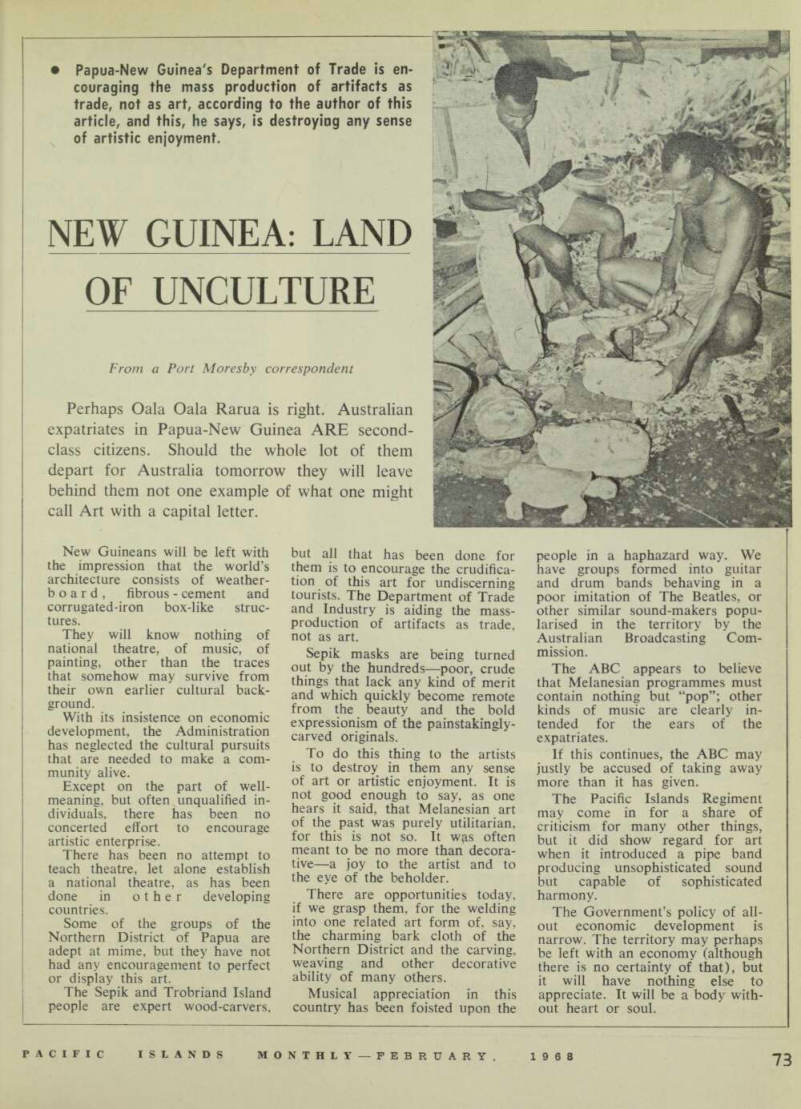
but all that has been done for them is to encourage the crudification of this art for undiscerning tourists. The Department of Trade and Industry is aiding the massproduction of artifacts as trade, not as art.
Sepik masks are being turned out by t he hundreds—poor, crude things that lack any kind of merit and which quickly become remote from the beauty and the bold expressionism of the painstakinglycarved originals< H , ° . ... . . do 1S fbmg to the artists 18 to destr oy m them any sense art or ar tistic enjoyment. It is £ ot 8 9° d ? ay ’ ? 8 one lt said ’ t “ at Melanesian art the past was purely utilitarian, f °r thls 18 not so - Jt , waB °f ten T 1631 to . be no more than decorat [ ve a Joy t° the artist and to tae eye °* t * ie beholder.
There are opportunities today, if we grasp them, for the welding i n t° one related art form of, say, the charming bark cloth of the Northern District and the carving, weaving and other decorative ability of many others.
Musical appreciation in this country has been foisted upon the
people in a haphazard way. We have groups formed into guitar and drum bands behaving in a poor imitation of The Beatles, or other similar sound-makers popu larised in the territory by the Australian Broadcasting Corn mission.
The ABC appears to believe that Melanesian programmes must contain nothing P but * “ pop ”; other kinds of music are clearly in tended for the ears of the expatriates, * . . . xl If this continues, the ABC may justly be accused of taking away more than it has given, The Pacific Islands Regiment may come in for a share of criticism for many other things, but it did show regard for art when it introduced a pipe band producing unsophisticated sound but capable of sophisticated harmony.
Tbe Government’s policy of all old economic development is narrow. The territory may perhaps be j e ft with an economy (although there is no certainty of that), but it will have nothing else to appreciate. It will be a body with out heart or soul.
• Papua-New Guinea's Department of Trade is en couraging the mass production of artifacts as trade, not as art, according to the author of this article, and this, he says, is destroying any sense of artistic enjoyment.