travel
pp. 47-52 · Read in the full issue

You, Too, Can Sail
The South Seas
By ANN GLENN, of the trimaran “ Rebel”
How does a girl from the desert of Texas wind up sailing across the Pacific in a trimaran? In my case, it was relatively simple. I married a fellow whose determined ambition is to sail around the world in his own sailboat.
Just where his ambition comes from is a little difficult to explain.
It seemed simple enough when he first told me the story. He was 11 years old, and it was a hard winter in Happy, Texas.
When the water pipes in the school froze, an unexpected holiday was declared, and the Glenns loaded the family into the car and drove 650 miles to Corpus Christi on the Gulf of Mexico.
During a harbour spin in a charter launch, Marvin saw a sun-tanned young man lolling in the cockpit of a small sailing dinghy, trailing his feet in the water. He took one look at this, remembered the zero degree
travel
S**? , b h aC , k in “W# and ?f p,ded * hat thls was the llfe for It was about five years later that he persuaded two of his younger brothers to go into partnership with b * m * n buying an d building a kit
boat ‘
At the end of a winter’s construe tion, the three boys were the proud owners of the only sailboat in Swisher County—an 8 ft pram.
By this time the family had moved from Happy to Tulia, and were con sequently 17 miles closer to the nearest navigable waters.
The boys carried their pram the remaining five miles to Tule Lake on top of the family car. From sheer necessity, they quickly became ex pert at manoeuvring in close quarters, because the lake was little more than 100 yards at its widest point, and a quarter of a mile long.
The boat provided as much pleasure as the Corpus Christi episode had promised, and the process of moving to bigger and better boats began.
By the time I came on to the scene, at Texas Tech. University, Marvin was sole owner of a 12 ft class boat, and years of reading boating magazines and sailing biographies had merely strengthened his ambition.
As our friendship deepened, my reading material was carefully monitored, and together, we read book after book on the adventure of sailing the South Seas.
By the time we married, two years later, it was decided. We would finish our last year of University, pull our mobile home to California, and look around for a place to build a boat.
We were in California a year
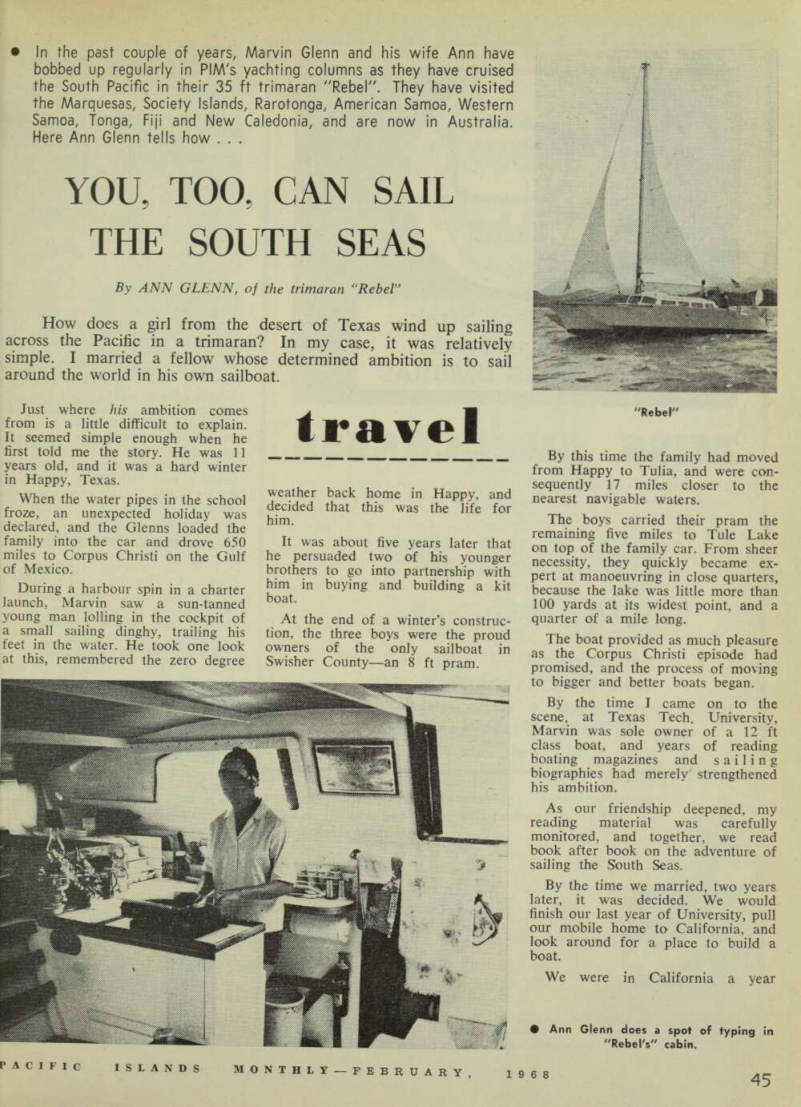
• In the past couple of years, Marvin Glenn and his wife Ann have bobbed up regularly in PIM's yachting columns as they have cruised the South Pacific in their 35 ft trimaran "Rebel". They have visited the Marquesas, Society Islands, Rarotonga, American Samoa, Western Samoa, Tonga, Fiji and New Caledonia, and are now in Australia.
Here Ann Glenn tells how . . .
"Rebel”
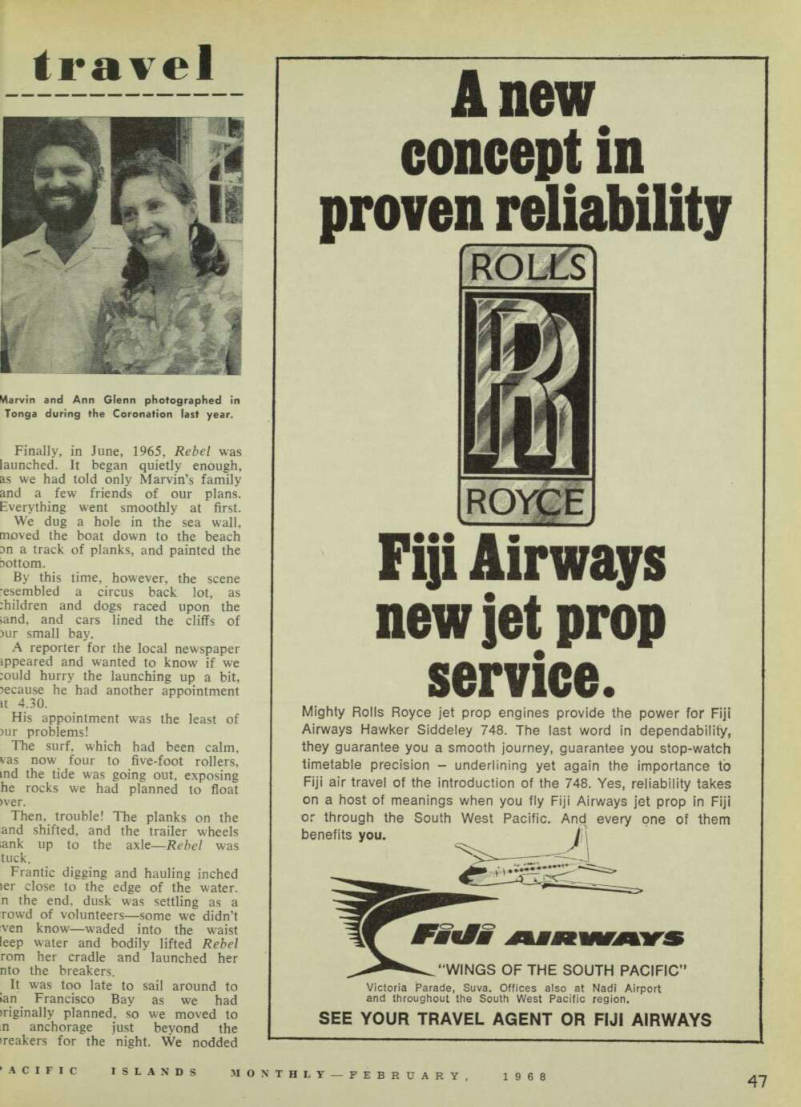
Ann Glenn does a spot of typing in "Rebel's" cabin.
before we found that place, but the time was well spent. We bought a set of plans for a 35 ft trimaran from Arthur Piver, and spent rainy week ends building a scale model and fine weekends visiting possible building sites in the area.
Then, in 1961, we stumbled on to the perfect situation—a large, rambl ing house set on pilings above a stretch of private beach, and, most important of all, beside the house was a vacant lot where we could begin our project.
What followed was nearly four years’ of construction. All that time Marvin continued to work as an industrial engineer and I continued to teach at a local high school.
Marvin’s salary was for living ex penses and for building the boat.
Mine was used to pay for the house.
When we were ready to sail, we decided we would sell the house and live on the monthly payments.
Money from selling the car, the furniture, and personal belongings would be added to the savings account to provide a lump sum in case of unexpected expenses.
But, four years is a long time, and keeping our enthusiasm was much harder than any economies we practised.
Neighbours watched
True to cartoon tradition, the frames for the boat were built ir the living room. After that, con Struction moved outdoors—to the great interest of the neighbours anc the Sunday beach strollers.
We smiled to ourselves as w« overheard their comments: “It’s toe narrow; it’ll turn over”. And, as we finished the main hull and startec the first float: “They’ve made i mistake; they’re starting again”.
Confusion and speculation in creased, for by the time we begai the third hull, a friend buildinj another trimaran had moved hi three hulls to the lot, and the plaa was locally known as Glenn Boa Works.
At the end of a year, we had com pleted the three hulls and connectinj crossarms. We were confident wi would be sailing very soon. Thi second year crawled by as we buil decks and cabin, cut hatches an< installed windows, and began th slow job of interior work.
The third year was even mon painful. We discovered that the cos of construction was fractional com pared with the cost of rigging, an< we spent a frustrating amount o time shopping for the best buy oi countless items of expensive gear.
Finally, in June, 1965, Rebel was launched. It began quietly enough, as we had told only Marvin’s family and a few friends of our plans.
Everything went smoothly at first.
We dug a hole in the sea wall, moved the boat down to the beach an a track of planks, and painted the bottom.
By this time, however, the scene ■esembled a circus back lot, as diildren and dogs raced upon the sand, and cars lined the cliffs of >ur small bay.
A reporter for the local newspaper ippeared and wanted to know if we :ould hurry the launching up a bit, )ecause he had another appointment it 4.30.
His appointment was the least of )ur problems!
The surf, which had been calm, vas now four to five-foot rollers, md the tide was going out, exposing he rocks we had planned to float >ver.
Then, trouble! The planks on the and shifted, and the trailer wheels ;ank up to the axle —Rebel was tuck.
Frantic digging and hauling inched ler close to the edge of the water, n the end, dusk was settling as a rowd of volunteers—some we didn’t ven know—waded into the waist leep water and bodily lifted Rebel rom her cradle and launched her nto the breakers.
It was too late to sail around to ►an Francisco Bay as we had >riginally planned, so we moved to n anchorage just beyond the •reakers for the night. We nodded
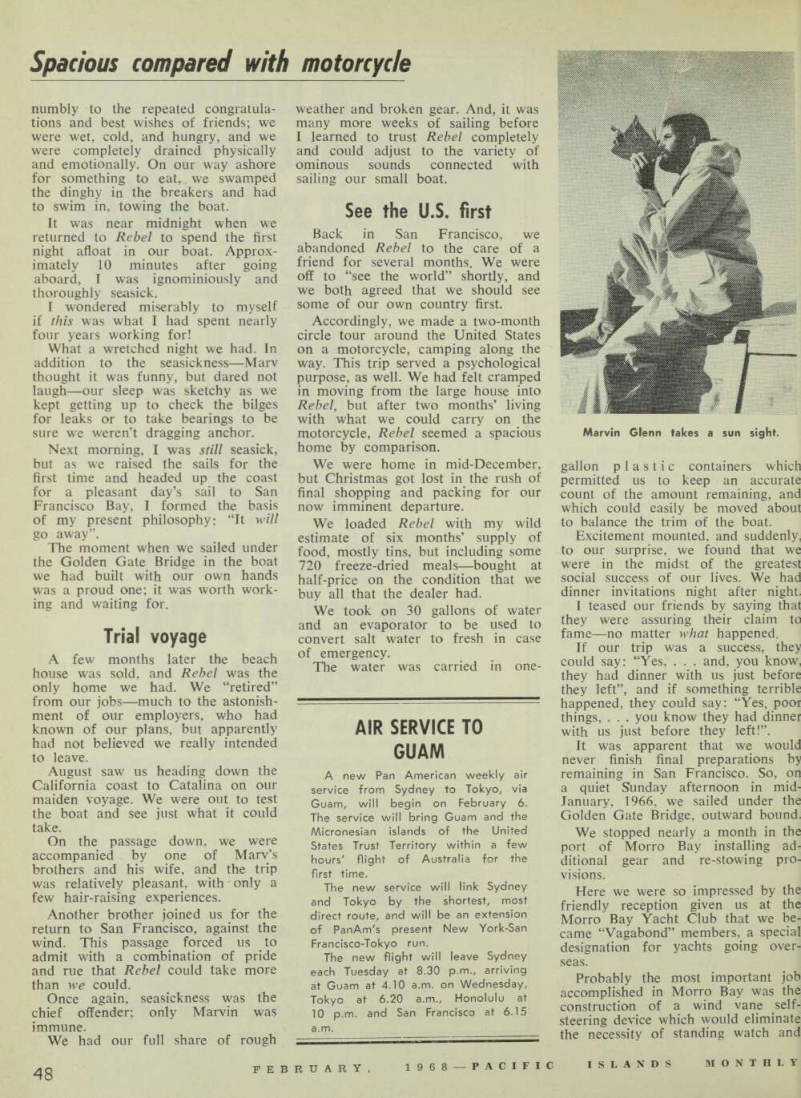
Marvin and Ann Glenn photographed in Tonga during the Coronation last year.
Spacious compared with motorcycle
numbly to the repeated congratula tions and best wishes of friends; we were wet, cold, and hungry, and we were completely drained physically and emotionally. On our way ashore for something to eat, we swamped the dinghy in the breakers and had to swim in, towing the boat.
It was near midnight when we returned to Rebel to spend the first night afloat in our boat. Approx imately 10 minutes after going aboard, I was ignominiously and thoroughly seasick.
I wondered miserably to myself if this was what I had spent nearly four years working for!
What a wretched night we had. In addition to the seasickness—Marv thought it was funny, but dared not laugh—our sleep was sketchy as we kept getting up to check the bilges for leaks or to take bearings to be sure we weren’t dragging anchor.
Next morning, I was still seasick, but as we raised the sails for the first time and headed up the coast for a pleasant day’s sail to San Francisco Bay, I formed the basis of my present philosophy: “It will go away”.
The moment when we sailed under the Golden Gate Bridge in the boat we had built with our own hands was a proud one; it was worth work ing and waiting for.
Trial voyage
A few months later the beach house was sold, and Rebel was the only home we had. We “retired” from our jobs—much to the astonish ment of our employers, who had known of our plans, but apparently had not believed we really intended to leave.
August saw us heading down the California coast to Catalina on our maiden voyage. We were out to test the boat and see just what it could take.
On the passage down, we were accompanied by one of Marv’s brothers and his wife, and the trip was relatively pleasant, with only a few hair-raising experiences.
Another brother joined us for the return to San Francisco, against the wind. This passage forced us to admit with a combination of pride and rue that Rebel could take more than we could.
Once again, seasickness was the chief offender; only Marvin was immune.
We had our full share of rough
weather and broken gear. And, it was many more weeks of sailing before I learned to trust Rebel completely and could adjust to the variety of ominous sounds connected with sailing our small boat.
See the U.S. first
Back in San Francisco, we abandoned Rebel to the care of a friend for several months. We were off to “see the world” shortly, and we both agreed that we should see some of our own country first.
Accordingly, we made a two-month circle tour around the United States on a motorcycle, camping along the way. This trip served a psychological purpose, as well. We had felt cramped in moving from the large house into Rebel, but after two months’ living with what we could carry on the motorcycle. Rebel seemed a spacious home by comparison.
We were home in mid-December, but Christmas got lost in the rush of final shopping and packing for our now imminent departure.
We loaded Rebel with my wild estimate of six months’ supply of food, mostly tins, but including some 720 freeze-dried meals—bought at half-price on the condition that we buy all that the dealer had.
We took on 30 gallons of water and an evaporator to be used to convert salt water to fresh in case of emergency.
The water was carried in one-
gallon plastic containers which permitted us to keep an accurate count of the amount remaining, and which could easily be moved about to balance the trim of the boat.
Excitement mounted, and suddenly, to our surprise, we found that we were in the midst of the greatest social success of our lives. We had dinner invitations night after night.
I teased our friends by saying that they were assuring their claim to fame—no matter what happened.
If our trip was a success, they could say: “Yes, . . . and, you know, they had dinner with us just before they left”, and if something terrible happened, they could say: “Yes, poor things, . . . you know they had dinner with us just before they left!”.
It was apparent that we would never finish final preparations by remaining in San Francisco. So, on a quiet Sunday afternoon in mid- January, 1966, we sailed under the Golden Gate Bridge, outward bound.
We stopped nearly a month in the port of Morro Bay installing ad ditional gear and re-stowing pro visions.
Here we were so impressed by the friendly reception given us at the Morro Bay Yacht Club that we be came “Vagabond” members, a special designation for yachts going over seas.
Probably the most important job accomplished in Morro Bay was the construction of a wind vane self steering device which would eliminate the necessity of standing watch and
Marvin Glenn takes a sun sight.
watch and would permit us to sleep at night.
On “sea trials” between Morro Bay and San Diego, the vane proved only partially effective, so our final job in San Diego was to re-design and re-build it.
Completed, tested, and approved, the vane was dubbed “Johnnie REB”, and became a permanent member of the crew. On the subsequent voyage, for about 85 per cent, of the time, we were able to “let Johnnie do it”.
First step, 3,200 miles
Finally we reached the point where nothing remained but to raise the sails, cast off the dock lines, and wave goodbye.
On March 9, we slipped through a light early morning fog and headed south and west toward the Marquesas Islands, 3,200 miles away.
The four years required to build Rebel had provided plenty of time for studying related subjects, includ ing navigation.
This was our only vague un certainty as we faced the vast stretch of water between us and our first landfall. But Guadalupe Island, ap proximately 200 miles along our course, provided a final checkpoint, and, on the second day, when Marvin’s noon sun sight placed us within a few miles of our known aosition, we sailed on, reassured.
Fhe dream had become reality.
In the two years’ cruising that has brought us to Australia, if the pas sages between islands have sometimes 3een terrifying, sometimes boring— lie independence of travelling in our )wn boat has more than com aensated.
We have been able to travel where ve wanted to, when we wanted; the mly timetable we keep is dictated ?y the seasons. And we have been ible to afford prolonged visits )ecause we have come equipped with Dur own food and lodging.
Cruising from island to island is i far cry from teaching in a Texas schoolroom, but it is a way of life hat I have adopted with great satis :action.
Rebel and her crew will continue o sail for as long as it is financially r easible. Then, chances are 10 to )ne, that we will go back to the >eginning and start working step by tep toward another boat and another :ruise!
• Sydney-based James Anderson, a young American photo-journalist whose work has been appearing widely lately in national and international magazines, including “Life”, wrote the following caustic commentary after a visit to Papua-New Guinea. PIM pub lishes it without comment, and invites replies.