Off the beaten track,
pp. 43-46 · Read in the full issue
down Malaita way
By staff writer KEN McGREGOR
Don’t miss a trip to Malaita when you visit the British Solomon Islands Protectorate.
The BSIP’s most populous island is only a 30-minute plane ride from Henderson Airfield, 10 miles out of the Solomons capital, Honiara, on Guadalcanal.
Recently I paid my $17.40 for a eturn day trip from Honiara to see tie big island, centre of blackbirding divides late last century. (Because f its large population, Malaita was n ideal spot for recruiters from the Queensland and Fiji sugar planta ins).
A small light plane from Megapode drways, the New Guinea-owned 'SIP internal airline, left Henderson t 8 a.m. and returned about 5 p.m.
Up front with the pilot, Harold [all, I was rewarded with wide iews of Honiara and eastern Guadal anal before we moved into a set Durse north-east towards Malaita, cross the blue Pacific.
We flew very low and picked out small craft and outriggers without any trouble. After 10 minutes we reached the Florida Group of islands, with tiny islets and motus surrounded by brilliant green reefs and sandy beaches. From the air there were few signs of European life—only tiny thatched villages popping into view along the coastline or in little clearings inland.
Pleasant drives
We flew on over Big and Small Gela Islands and over the ocean for another 10 minutes before the great navy-blue shape of Malaita appeared out of the sea.
Malaita’s airstrip is on the island’s north-west coast, about six miles from the main town, Auki. It is built on the water’s edge.
We landed smoothly, and jumped out to be welcomed by a handful of Europeans, Chinese and dozens of laughing ‘picaninnis’ (Malaita youngsters). I boarded a sturdy Jeep to take me to Auki.
It was a pleasant 20-minute drive, along a mostly dirt road, winding among dense trees covered with vines of every colour of green, and shaded coconut groves with smaller cocoa trees nestling under the palms.
Auki is one of those beautiful South Seas towns with an ideal har bour, several native villages with huts on stilts by the water’s edge and the inevitable Chinese trade stores dominating the main street.
They play marbles
At the end of the street, is the small overworked little wharf where island traders of all descriptions tie up.
In the concreted village market place, which opened on Wednesdays and Fridays (unfortunately I picked a Tuesday), about two dozen
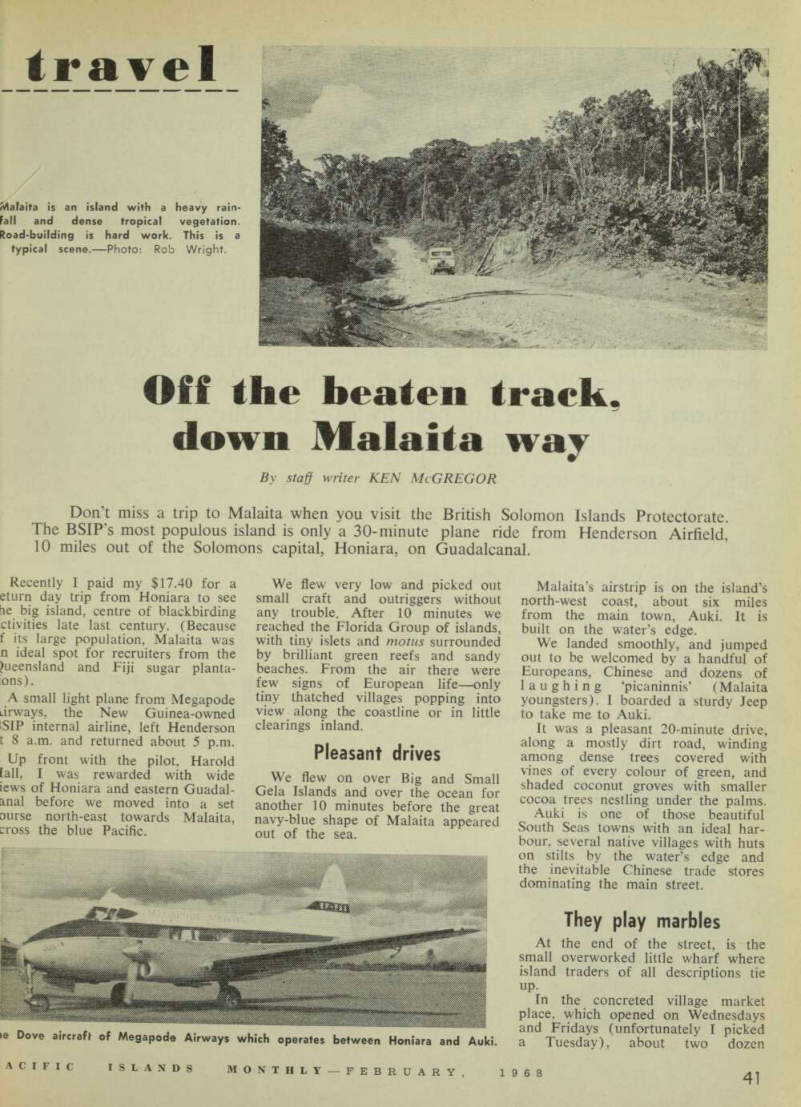
Malaita is an island with a heavy rain- Fali and dense tropical vegetation.
Road-building is hard work. This is a typical scene. Photo: Rob Wright.
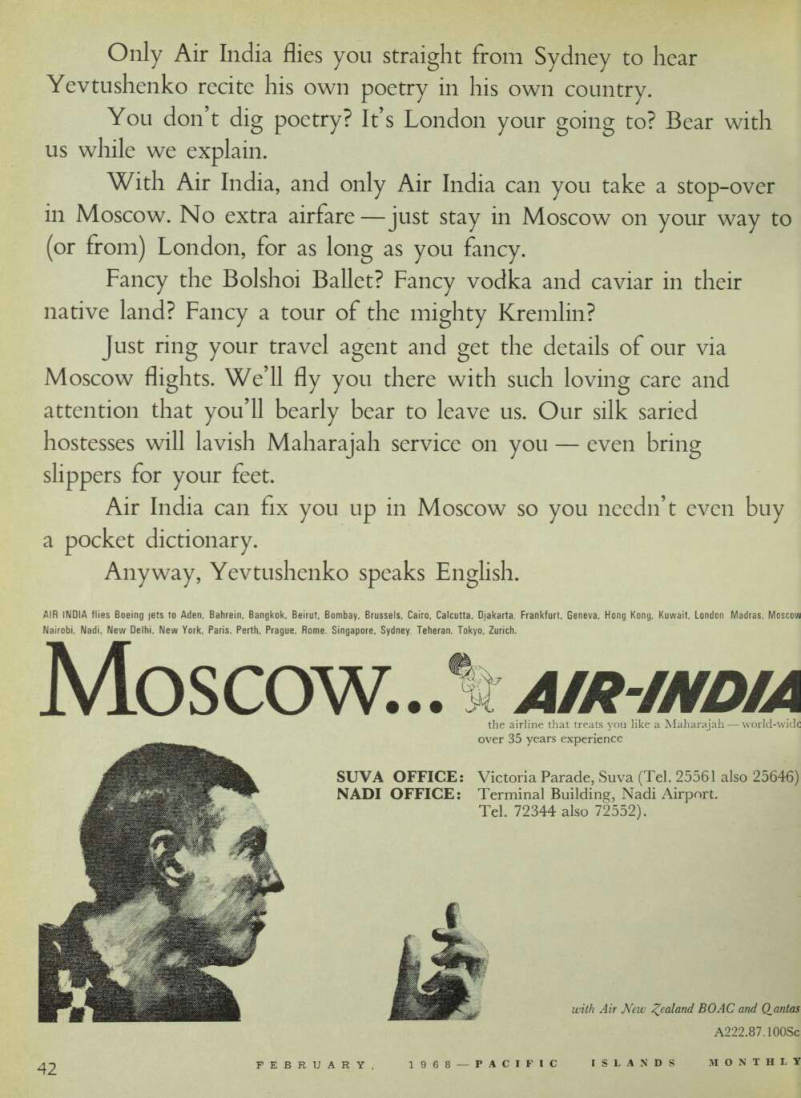
[?]e Dove aircraft of Megapode Airways which operates between Honiara and Auki.
islanders watched while three boys played marbles.
All the Chinese stores, and there are six in Auki, had abundant sup plies of marbles on display and together with umbrellas, they are big sellers. The umbrellas combat the sun rather than the rain, especially for women with babies. But a lot of the menfolk are partial to them too.
Most men wear a pair of shorts, maybe a singlet, and thongs or sandals. Sunglasses are popular.
Women are quite content with a laplap around their waists—nothing else is required. Malaita, while only a few miles north of Guadalcanal, is noticeably hotter and the humidity is also higher.
Auki Island village, set on a little island about half a mile off Auki wharf, is very pretty with about 20 stilted huts around the foreshore with coconuts in their backyards.
A trip to the village is worthwhile in one of the many outrigger canoes beached near the wharf.
Langa Tanga Lagoon, south of
Auki, stretches for five miles, and contains many beautfiul little islands dotted with coconut palms, hibiscus and other tropical foliage.
You can walk about two miles south of Auki over a narrow bridge and through a village as primitive as you are likely to find anywhere.
Huts are built off the ground and families eat around small earthern fireplaces underneath.
Club life
Eyes peeped out of the huts at me and cries of “Good Morning” came from all quarters.
Just behind the village is a pri mitive pig pen where half a dozen pigs wandered about cheerfully.
Someone had stuck a picture of the Queen on one hut and a neigh bour had countered with an equally old picture of Prince Philip. They believe in the monarchy at Auki!
Aukl’s new nine-hole golf course had just been completed and locals claimed that golfers who played Honiara’s bigger course just couldn’t handle the Auki one.
“Auki’s course is deceptive,” I was told. “Looks a lot shorter than it really is, and there are a lot of traps,”
The Malika , a 40 ft motor vessel which carries passengers from Malaita on a regular run to the “big smoke” of Honiara, pushed off on its nine and a half hour trip about 11 a.m. chockablock with passengers.
Chinese businessmen
For a little town, Auki has its share of clubs. There are the Auki Club, with about 60 members; the Auki Golf Club—26 members; and the Auki Tennis Club with an asphalt and cement court. Rarusa Club, a smaller version of Honiara’s successful Honiara Club, has a big following of Solomon Islanders, and there is the South Sea Community Club, which includes five Fijian families, recruited by the BSIP Public Works Department.
The Chinese traders include Kwang Chong and Company, Sze Tu Kut, Quan Kew, Quan Yin, Quan Hong and Company (a branch of the Honiara company of the same name) Chow Lai (store and bakery) and Leong Yee (bakery only).
As in most Pacific Islands, the Chinese are respected as both good
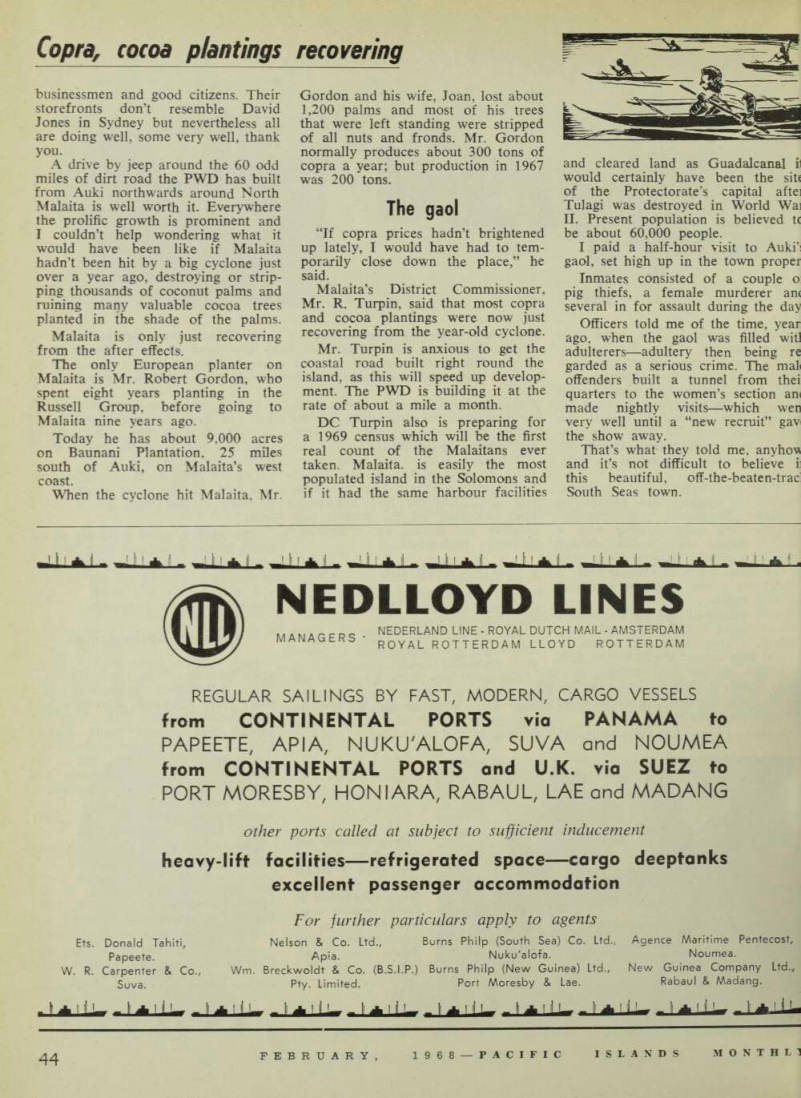
This is Malaita's old hospital at Auki. It has been closed down as such, but is being refurbished to handle malaria cases and for use as an administrative centre.
Photo: Rob Wright.
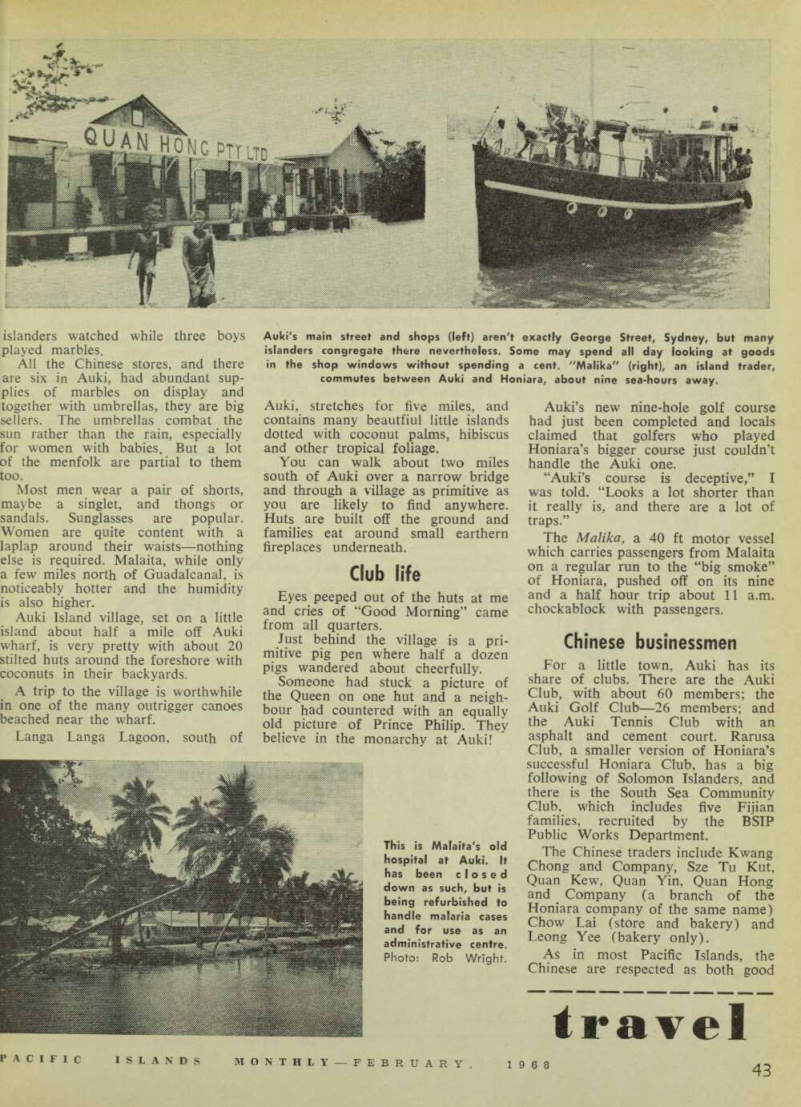
Auki's main street and shops (left) aren't exactly George Street, Sydney, but many islanders congregate there nevertheless. Some may spend all day looking at goods in the shop windows without spending a cent. "Malika" (right), an island trader, commutes between Auki and Honiara, about nine sea-hours away.
Copra, cocoa plantings recovering
businessmen and good citizens. Their storefronts don’t resemble David Jones in Sydney but nevertheless all are doing well, some very well, thank you.
A drive by jeep around the 60 odd miles of dirt road the PWD has built from Auki northwards around North Malaita is well worth it. Everywhere the prolific growth is prominent and I couldn’t help wondering what it would have been like if Malaita hadn’t been hit by a big cyclone just over a year ago, destroying or strip ping thousands of coconut palms and ruining many valuable cocoa trees planted in the shade of the palms.
Malaita is only just recovering from the after effects.
The only European planter on Malaita is Mr. Robert Gordon, who spent eight years planting in the Russell Group, before going to Malaita nine years ago.
Today he has about 9,000 acres on Baunani Plantation, 25 miles south of Auki, on Malaita’s west coast.
When the cyclone hit Malaita, Mr.
Gordon and his wife, Joan, lost about 1,200 palms and most of his trees that were left standing were stripped of all nuts and fronds. Mr. Gordon normally produces about 300 tons of copra a year; but production in 1967 was 200 tons.
The gaol
“If copra prices hadn’t brightened up lately, I would have had to tem porarily close down the place,” he said.
Malaita’s District Commissioner, Mr. R. Turpin, said that most copra and cocoa plantings were now just recovering from the year-old cyclone.
Mr. Turpin is anxious to get the coastal road built right round the island, as this will speed up develop ment. The PWD is building it at the rate of about a mile a month.
DC Turpin also is preparing for a 1969 census which will be the first real count of the Malaitans ever taken. Malaita. is easily the most populated island in the Solomons and if it had the same harbour facilities
and cleared land as Guadalcanal il would certainly have been the site of the Protectorate’s capital aftei Tulagi was destroyed in World Wai 11. Present population is believed tc be about 60,000 people.
I paid a half-hour visit to Auki’; gaol, set high up in the town proper Inmates consisted of a couple o: pig thiefs, a female murderer anc several in for assault during the day Officers told me of the time, year ago. when the gaol was filled will adulterers—adultery then being re garded as a serious crime. The mal( offenders built a tunnel from thei quarters to the women’s section an< made nightly visits—which wen very well until a “new recruit” gavi the show away.
That’s what they told me, anyhow and it’s not difficult to believe ii this beautiful, off-the-beaten-trad South Seas town.