Are New Guineans drinking
pp. 34-36 · Read in the full issue
more and enjoying it less?
I sometimes think that the first 40 years of this century were in some respects a golden age for those Papuans who had come into contact with Christianity and the Pax Britannica during the last quarter of the previous one. This may be just senile nostalgia for “the good old days”.
But I don’t think that it is.
IT is true that during those years paternalism and racial discrimi nation were rampant. It is true that health, education and social welfare services were rudimentary and economic development minimal.
But it is also true that this period was one in which Papuans who had come under government and mission influence had abandoned the worst of their own vices and had not yet adopted the worst of ours.
In a world in which Noah’s epoch making discovery of how to get drunk had spread far and wide, primitive Papua was almost unique in being practically free from intoxi cating beverages. In the western district of Papua, the Kiwai made a drink locally known as gamada, which appears to have closely re sembled, if it was not identical with, the Polynesian kava; and, like the latter, it was used mainly for cere monial purposes.
The much more potent “coconut toddy” appears to have been a later introduction from either Indonesia or the Torres Straits islands, and not to have been indigenous.
They didn't drink
I have been told that a kava- type beverage was made and drunk in some parts of New Guinea too. But by and large, it is true to say that prior to contact with Europeans, the vast majority of Papuans and New Guineans had no means of get ting drunk.
In pre-war Papua (as distinct, per haps, from New Guinea with its German background) there was very little drinking by indigenes. The law forbade it, and few Papuans broke or even resented the law. There was a certain amount of pilfering of beer and spirits, and there were a few metho addicts. But it wasn’t really a problem, except perhaps in the Daru area where contact with Thurs day Island had been considerable.
Then came the Pacific war, and with it Australian and American troops—and their beer. In sharing the latter with the friendly and help-
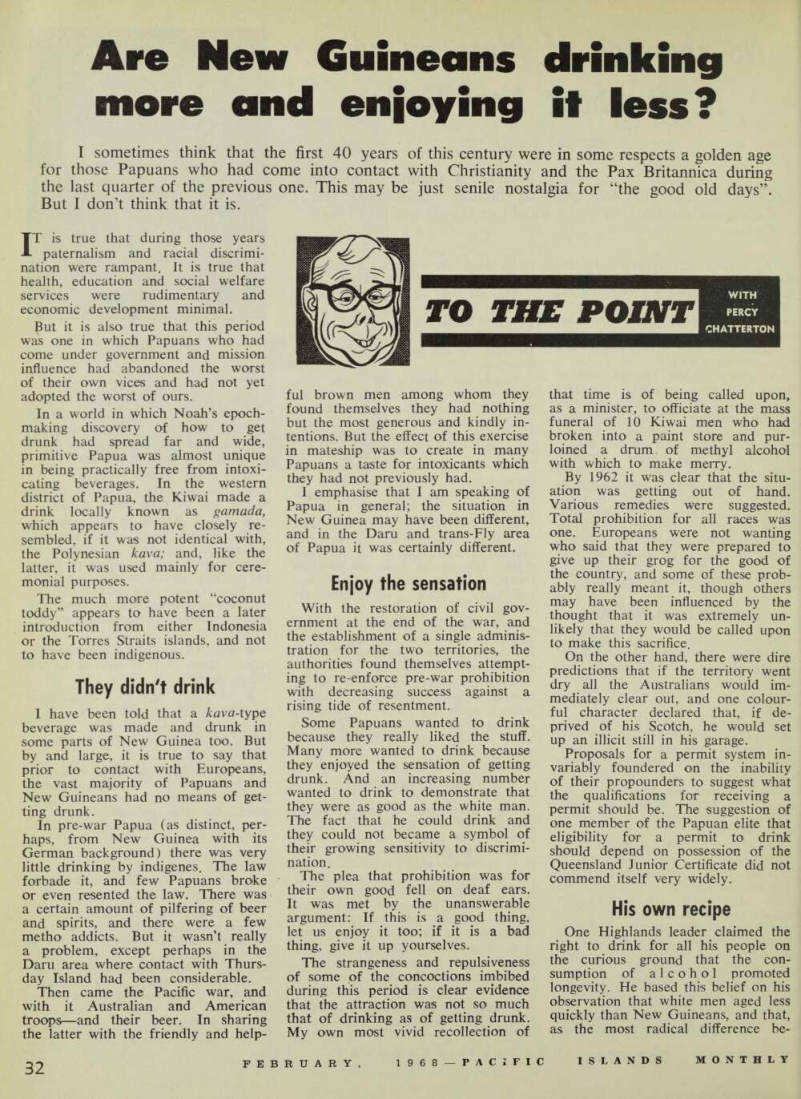
wd fit J I / f i ' jd J percy chatterton
ful brown men among whom they found themselves they had nothing but the most generous and kindly in tentions. But the effect of this exercise in mateship was to create in many Papuans a taste for intoxicants which they had not previously had. 1 emphasise that I am speaking of Papua in general; the situation in New Guinea may have been different, and in the Daru and trans-Fly area of Papua it was certainly different.
Enjoy the sensation
With the restoration of civil gov ernment at the end of the war, and the establishment of a single adminis tration for the two territories, the authorities found themselves attempt ing to re-enforce pre-war prohibition with decreasing success against a rising tide of resentment.
Some Papuans wanted to drink because they really liked the stuff.
Many more wanted to drink because they enjoyed the sensation of getting drunk. And an increasing number wanted to drink to demonstrate that they were as good as the white man.
The fact that he could drink and they could not became a symbol of their growing sensitivity to discrimi nation.
The plea that prohibition was for their own good fell on deaf ears.
It was met by the unanswerable argument: If this is a good thing, let us enjoy it too; if it is a bad thing, give it up yourselves.
The strangeness and repulsiveness of some of the concoctions imbibed during this period is clear evidence that the attraction was not so much that of drinking as of getting drunk.
My own most vivid recollection of
that time is of being called upon, as a minister, to officiate at the mass funeral of 10 Kiwai men who had broken into a paint store and pur loined a drum of methyl alcohol with which to make merry.
By 1962 it was clear that the situ ation was getting out of hand.
Various remedies were suggested.
Total prohibition for all races was one. Europeans were not wanting who said that they were prepared to give up their grog for the good of the country, and some of these prob ably really meant it, though others may have been influenced by the thought that it was extremely un likely that they would be called upon to make this sacrifice.
On the other hand, there were dire predictions that if the territory went dry all the Australians would im mediately clear out, and one colour ful character declared that, if de prived of his Scotch, he would set up an illicit still in his garage.
Proposals for a permit system in variably foundered on the inability of their propounders to suggest what the qualifications for receiving a permit should be. The suggestion of one member of the Papuan elite that eligibility for a permit to drink should depend on possession of the Queensland Junior Certificate did not commend itself very widely.
His own recipe
One Highlands leader claimed the right to drink for all his people on the curious ground that the con sumption of alcohol promoted longevity. He based this belief on his observation that white men aged less quickly than New Guineans, and that, as the most radical difference be
tween their respective ways of life was that white men were free to get drunk while New Guineans were not, it was obvious that the secret of longevity lay in the use of alcohol, a secret which the white men were selfishly withholding from his people.
The final decision to remove all restrictions on drinking based on race, and to try to curb over ndulgence by tightening up the pro visions of the Liquor Licensing CLdinance, was probably the only >ne which could have been made.
A permit system would merely aave shifted the frontier of resent nent from one boundary line to mother; it would not have removed t. And it is difficult to see how otal prohibition could have been nade to work—for two reasons.
In the first place, the long, un guarded and sparsely inhabited coast ine of New Guinea would have made imuggling an extremely profitable md comparatively risk-free pro fession.
In the second place, by this time nost Papuans and New Guineans lad found that the preparation of )Otent home-brews from readily ivailable fruits such as papaws was luite easy, and that even the home iistillation of spirits from such naterials, while a little more diffi cult, was not beyond the ability of a esourceful villager.
So, on September 26, 1963, the loors of P-NG’s pubs were thrown ipen to all races.
They can put it away!
It had been predicted that this vould be the signal for an orgy of Irinking by Papuans and New juineans, followed by a tailing off >nce the novelty had subsided.
The reverse proved to be the case.
Papuans, at any rate, approached the exercise of their new freedom cautiously, and from small begin lings the volume of drinking built ip gradually. It has continued to mild up since, and from my own vantage point in a predominantly ndigenous suburb I would hazard he opinion that both the volume of irinking and the volume of excessive irinking are still building up.
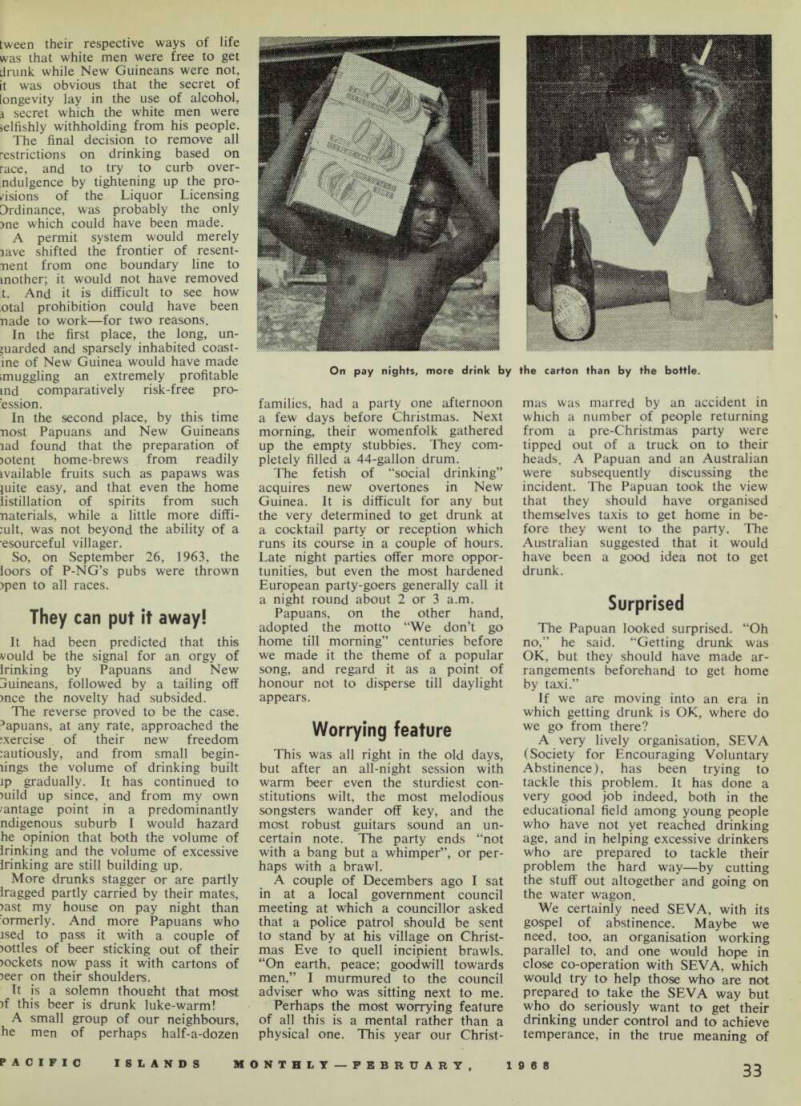
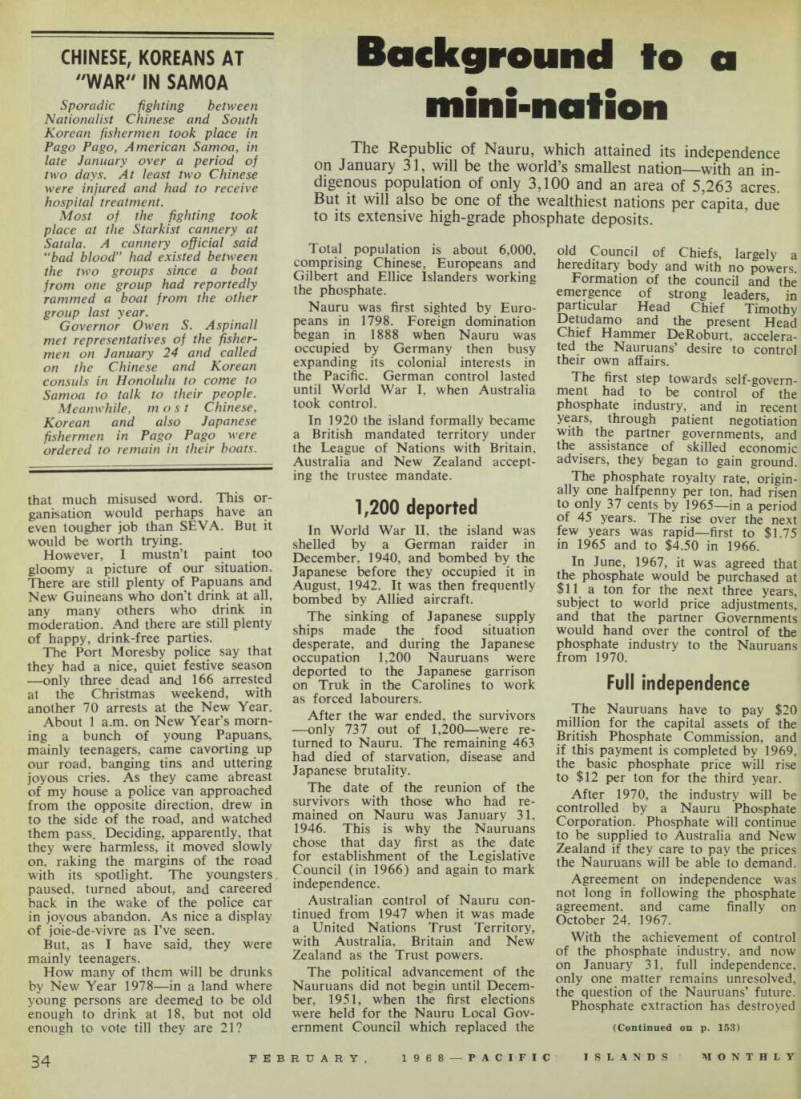
More drunks stagger or are partly Lagged partly carried by their mates, last my house on pay night than hrmerly. And more Papuans who ised to pass it with a couple of lottles of beer sticking out of their lockets now pass it with cartons of leer on their shoulders.
It is a solemn thought that most if this beer is drunk luke-warm!
A small group of our neighbours, he men of perhaps half-a-dozen
families, had a party one afternoon a few days before Christmas. Next morning, their womenfolk gathered up the empty stubbies. They com pletely filled a 44-gallon drum.
The fetish of “social drinking” acquires new overtones in New Guinea. It is difficult for any but the very determined to get drunk at a cocktail party or reception which runs its course in a couple of hours.
Late night parties offer more oppor tunities, but even the most hardened European party-goers generally call it a night round about 2 or 3 a.m.
Papuans, on the other hand, adopted the motto “We don’t go home till morning” centuries before we made it the theme of a popular song, and regard it as a point of honour not to disperse till daylight appears.
Worrying feature
This was all right in the old days, but after an all-night session with warm beer even the sturdiest con stitutions wilt, the most melodious songsters wander off key, and the most robust guitars sound an un certain note. Hie party ends “not with a bang but a whimper”, or per haps with a brawl.
A couple of Decembers ago I sat in at a local government council meeting at which a councillor asked that a police patrol should be sent to stand by at his village on Christ mas Eve to quell incipient brawls.
“On earth, peace; goodwill towards men,” I murmured to the council adviser who was sitting next to me.
Perhaps the most worrying feature of all this is a mental rather than a physical one. This year our Christ
mas was marred by an accident in which a number of people returning from a pre-Christmas party were tipped out of a truck on to their heads. A Papuan and an Australian were subsequently discussing the incident. The Papuan took the view that they should have organised themselves taxis to get home in be fore they went to the party. The Australian suggested that it would have been a good idea not to get drunk.
Surprised
The Papuan looked surprised. “Oh no,” he said. “Getting drunk was OK, but they should have made ar rangements beforehand to get home by taxi.”
If we are moving into an era in which getting drunk is OK, where do we go from there?
A very lively organisation, SEVA (Society for Encouraging Voluntary Abstinence), has been trying to tackle this problem. It has done a very good job indeed, both in the educational field among young people who have not yet reached drinking age, and in helping excessive drinkers who are prepared to tackle their problem the hard way—by cutting the stuff out altogether and going on the water wagon.
We certainly need SEVA, with its gospel of abstinence. Maybe we need, too, an organisation working parallel to, and one would hope in close co-operation with SEVA, which would try to help those who are not prepared to take the SEVA way but who do seriously want to get their drinking under control and to achieve temperance, in the true meaning of
On pay nights, more drink by the carton than by the bottle.
that much misused word. This or ganisation would perhaps have an even tougher job than SEVA. But it would be worth trying.
However, I mustn’t paint too gloomy a picture of our situation.
There are still plenty of Papuans and New Guineans who don’t drink at all, any many others who drink in moderation. And there are still plenty of happy, drink-free parties.
The Port Moresby police say that they had a nice, quiet festive season —only three dead and 166 arrested at the Christmas weekend, with another 70 arrests at the New Year.
About 1 a.m. on New Year’s morn ing a bunch of young Papuans, mainly teenagers, came cavorting up our road, banging tins and uttering joyous cries. As they came abreast of my house a police van approached from the opposite direction, drew in to the side of the road, and watched them pass. Deciding, apparently, that they were harmless, it moved slowly on, raking the margins of the road with its spotlight. The youngsters paused, turned about, and careered back in the wake of the police car in joyous abandon. As nice a display of joie-de-vivre as I’ve seen.
But, as I have said, they were mainly teenagers.
How many of them will be drunks by New Year 1978—in a land where young persons are deemed to be old enough to drink at 18, but not old enough to vote till they are 21?