No shortage of ideas on what
p. 33 · Read in the full issue
to do about New Guinea
By Robert Langdon
A thousand or so people attended a summer school in Canberra over the Australia Day holiday weekend to hear discussions on what Australia should or should not do in New Guinea.
The school was arranged by the Australian Institute of Political Science. Several dozen Europeans and about a dozen New Guineans ad dressed the school. There was no shortage of ideas, including a good proportion of the ivory tower and extra woolly variety.
A common view on the part of many European speakers was that Australia’s paternal and colonialist attitude towards the territory must end; and that independence for the territory should be its stated policy.
Most of the New Guinean speakers, on the other hand, never mentioned the word independence, or if they did, they seemed to think it was a long way off. But they made it clear that they would like to see a continuance of Australian aid, and plenty of it. (This raised an un answered question: Is it possible to give aid without being paternal?)
Presure from without
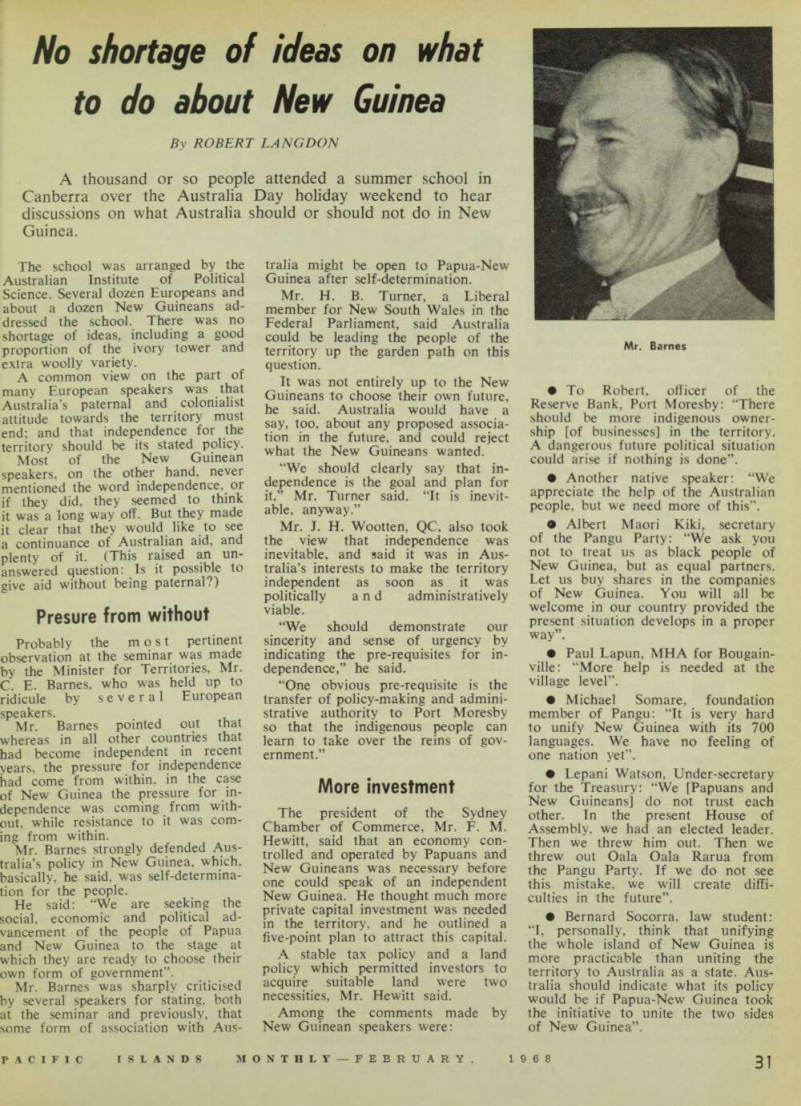
Probably the most pertinent observation at the seminar was made by the Minister for Territories, Mr.
C. E. Barnes, who was held up to ridicule by several European speakers.
Mr. Barnes pointed out that whereas in all other countries that had become independent in recent years, the pressure for independence had come from within, in the case of New Guinea the pressure for in dependence was coming from with out, while resistance to it was com ing from within.
Mr. Barnes strongly defended Aus tralia’s policy in New Guinea, which, basically, he said, was self-determina tion for the people.
He said; “We are seeking the social, economic and political ad vancement of the people of Papua and New Guinea to the stage at which they are ready to choose their own form of government”.
Mr. Barnes was sharply criticised by several speakers for stating, both at the seminar and previously, that some form of association with Aus
tralia might be open to Papua-New Guinea after self-determination.
Mr. H. B. Turner, a Liberal member for New South Wales in the Federal Parliament, said Australia could be leading the people of the territory up the garden path on this question.
It was not entirely up to the New Guineans to choose their own future, he said. Australia would have a say, too, about any proposed associa tion in the future, and could reject what the New Guineans wanted.
“We should clearly say that in dependence is the goal and plan for it,” Mr. Turner said. “It is inevit able, anyway.”
Mr. J. H. Wootten, QC, also took the view that independence was inevitable, and said it was in Aus tralia’s interests to make the territory independent as soon as it was politically and administratively viable.
“We should demonstrate our sincerity and sense of urgency by indicating the pre-requisites for in dependence,” he said.
“One obvious pre-requisite is the transfer of policy-making and admini strative authority to Port Moresby so that the indigenous people can learn to take over the reins of gov ernment.”
AAore investment
The president of the Sydney Chamber of Commerce, Mr. F. M.
Hewitt, said that an economy con trolled and operated by Papuans and New Guineans was necessary before one could speak of an independent New Guinea. He thought much more private capital investment was needed in the territory, and he outlined a five-point plan to attract this capital.
A stable tax policy and a land policy which permitted investors to acquire suitable land were two necessities, Mr. Hewitt said.
Among the comments made by New Guinean speakers were;
• To Robert, officer of the Reserve Bank, Port Moresby; “There should be more indigenous owner ship [of businesses] in the territory.
A dangerous future political situation could arise if nothing is done”. • Another native speaker; “We appreciate the help of the Australian people, but we need more of this”. • Albert Maori Kiki, secretary of the Pangu Party; “We ask you not to treat us as black people of New Guinea, but as equal partners.
Let us buy shares in the companies of New Guinea. You will all be welcome in our country provided the present situation develops in a proper way”. • Paul Lapun, MHA for Bougain ville: “More help is needed at the village level”. • Michael Somare, foundation member of Pangu: “It is very hard to unify New Guinea with its 700 languages. We have no feeling of one nation yet”. • Lepani Watson, Under-secretary for the Treasury; “We [Papuans and New Guineans] do not trust each other. In the present House of Assembly, we had an elected leader.
Then we threw him out. Then we threw out Gala Gala Rarua from the Pangu Party. If we do not see this mistake, we will create diffi culties in the future”. • Bernard Socorra, law student; “I, personally, think that unifying the whole island of New Guinea is more practicable than uniting the territory to Australia as a state. Aus tralia should indicate what its policy would be if Papua-New Guinea took the initiative to unite the two sides of New Guinea”.
Mr. Barnes