E. Highlands Candidate
pp. 27-28 · Read in the full issue
Is No Ordinary Young
Business Tycoon
From a correspondent in Goroka, NG Wherever you go in the Eastern Highlands of New Guinea these days—Kainantu, Obura, Wonenara, Okapa, Lufa, Wata bung, the Bena and, of course, Goroka itself —you are likely to run into a medium-sized fresh-faced, tow-headed talkative young man sponsoring his own candidature for the Eastern Highlands regional seat in P-NG’s new House of Assembly.
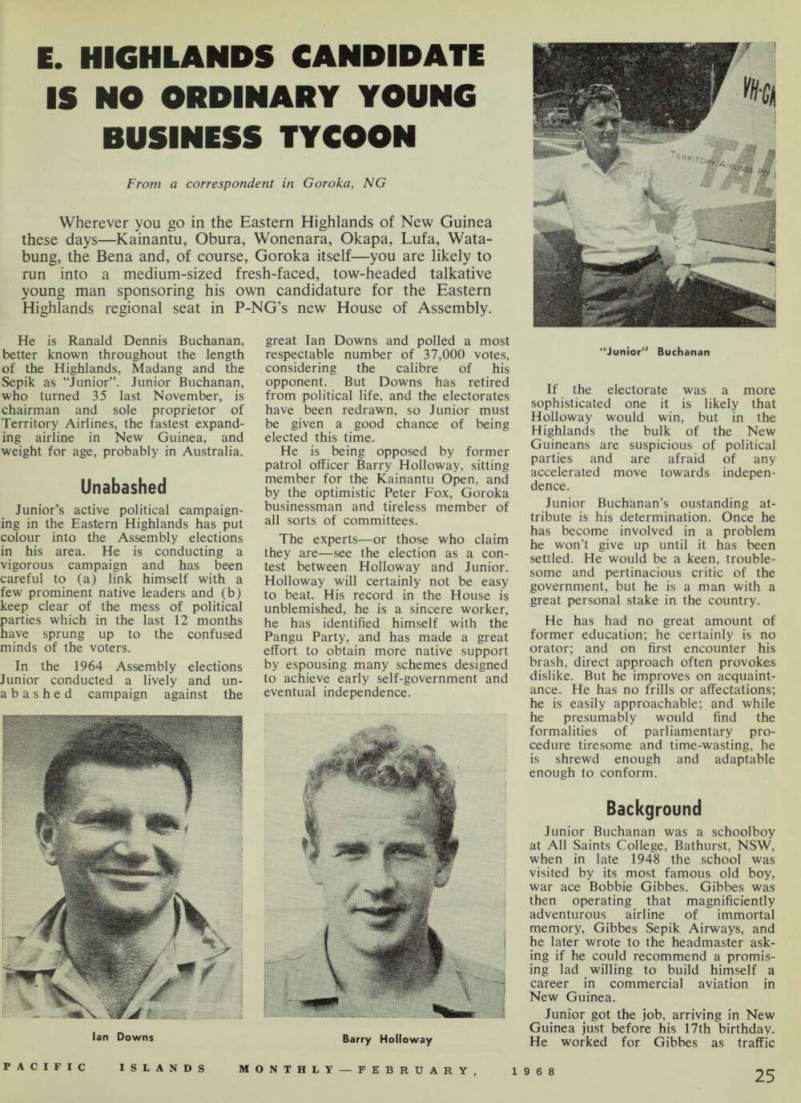
He is Ranald Dennis Buchanan, better known throughout the length of the Highlands, Madang and the Sepik as “Junior”, Junior Buchanan, who turned 35 last November, is chairman and sole proprietor of Territory Airlines, the fastest expand ing airline in New Guinea, and weight for age, probably in Australia.
Unabashed
Junior’s active political campaign ing in the Eastern Highlands has put colour into the Assembly elections in his area. He is conducting a vigorous campaign and has been careful to (a) link himself with a few prominent native leaders and (b) keep clear of the mess of political parties which in the last 12 months have sprung up to the confused minds of the voters.
In the 1964 Assembly elections Junior conducted a lively and un abashed campaign against the
great lan Downs and polled a most respectable number of 37,000 votes, considering the calibre of his opponent. But Downs has retired from political life, and the electorates have been redrawn, so Junior must be given a good chance of being elected this time.
He is being opposed by former patrol officer Barry Holloway, sitting member for the Kainantu Open, and by the optimistic Peter Fox, Goroka businessman and tireless member of all sorts of committees.
The experts—or those who claim they are—see the election as a con test between Holloway and Junior.
Holloway will certainly not be easy to beat. His record in the House is unblemished, he is a sincere worker, he has identified himself with the Pangu Party, and has made a great effort to obtain more native support by espousing many schemes designed to achieve early self-government and eventual independence.
If the electorate was a more sophisticated one it is likely that Holloway would win, but in the Highlands the bulk of the New Guineans are suspicious of political parties and are afraid of any accelerated move towards indepen dence.
Junior Buchanan’s oustanding at tribute is his determination. Once he has become involved in a problem he won’t give up until it has been settled. He would be a keen, trouble some and pertinacious critic of the government, but he is a man with a great personal stake in the country.
He has had no great amount of former education; he certainly is no orator; and on first encounter his brash, direct approach often provokes dislike. But he improves on acquaint ance. He has no frills or affectations; he is easily approachable; and while he presumably would find the formalities of parliamentary pro cedure tiresome and time-wasting, he is shrewd enough and adaptable enough to conform.
Background
Junior Buchanan was a schoolboy at All Saints College, Bathurst, NSW, when in late 1948 the school was visited by its most famous old boy, war ace Bobbie Gibbes. Gibbes was then operating that magnificiently adventurous airline of immortal memory, Gibbes Sepik Airways, and he later wrote to the headmaster ask ing if he could recommend a promis ing lad willing to build himself a career in commercial aviation in New Guinea.
Junior got the job, arriving in New Guinea just before his 17th birthday.
He worked for Gibbes as traffic
lan Downs
Barry Holloway
"Junior" Buchanan
officer and general clerk in various territory centres, ending in Goroka in 1955.
It was there, in 1958, that he got his big opportunity by raising sufficient capital to buy Territory Airlines. The company had been put up for sale following the crash of a Tiger Moth in 1957, in which the company’s managing director and chief engineer. Jack Gray, and one of the principal shareholders, Jim Smith, were killed.
Opposition
The airline at that time consisted of one DH 84 and a Cessna 170.
Junior decided to concentrate on Cessna operations. The staff then con sisted of himself, a pilot/engineer and an office girl.
He disposed of the DH 84 and got another Cessna, a 180, in March, 1959, and within a couple of years he had four Cessnas operating in the Highlands and occasionally in the Madang district.
He found himself up against strong opposition almost from the start.
MAL, the W. R. Carpenter sub sidiary, had previously bought out Gibbes Sepik Airways and MAL had in turn been bought out by Ansett- ANA. Then in 1961, following the withdrawal of Qantas operations in New Guinea, TAA had acquired Qantas’ four single-engined Otters, which were available for charter
operations. Junior, then only 28, found himself in a struggle for survival against the two giants of Australian commercial aviation.
He didn’t sit down and wait to be wiped out. He kept his aircraft flying by adopting very competitive charter rates and he won the sympathy of a rapidly growing number of settlers. Assisted by the invaluable advice of his first sponsor, the redoubtable negotiator Bobbie Gibbes, Junior kept niggling at the Administrator of the day, Sir Donald Cleland, and the Department of Territories in Canberra. Sir Donald and the then Minister for Territories, Mr. Hasluck, and the secretary of his department, “Eskie” Lambert, were impressed by Junior’s courage and drive, and it was through their good offices that Junior eventually got an interview with the then Minister for Civil Aviation, the late Senator Sir Shane Paltridge. On this man Junior’s future depended.
Junior told Sir Shane that Ansett was his main threat because that company had been granted exclusive rights to service the five major freight ports from Mt. Hagen, which was the centre of the rapidly expanding Highlands district.
Sir Shane advised Junior, “Go and have a talk with Reg Ansett”. Junior, the extrovert who would not be deterred from attempting to interview the Pope or President Johnson if it suited him, approached the powerful Ansett boss. Said Reg, in effect; “For God’s sake, keep out of my hair and you’ll get by!”
Junior got by. In February last year Ansett announced he was dis posing of all his light aircraft in New Guinea, except for four Piaggios w u hich would no longer engage in charter work, Rrmlit future DnyriT Turure Today Territory Airlines operates unrestricted charter services in the four Highlands districts and Madang, and its fleet consists of three Cessna 185’s, six Cessna 206’s, three Cessna 336’5, one Cessna 402 (pressurised nine seater) with another on order, and two Beechcraft Barons. There were three Barons, but one crashed in November.
To fly these aircraft the company employs 23 pilots, headed by the operations manager Wes Guy, DFC, one of the territory’s most ex perienced pilots, and 28 other Euro peans and more than 50 New Guineans. In Goroka, Junior has a new . two-storey office building and terminal, modern workshops for all 1 118 , se rvlcin S and numerous houses and “ ats to “ ouse h lB s t a *t- One would think that the develop ment of this considerable enterprise would be more than suffeient to occupy the attention of a man of 35 with a wife and five children, But Junior Buchanan is no ordinary young business tycoon. He is a member of the District Advisory Council, and is vice-president of the Goroka Council. His latest bid to become a politician is being watched with great interest locally.