Plenty of variety in P-NG's
pp. 26-155 · Read in the full issue
second genera! election
From a Port Moresby correspondent Nominations for Papua-New Guinea’s second House of Assembly closed on February 5 with 484 candidates to contest the 84 seats in the elections to be held from February 17 to March 16. This compares with 299 candidates for 54 elec torates in the first general election in March, 1964.
In this year’s election, there are 15 regional and 69 open electorates.
The regional electorates can only be contested by candidates with certain minimum educational qualifications— the P-NG Intermediate Certificate or its equivalent.
The list of 50-odd candidates for the regional electorates, includes nearly two dozen Papuans and New Guineans with the necessary educa tional qualifications.
This should convince even Mr.
Nathaniel Eastman, of Liberia, that the change from “special” to “regional” electorates was not just a piece of humbug.
Political parties
Even in the Western Highlands, the list of eight candidates includes three New Guineans.
In the open electorates, too, there appears to be quite a sprinkling of young, well-educated men, and it will be interesting to see how many of them can defeat their more mature, but less educated opponents.
Six political parties—all unthought of at the last election have
sponsored candidates. These parties are the United Democratic Party, Pangu, All Peoples’ Party, New Guinea Agriculture Reform Party, the Territory Country Party and the National Progress Party (NAPRO).
The youngest candidate is a 21year-old New Guinean, Herman Kabai, a school teacher, who is con testing the East Sepik regional elec torate.
The oldest is Mr. Percy Chatter ton, a 69-year-old retired English missionary, who has lived in Papua since 1924. Mr. Chatterton, who represented Central Special in the last House, is seeking re-election in the Moresby Open Electorate, which comprises the urban area of Port Moresby. He is opposed by the recently-retired and much-respected Director of District Administration, Mr. Keith McCarthy, who is probably better known on the New Guinea side of the border than in Papua.
There are nearly 50 Europeans contesting the elections in either the regional or open electorates. Only one has been returned unopposed— Mr. Ron Neville, representative for West Papua Special in the last House, who will occupy the Southern High lands regional seat.
Straight fight
Other candidates, all New Guineans, to be returned unopposed are Joe Paul Langro (West Sepik Regional), Wesani Iwoksim (Upper Sepik) and Tei Abal (Wabag). Tei Abal, a self-educated man of 37, was one of the most impressive speakers in the last Assembly.
Speaker Horrie Niall, who was unopposed in 1964, is now opposed in the Morobe Regional Electorate by Tony Voutas, the young university graduate who, following the death of Bill Bloomfield, won the Kaindi by-election by a very comfortable majority.
This contest, between a member of the “old guard” and one of the
foundation members of Pangu, will be watched with great interest.
Another straight fight between Europeans which will be full of interest is that between Don Barrett and Roy Ashton, both members of the last House, for the New Britain Regional Electorate.
At the other end of the scale, one of the Chimbu electorates, Sinasina is to be contested by no fewer than 16 candidates.
There will be a specially interest ing line-up in Central Regional, with two European and three Papuan candidates. Of the latter, one repre sents Pangu, a second the newly formed NAPRO party, while the third, Oala Oala Rama, is standing
(Continued on. p. 153)
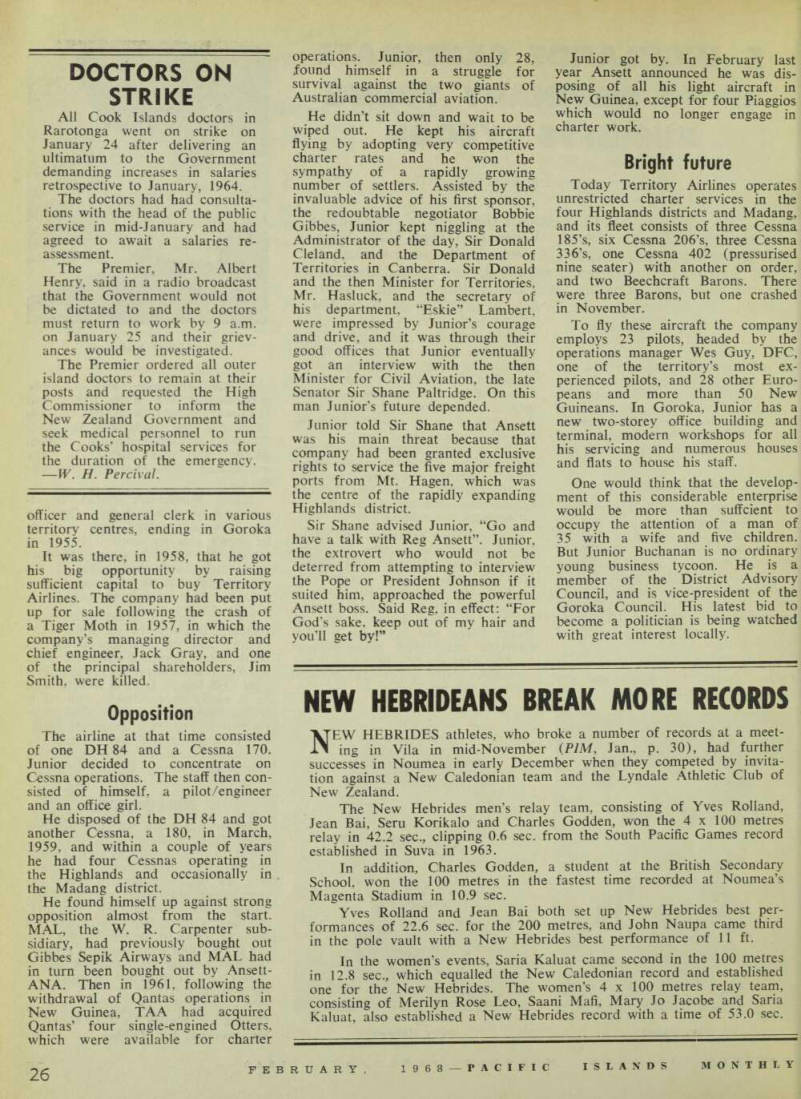
Among the long list of native candidates at the election is the famous cult leader Yali, who failed to gain a seat in the last Assembly.
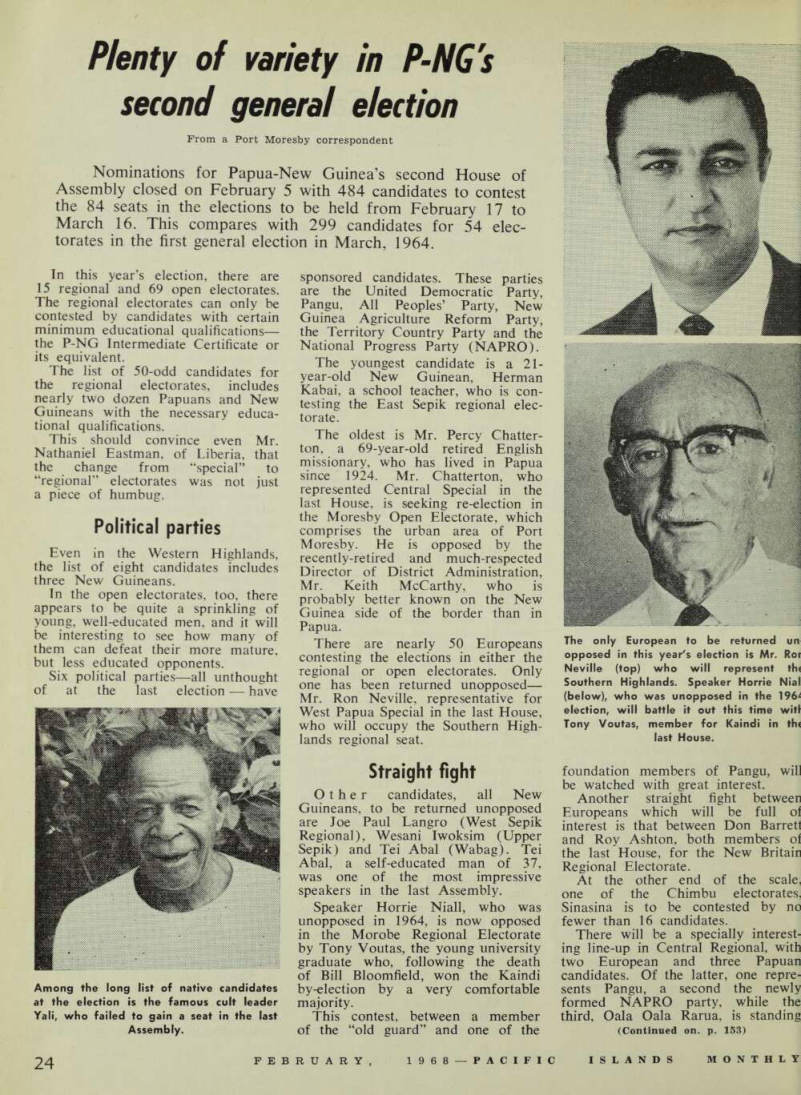
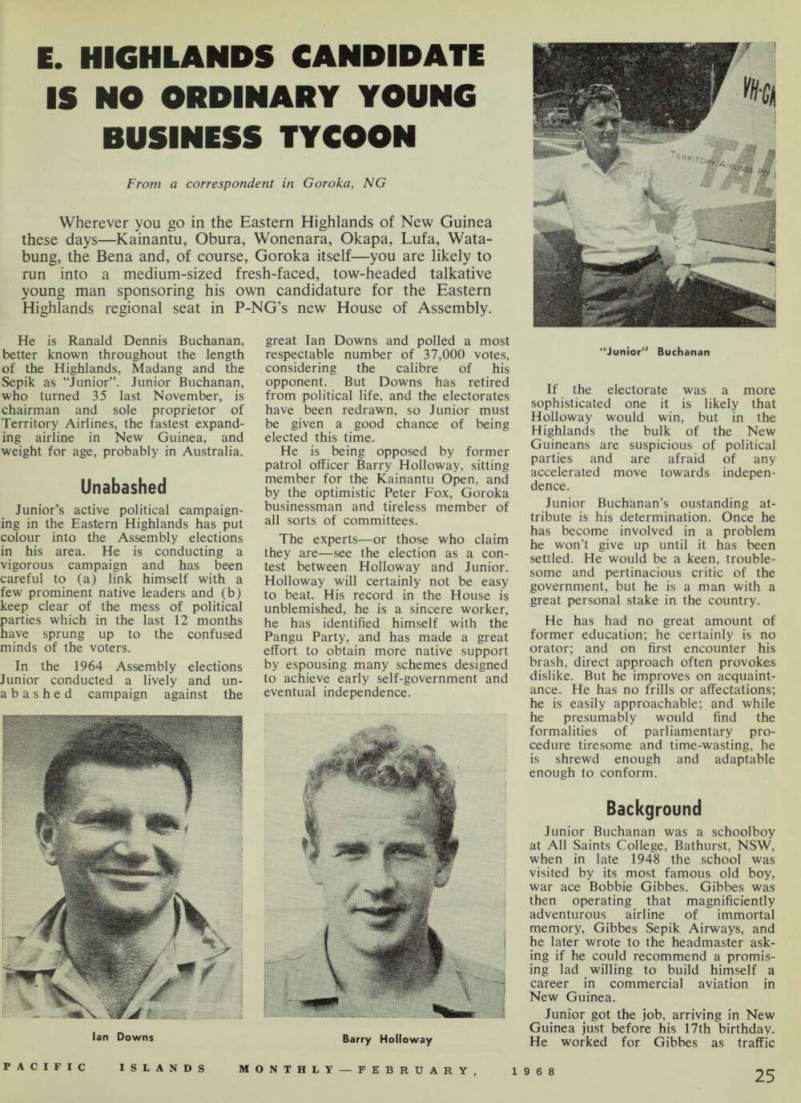
The only European to be returned un opposed in this year's election is Mr. Ro[?] Neville (top) who will represent the Southern Highlands. Speaker Horrie Nial (below), who was unopposed in the 1964 election, will battle it out this time with Tony Voutas, member for Kaindi in the last House.
as an independent. Of the two Euro peans, one, Ron Slaughter, is a former elected member of Legco, while Andy Anderson was an un successful contender in the 1964 elections.
Among the other European can didates is sitting member Keith Tetley, who is not given much chance of re-election in Kikori Open.
He is opposed by Pangu’s Albert Mauri Kiki and by a well-known Koriki leader, Tommy Kabu, a NAPRO candidate. The last named could well give Albert Mauri Kiki a nasty fright.
Over the border
Two Papuans are giving it a go in New Guinea. A young Motuan school teacher, Morea Tabe, is one of five candidates challenging Zure Zurecnuoc, Treasury’s Under-sec retary, in the Finschhafen Open.
Zure is exuding confidence in his ability to hold his opponents off.
The other Papuan who has crossed the border for the election is even more courageous. He is a storeman.
John Baptist Poe, who is challenging the Rai Coast’s famous and formid able cult leader, Yali, well-known to readers of Peter Lawrence’s Road Belong Cargo.
In North Bougainville, Francis Hagai, one of the leaders of the much-publicised Hahalis Welfare Society, has two opponents, both, like himself, ex-teachers, but in other respects having a very different background. Both are local govern ment councillors. One, Donatus Mola, is a vice-president of P-NG’s Federa tion of Savings and Loans Societies, while the other, Samson Purupuru, was a member of the Electoral Boundaries Committee which revised the electoral boundaries in 1966-67.
This should be a very interesting contest indeed.
In Western Papua there will be one father-and-son team out electioneering. Robert Tabua, Under secretary for Public Works in the last House, is contesting the South Fly Open, while his son. Goodwill Tabua, is entered for the Gulf and Western Regional under the banner
Of Napro.
In the Alotau Open, well-known sitting member John Guise is opposed by two Papuans and one European; but the prevailing opinion seems to be that he will have no difficulty in holding his seat.
Forty-six native public servants have resigned to contest the elections.
Sixteen of these are interpreters, eight are teachers and six are clerical assistants.
In addition to these 46 officers, two policeman have resigned. All can return to their old jobs if un successful.
Besides the native and European candidates, there are about half a dozen Chinese standing for election.
But there is only one woman can didate—the mixed race wife of a plantation owner.
About 1,180,000 voters are on the rolls. This is about 10 per cent, up on 1964.
UN observers
Candidates forfeit their S5O nomination fee if they fail to win one-eighth of the successful can didate’s total of primary votes.
Voting is non-compulsory and a modified preferential system whereby a “number one” against any can didate’s name is sufficient for a formal vote.
A four-man United Nations mission will visit the Trust Territory of New Guinea to observe the elec tions.
The mission will comprise dele gates from New Zealand, France, Britain and Liberia.