Independence Comes
pp. 23-24 · Read in the full issue
To Tiny Nauru
But Now What?
From PIM editor STUART INDER and PlM’s Nauru correspondent NAURU, January 31 It is a surprising thing that independence day for Nauru is been less spectacular than the occasion exactly two sars ago when Nauru inaugurated its first Legislative ouncil.
Today there have been more dis iguished visitors, more ceremonial id more speeches than there were ro years ago, but there has been ss headiness in the air, less ithusiasm than two years ago.
One reason for this is that auruans are not normally demon rative. But there is another reason.
Nauru appears to be a more mbre island for having finally hieved the substance for the adow. I don’t mean that the island apprehensive about its future—it els fit enough to manage. But now dependence is here what is left on e horizon? Much hard work.
The celebrations themselves are a eat success.
The fireworks, the concerts, the Hilary ceremonies and formal pro edings have been run both with actitude and with a welcome avening of that Nauruan fo rmality which creeps in on those *:asions when the official pro amme becomes overwhelming.
It’s all been very well arranged, ae independent Republic of Nauru me into existence at midnight auru time this morning with the
beautiful sounds of a Nauruan church choir singing Nauruan hymns at a combined Catholic and Protestant service under the palms.
Fireworks especially brought from Sydney together with an expert to set them off gave the Nauruan children—and Nauru has many children—their first treat.
Leaders chosen
Only a few hours later it was very much an adult show, with coats and ties, as official visitors crowded the small Legislative Assembly chambers to watch the inaugural Assembly elect, without any fuss, the Speaker and the five men who will manage the affairs of the nation as the Council of State for the next few months (see PP- 22, 34).
Nauru’s constitution, which comes into force today, makes no mention of a President, Chief Minister or Cabinet Minister. These details have yet to be decided by the Consti tutional Convention, which is legally entitled to continue its deliberations until June 30.
Although there is some talk by
Convention members that a Presid ency might be “too grand”, there is no real doubt that, basically, the executive of the new republic will be along the lines of the draft sub mitted by the Nauruans to the partnership powers several months ago—that is a President and Chief Minister and Cabinet Ministers.
But the deliberations of the next few months should be interesting, nevertheless, just in case new divisions show up.
It was no surprise that the man elected as the chairman of the Council of State this morning was Head Chief Hammer Deßoburt, the architect of Nauruan independence.
And, of course, it was Deßoburt, who, in a brief ceremony, with little pomp, raised for the first time the royal blue and gold Nauruan flag.
There was no cheering but it was a moving moment, especially for Deßoburt himself.
Hotel-less Nauru has had to go to extraordinary lengths to accommodate the modest list of visitors who have arrived for the celebrations of Inde pendence Day.
A crash programme of house
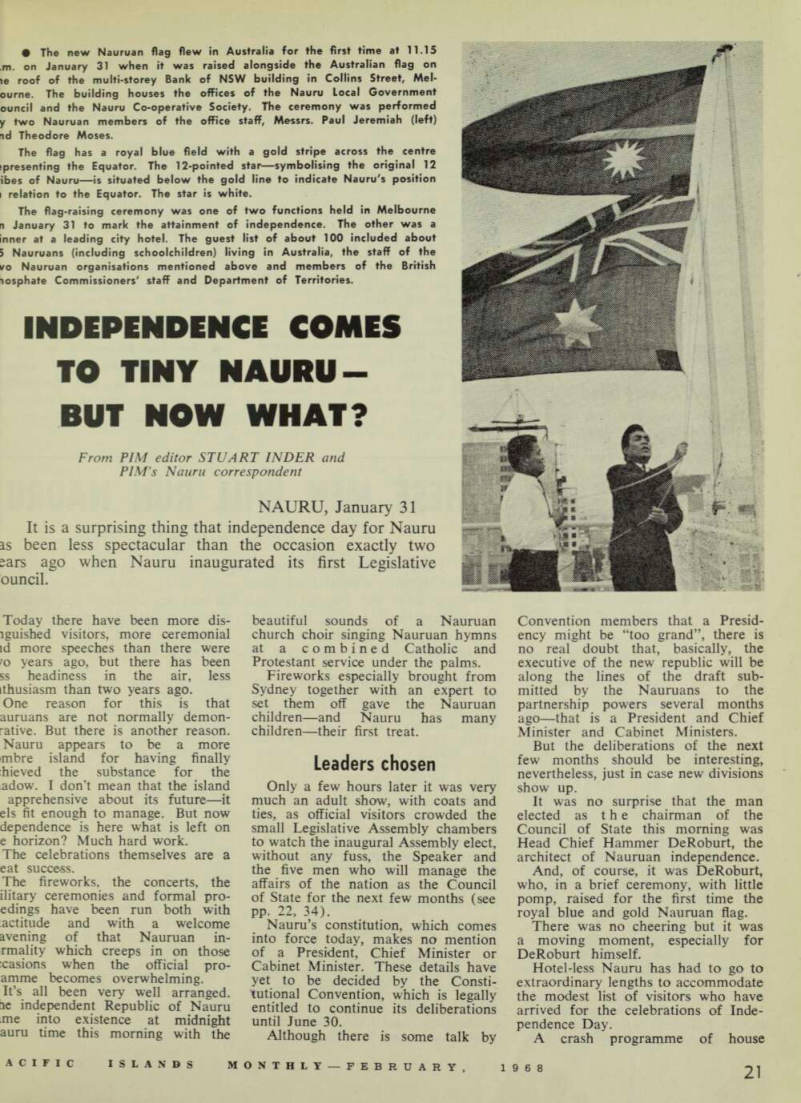
• The new Nauruan flag flew in Australia for the first time at 11.15 [?]m. on January 31 when it was raised alongside the Australian flag on [?] roof of the multi-storey Bank of NSW building in Collins Street, Mel [?]ourne. The building houses the offices of the Nauru Local Government [?]ouncil and the Nauru Co-operative Society, The ceremony was performed [?]y two Nauruan members of the office staff, Messrs. Paul Jeremiah (left) and Theodore Moses.
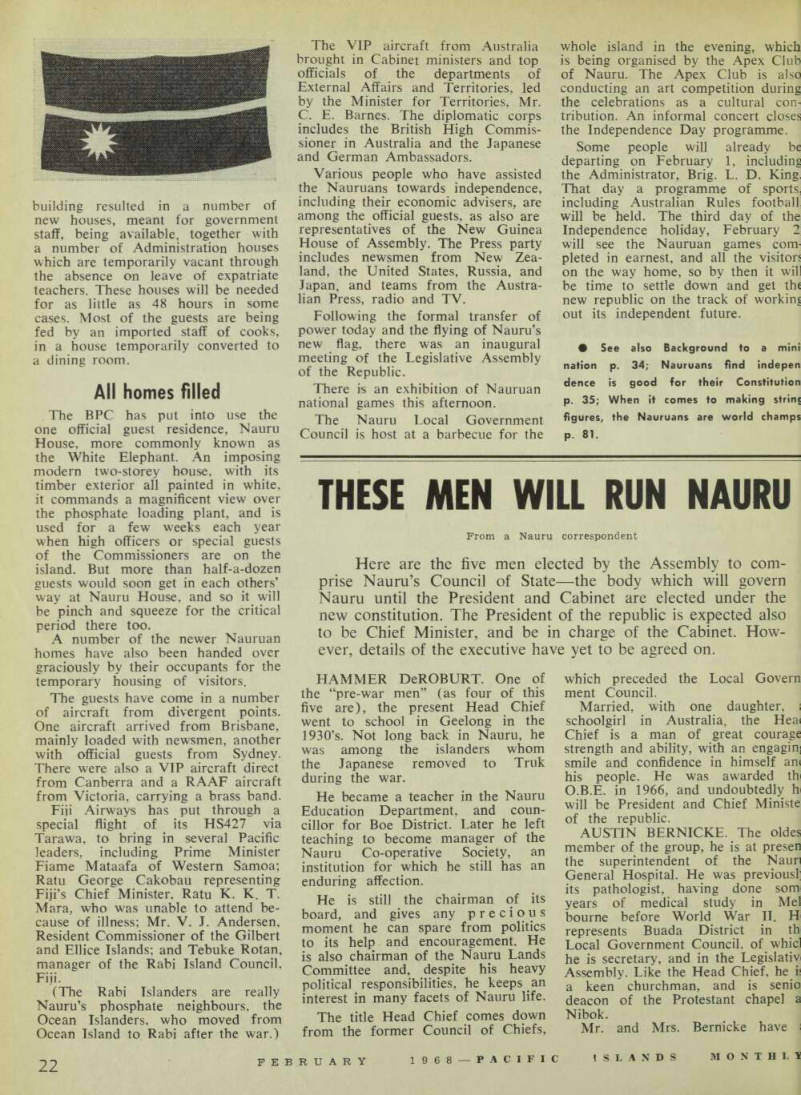
The flag has a royal blue field with a gold stripe across the centre [?]presenting the Equator. The 12-pointed star—symbolising the original 12 [?]ibes of Nauru —Is situated below the gold line to indicate Nauru's position [?] relation to the Equator. The star is white.
The flag-raising ceremony was one of two functions held in Melbourne January 31 to mark the attainment of independence. The other was a [?]inner at a leading city hotel. The guest list of about 100 included about 5 Nauruans (including schoolchildren) living in Australia, the staff of the vo Nauruan organisations mentioned above and members of the British [?]osphate Commissioners' staff and Department of Territories.
building resulted in a number of new houses, meant for government staff, being available, together with a number of Administration houses which are temporarily vacant through the absence on leave of expatriate teachers. These houses will be needed for as little as 48 hours in some cases. Most of the guests are being fed by an imported staff of cooks, in a house temporarily converted to a dining room.
All homes filled
The BPC has put into use the one official guest residence, Nauru House, more commonly known as the White Elephant. An imposing modern two-storey house, with its timber exterior all painted in white, it commands a magnificent view over the phosphate loading plant, and is used for a few weeks each year when high officers or special guests of the Commissioners are on the island. But more than half-a-dozen guests would soon get in each others’ way at Nauru House, and so it will be pinch and squeeze for the critical period there too.
A number of the newer Nauruan homes have also been handed over graciously by their occupants for the temporary housing of visitors.
The guests have come in a number of aircraft from divergent points.
One aircraft arrived from Brisbane, mainly loaded with newsmen, another with official guests from Sydney.
There were also a VIP aircraft direct from Canberra and a RAAF aircraft from Victoria, carrying a brass band.
Fiii Airways has put through a special flight of its H 5427 via Tarawa, to bring in several Pacific leaders, including Prime Minister Fiame Mataafa of Western Samoa; Ratu George Cakobau representing Fiji’s Chief Minister, Ratu K, K. T.
Mara, who was unable to attend be cause of illness; Mr. V. J. Andersen, Resident Commissioner of the Gilbert and Ellice Islands; and Tebuke Rotan, manager of the Rabi Island Council, Fiji. (The Rabi Islanders are really Nauru’s phosphate neighbours, the Ocean Islanders, who moved from Ocean Island to Rabi after the war.)
The VIP aircraft from Australia brought in Cabinet ministers and top officials of the departments of External Affairs and Territories, led by the Minister for Territories, Mr.
C. E. Barnes. The diplomatic corps includes the British High Commissioner in Australia and the Japanese and German Ambassadors.
Various people who have assisted the Nauruans towards independence, including their economic advisers, are among the official guests, as also are representatives of the New Guinea House of Assembly. The Press party includes newsmen from New Zealand, the United States, Russia, and Japan, and teams from the Australian Press, radio and TV.
Following the formal transfer of power today and the flying of Nauru’s new flag, 'there was an inaugural meeting of the Legislative Assembly of the Republic.
There is an exhibition of Nauruan national games this afternoon.
The Nauru Local Government Council is host at a barbecue for the
whole island in the evening, which is being organised by the Apex Club of Nauru. The Apex Club is also conducting an art competition during the celebrations as a cultural con tribution. An informal concert closes the Independence Day programme.
Some people will already be departing on February 1, including the Administrator, Brig. L. D. King.
That day a programme of sports, including Australian Rules football, will be held. The third day of the Independence holiday, February 2 will see the Nauruan games com pleted in earnest, and all the visitors on the way home, so by then it will be time to settle down and get the new republic on the track of working out its independent future.
• See also Background to a mini[?] nation p. 34; Nauruans find indepen dence is good for their Constitution p. 35; When it comes to making string figures, the Nauruans are world champs p. 81.