Up Front
pp. 16-17 · Read in the full issue
with the editor
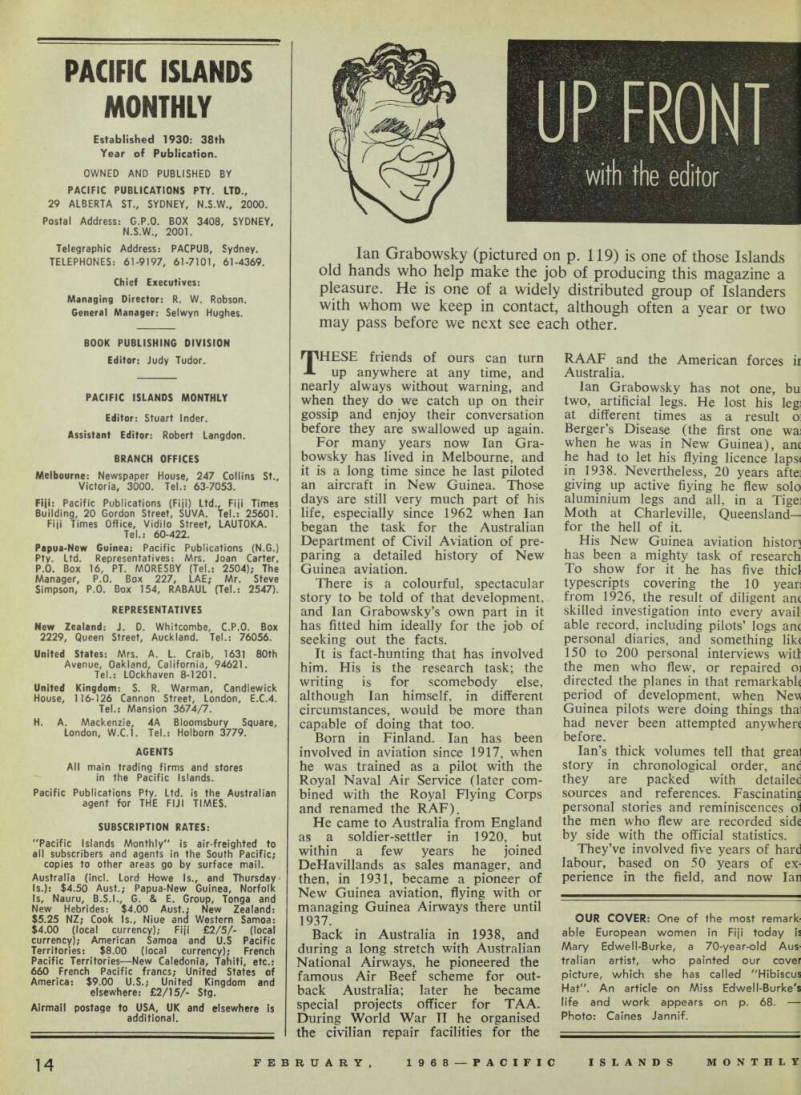
lan Grabowsky (pictured on p. 119) is one of those Islands old hands who help make the job of producing this magazine a pleasure. He is one of a widely distributed group of Islanders with whom we keep in contact, although often a year or two may pass before we next see each other.
THESE friends of ours can turn up anywhere at any time, and nearly always without warning, and when they do we catch up on their gossip and enjoy their conversation before they are swallowed up again.
For many years now lan Gra bowsky has lived in Melbourne, and it is a long time since he last piloted an aircraft in New Guinea. Those days are still very much part of his life, especially since 1962 when lan began the task for the Australian Department of Civil Aviation of pre paring a detailed history of New Guinea aviation.
There is a colourful, spectacular story to be told of that development, and lan Grabowsky’s own part in it has fitted him ideally for the job of seeking out the facts.
It is fact-hunting that has involved him. His is the research task; the writing is for scomebody else, although lan himself, in different circumstances, would be more than capable of doing that too.
Born in Finland. lan has been involved in aviation since 1917, when he was trained as a pilot with the Royal Naval Air Service (later com bined with the Royal Flying Corps and renamed the RAF), He came to Australia from England as a soldier-settler in 1920, but within a few years he joined DeHavillands as sales manager, and then, in 1931, became a pioneer of New Guinea aviation, flying with or managing Guinea Airways there until 1937.
Back in Australia in 1938, and during a long stretch with Australian National Airways, he pioneered the famous Air Beef scheme for out back Australia; later he became special projects officer for TAA.
During World War II he organised the civilian repair facilities for the
RAAF and the American forces ii Australia. lan Grabowsky has not one, bu two, artificial legs. He lost his leg; at different times as a result o: Berger’s Disease (the first one wai when he was in New Guinea), am he had to let his flying licence laps< in 1938. Nevertheless, 20 years afte; giving up active flying he flew solo aluminium legs and all, in a Tige; Moth at Charleville, Queensland— for the hell of it.
His New Guinea aviation histor] has been a mighty task of research To show for it he has five thicl typescripts covering the 10 yean from 1926, the result of diligent anc skilled investigation into every avail able record, including pilots’ logs anc personal diaries, and something like 150 to 200 personal interviews witl the men who flew, or repaired oi directed the planes in that remarkable period of development, when Nev Guinea pilots were doing things thai had never been attempted anywhere before. lan’s thick volumes tell that greal story in chronological order, anc they are packed with detailed sources and references. Fascinating personal stories and reminiscences ol the men who flew are recorded side by side with the official statistics.
They’ve involved five years of hard labour, based on 50 years of ex perience in the field, and now lan
has to give the work up. In Sydney the other day for a much-needed rest, we caught up with each other, and I found him far from well.
He told me how, about a month earlier, he had gone to his Mel bourne office as usual, sat down, and broke into a shivering sweat. He couldn’t go on. His doctor has told him he can’t do any more work on his aviation records; he must retire. lan is 68. His stumps are giving him pain for the first time in many years.
What happens to his five volumes covering the first 10 years of New Guinea’s aviation history, lan doesn’t know. They belong, of course, to the Department of Civil Aviation, but there are no plans to have them edited or published.
I believe it would be better to get them published sooner rather than later, so that the dwindling band of pioneers who are still on deck can correct any errors or make any ad ditions to the record. And it’s a valuable record.
There surely is a task here for Papua-New Guinea’s new university, in combination perhaps with Qantas or the W.R. Carpenter Group, who have shared in New Guinea’s aviation development. Little finance would be needed. What proposals, please, to publish lan Grabowsky’s massive labour of love?
ON this subject of old hands, old friends and old records, this is the occasion to announce that PIM will soon farewell assistant editor Robert Langdon. After nearly six years with PIM, Bob in April will join the staff of the Australian National University, Canberra. He is to establish there a new clearing centre for Pacific manuscript material, and his task will be to ferret out Islands material before it is lost, for the benefit of several libraries in Australia, New Zealand and the US.
PIM is a very personal magazine.
We make more friends than money.
I bear Bob’s departure as a personal cross, for PIM to some extent is Robert Langdon; he has added his own ingredients of scholarship and specialised research to PI M’s recipe.
The taste of the magazine won’t be quite the same, and I shall miss him as a personal friend.
But his skilled pen will not be lost to us entirely, for he plans to be an occasional contributor on the sub jects that are his special love, such as Polynesian history. He’ll always be welcome in PlM’s paper-strewn office when he’s in town; as are the lan Grabowskys of the Pacific.
Stuart Inder