It's Old Stuff In
pp. 90-91 · Read in the full issue
Cutting ships in halves
The South Seas
From GORDON RUSSELL in Wellington It is not often that a ship is deliberately cut in two, the halves pushed apart and an extra midship section fastened into place.
The operation has an audacious flavour that brings Press photo graphers around—and this was the case when the Cook Islands trader Tagua was lengthened by 18 ft in an Auckland shipyard in September ( PIM, Oct., p. 107). The additional length means that the Tagua can now carry another 60 tons for her owners, Messrs. Silk and Boyd, who operate the vessel out of Rarotonga.
The operation on the Tagua and her connection with Rarotonga re calls a similar operation that took place on Rarotonga exactly 135 years ago in very different circum stances. Had there been any Press reporters and photographers about in
those days, they would have captured quite a story.
The job was done by the Rev.
John Williams, the most dynamic of Rarotonga’s early missionaries.
Viliami, as the Rarotongans came to know him, had joined the London Missionary Society in 1817 and had set sail in the ship Harriet east about for the Societies via Sydney and New Zealand.
In the 364 days of that voyage he learnt a good deal about ships and the sea, and in 1821 he revisited Sydney, purchased the schooner Endeavour, sailed her back to the Societies and explored the little
known Hervey Group, as the Southern Cooks were called in those days.
In 1823 two native pastors were landed at Rarotonga in the Endeavour in dramatic circumstances, and in 1827 Williams joined them to con solidate the new order.
A year later, fretting for new pastures, he determined to build his own ship on the spot, something about 70 tons, schooner rigged.
He had no saw, no canvas, no rope and very little iron, but there was plenty of fine timber on the island and an army of husky ex warriors on call.
Makeshift forge
Williams set to work and when the keel was laid tattooed Islanders sallied forth with bamboo patterns of ribs and planking for branches made to measure. These were split in two with hand-forged wedges and adzed to shape, one for each side.
The ribs and the double planking were fastened with ironwood tree nails, the planking caulked with a concoction of coconut husks, dried banana stalks and shredded tapa cloth.
Lacking a forge Williams, evolved a wooden one—a two-cylinder affair like a huge bilge pump that delivered a fine blast through a perforated stone to a coconut charcoal fire.
He made a turning lathe for shap ing sheaves for his home-made blocks, and a rope-making machine for twisting the tough fibres of the
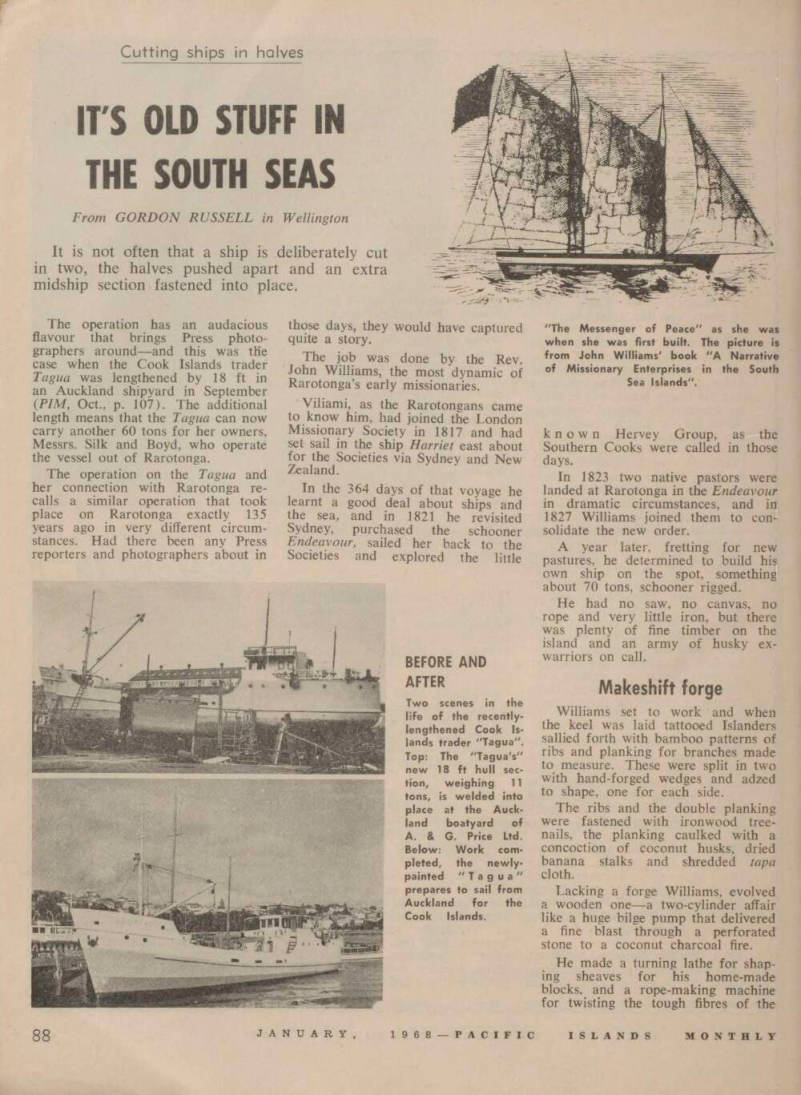
"The Messenger of Peace" as she was when she was first built. The picture is from John Williams' book "A Narrative of Missionary Enterprises in the South Sea Islands".
Before And
After
Two scenes in the life of the recently lengthened Cook Is lands trader "Tagua".
Top: The "Tagua's" new 18 ft hull sec tion, weighing 11 tons, is welded into place at the Auck land boatyard of A. & G. Price Ltd.
Below: Work com pleted, the newly painted "Tagua" prepares to sail from Auckland for the Cook Islands.
hibiscus tree bark. He forged pintles for his rudder from a pickaxe, a cooper’s adze and a large hoe.
Sails were fashioned from Raro tongan sleeping mats, quilted together, hemmed to shape. As a substitute for anchors, crates of wood filled with stones were used.
Eventually the ship, called the Messenger of Peace, rode upon the waters; and in due course Williams sailed her to Tahiti.
By good fortune HMS Seringa patam was there and the full re sources of the Navy were placed at his disposal.
With genuine oakum in her seams, new masts and rigging and real canvas sails, the home-made schooner became a stout and able vessel.
Over the next four years she covered many thousands of sea miles, to and fro through the Societies, the Cooks, and the Tongan Group.
Best of all, in Williams’ view, she took him to the untouched islands of Samoa, where he introduced the Gospel with great success.
In March, 1832, Williams was back in Rarotonga, where he beached the Messenger of Peace at Avarua.
She was due for repairs and he wanted to lengthen her and give her a new stern.
But before he could do so, a full scale hurricane swept the island and demolished churches, schools, homes and crops.
Out of the swamp
The schooner finished up half a mile inland, half submerged in a taro swamp.
It was several weeks before things were sufficiently back to normal for Williams to begin making alterations and repairs. These were done while the ship was actually in the swamp.
Williams then called his flock of about 2,000 people to help him refloat the vessel.
Huge trees were felled and placed under the bows upon transverse fulcrums. Platforms were then built upon the soaring upper ends of these levers and filled with coral stones.
As the load increased the bows lifted and were chocked. By laborious repetition of this process the ship was lifted clear of the mud.
The swamp was then filled with stones, logs of wood were laid across it, rollers were laid under the vessel, and a chain cable was passed around it. Thus prepared, the united strength of Rarotonga set to work to move her.
Slowly, with a great whooping and chorusing, she moved towards the sea and in a short time, as Williams joyfully recorded, “floated in her pride upon the sea”.