Yesterday
p. 89 · Read in the full issue
An outbreak of polio in New Zealand caused near panic in several Pacific Islands territories 20 years ago.
Western Samoa slapped on strict quarantine precautions; the regular plane service from NZ was suspended; passengers and crew on NZ ships were not allowed ashore at Apia; flying-boat passengers from Sydney to the Solomons and the New Hebrides were not allowed to land; Fiji put all in coming travellers under 19 years into quarantine; and Norfolk Island banned visitors from New Zealand, thereby making things difficult for its own tourist industry.
THE polio scare was one of the main news stories in PIM for January, 1948. Other items 20 years ago this month were: HOLLAND was making plans for white colonisation on a large scale in Dutch New Guinea, which prompted PIM to comment that the Dutch policy was in strik ing contrast to that of Australia.
“Here are the Dutch setting up a new organisation to colonise Dutch New Guinea with white people,”
PIM said, “while Australia, with a large white colony already established in New Guinea, is setting up government depart ments whose chief purpose seems to be to push Europeans out of Australian New Guinea.”
TWO new shipping companies had started in Tahiti. The South Seas Shipping Company, with the diesel-engined ship Pomare, was to run between Tahiti and Hawaii, via Samoa, every six weeks and the Compagnie Taurua Limited, formed by five Tahitian residents, was to operate the Taurua, a former United States submarine chaser, in French Poly nesia.
HEAVY earth tremors, lasting several days, shook Tanna Island, New Hebrides, in Dec ember, making big cracks in roads, eroding the coastline and moving the French District Agent’s house by four inches.
TEN natives died and 20 more were likely to be blind for life, after they discovered and drank a cache of liquor in the Kokopo District of New Ireland, which was left behind by the oc cupying Japanese forces.
SIR Walter Ramsay McNicoll, Administrator of the Man dated Territory of New Guinea
from 1934 until the Japanese invasion early in 1942, died in Sydney in December, 1947 aged 70.
THE new Governor of Fiji and High Commissioner for the Western Pacific, Sir Brian Free ston, and his wife Lady Freeston, arrived in Wellington on their way to Suva.
A PEARL shell expert, Mr. C.
B. Alexander, announced plans to operate a £lOO,OOO fish ing industry in North Queensland and Papua waters with two vessels, bought at Cairns and Townsville.
COCOA prices were at an all time high. Western Samoan growers were receiving £245 a ton for beans and these prices were expected to continue.
FIJI had been having a season of strikes as a result of rising costs in the colony. At the Emperor and Loloma goldmines at Vatukoula, more than 900 workers had just resumed work after a week-long walk-out. In Suva, laundry workers had been out over board and lodging conces
sions; at Samabula, girl employees had been on strike over pay; and there had been a major hold-up at Nadi Airport.
A CASE that was to occupy the attention of PIM and New Guinea people for many months had come into the news for the first time. The case concerned Jock Garden, a well-known Labour leader, politician and government employee in Aus tralia, who had been charged in the Special Federal Court, Sydney, on January 2, 1948 on three charges of forgery and falsifica tion concerning a £50,000 timber deal in New Guinea.
Mrs. H. B. R. Parham,
writer, naturalist and travel ler, who was an authority on Fiji plant life, died in Suva on December 17, aged 85.
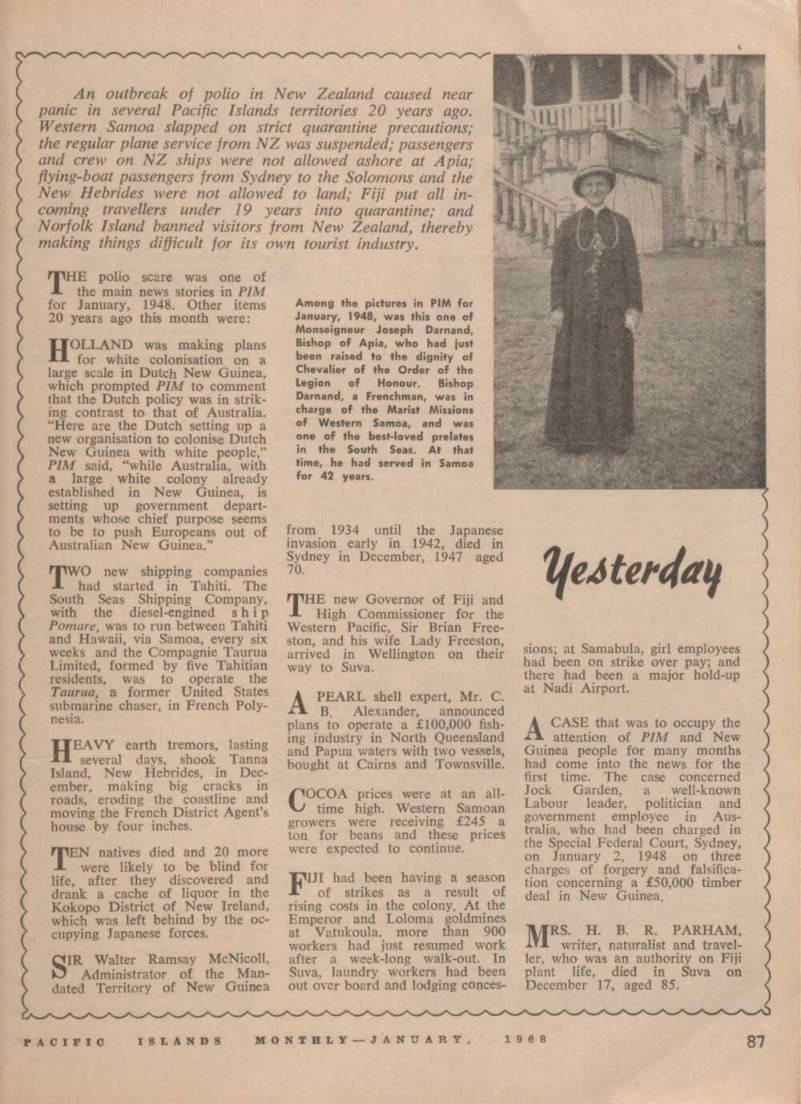
Among the pictures in PIM for January, 1948, was this one of Monseigneur Joseph Darnand, Bishop of Apia, who had just been raised to the dignity of Chevalier of the Order of the Legion of Honour. Bishop Darnand, a Frenchman, was in charge of the Marist Missions of Western Samoa, and was one of the best-loved prelates in the South Seas. At that time, he had served in Samoa for 42 years.