Were Europeans living in
pp. 63-71 · Read in the full issue

PIM man has a startling new theory...
Were Europeans living in the Eastern Pacific in the 16th century?
By Robert Langdon
Ever since the European explorers discovered the islands of the Pacific four and a half centuries ago, a controversy has been going on as to where the Islanders came from.
This controversy has been parti cularly focused on the origins of the Polynesians, who, being further from any continent than either the Mela nesians or the Micronesians, have created the greatest puzzle.
Some theorists, such as Thor Heyerdahl of Kon Tiki fame, have argued that the Polynesians came from the Americas, both North and South. Others have said that they came down the Asian corridor to Malaysia and struck into the Pacific from there; while at least one theorist, Andrew Sharp, believes they pushed into the Pacific from the direction of the Philippines.
Some of the theorists argue that the Polynesians found their islands by embarking on deliberate voyages of exploration. Others go along with Andrew Sharp in thinking that most of the islands were discovered when the islanders were accidentally blown from one place to another.
There is, in short, a theory on the Polynesians to suit almost every taste. But the Polynesian theorists have so far been agreed, by default, on one essential point—and that is that the ancient Polynesians were not descended from Europeans.
Plenty of evidence
To the best of my knowledge, no writer has ever even argued that some of the ancient Polynesians might have been descended from Europeans.
Yet there is, in my opinion, quite a lot of evidence to suggest that this could have been the case, especially in Tahiti and the surrounding islands.
When the first European explorers arrived in Tahiti in HMS Dolphin exactly two centuries ago, they found there many attractive people, some of whom were almost as light-skinned as themselves.
George Robertson, the Dolphin’s sailing master, observed that the Tahitians were of three different skin pigmentations.
“Some was a light coper collour, oythers a mulatto and some almost, if not altogeather white,” he said in his quaintly-spelt journal.
The copper-coloured people, Robertson said, were 10 times as numerous as the mulattoes (who were half-way in colour between the “whitest sort” and the “red or Indian colour”), while the mulattoes were “ten times as numerous as the whitest sort.”
Robertson also recorded that one woman he saw was “fully as fair, and hade as good features, as the generality of women in England”.
“Hade she been drest after the English manner, I am certain no man would have thought her of another country,” he added.
Bougainville, the French explorer, who visited Tahiti in 1768, was equally struck by the European ap pearance of many of the Tahitians, although he distinguished only two races among them.
Of the larger race, both in body size and numbers, he said; “Nothing distinguishes their features from those of the Europeans; and if they were clothed, if they lived less in the open air, and were less exposed to the sun at noon, they would be as white as ourselves.”
Some could blush
Captain Cook, who followed Bougainville in 1769, expressed similar views. The “superior” class of people, he wrote, were “not browner than people who are born or reside long in the West Indias, nay some of the women are almost as fair as Europeans.”
Cook’s companion, Joseph Banks,
thought the “better class” of people (especially the women) were “seldom browner than that kind of Brunette which many in Europe preferr to the finest red and white”. And he said he had even seen some of them “shew a Blush very manifestly”.
Pickersgill, one of Cook’s officers on his second voyage, recorded seeing a man who was the “coulour of a Flemmen” (i.e. a Fleming, or native of Flanders).
The man had red hair, bad teeth and grey eyes, and was at first taken for a European. “But on further examination,” Pickersgill wrote, “we found him to be a Native. How or by what means a white man comes to be born amongst a set of copper colour’d Indians, I leave the learned to account for”.
The white, or light-coloured people were not confined to Tahiti.
When Cook visited the neighbour ing islands of Huahine, Bora Bora, Raiatea, and Tahaa on his first voy age he found the natives—especially the women—even fairer than those of Tahiti. And on Huahine, in parti cular, he thought they were “more uniformly of one colour” than the Tahitians.
On the other hand, the mixed population that Cook and others had observed on Tahiti was also recorded at Raivavae, some 400 miles south of Tahiti.
When an officer from the Spanish ship Aguila went ashore there in 1775, he found that some of the
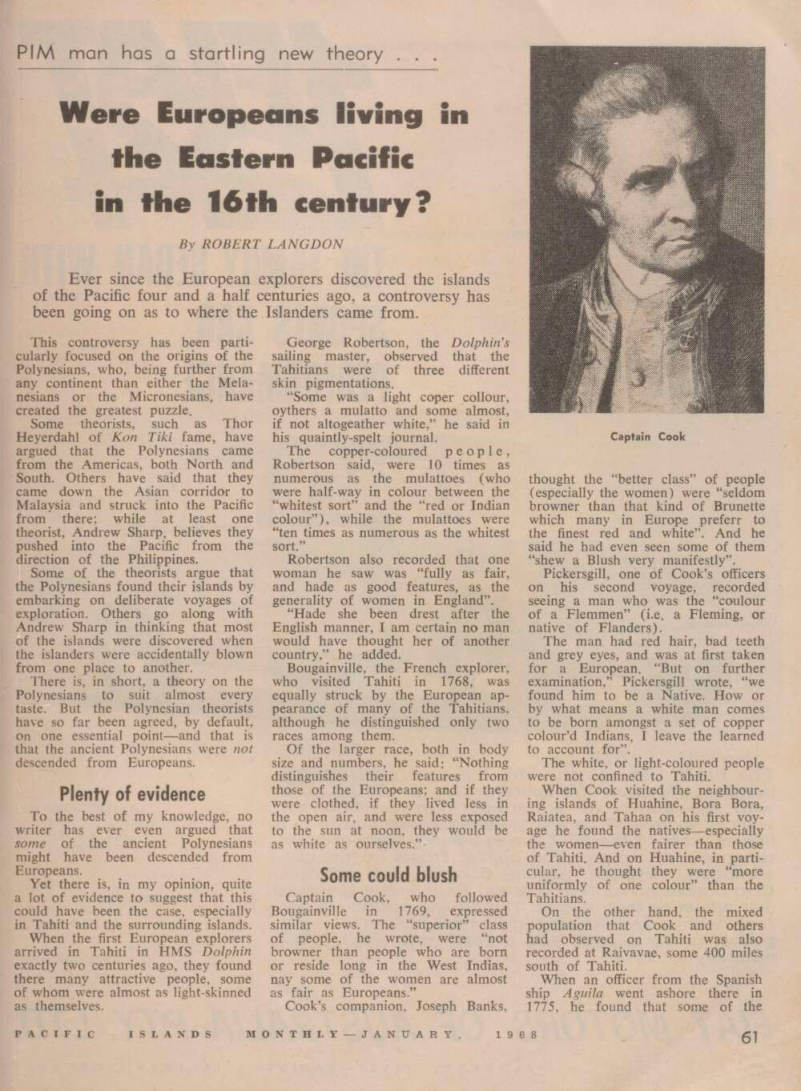
Captain Cook
people were white, some mulatto coloured, and some more swarthy.
On other islands again, there were apparently no white people at all. On Rurutu, 200 miles north-west of Raivavae, for example, Joseph Banks found the people “rather browner” than those in Tahiti and the other Society Islands. Kaukura, in the Tuamotus, was another such island.
Yet when the Russian explorer Bellingshausen visited it in July, 1820, he remarked that although the islanders were “very dark of face and body,” their features “did not differ from Europeans.”
“Brown”, “swarthy” and “copper coloured” were usually the adjectives applied by the early explorers to the natives of the Tuamotus. However, of the 76 atolls in the widely-scat tered Tuamotus, the explorers had landed on less than a dozen by the end the 18th century, and had there fore seen few of the natives at close quarters.
Explanations
The best explanations that anthro pologists have so far been able to offer for the presence of white or European-looking people in the Eastern Pacific in Captain Cook’s time are that: (1) Somehow, somewhere, thousands of years ago, the ancestors of the Polynesians mingled with a people of Caucasoid type before they moved into the Pacific from the Asiatic mainland. (2) The Polynesians are partly descended from a tribe of myster ious white men, headed by Thor Heyerdahl’s hero, Kon Tiki, who were pushed into the Pacific from Peru many centuries ago.
There is possibly some truth in both of these theories; but a more likely explanation, in my opinion, is that some of the Polynesians looked like Europeans two centuries ago because their ancestors in quite recent times were Europeans.
There is, at any rate, ample
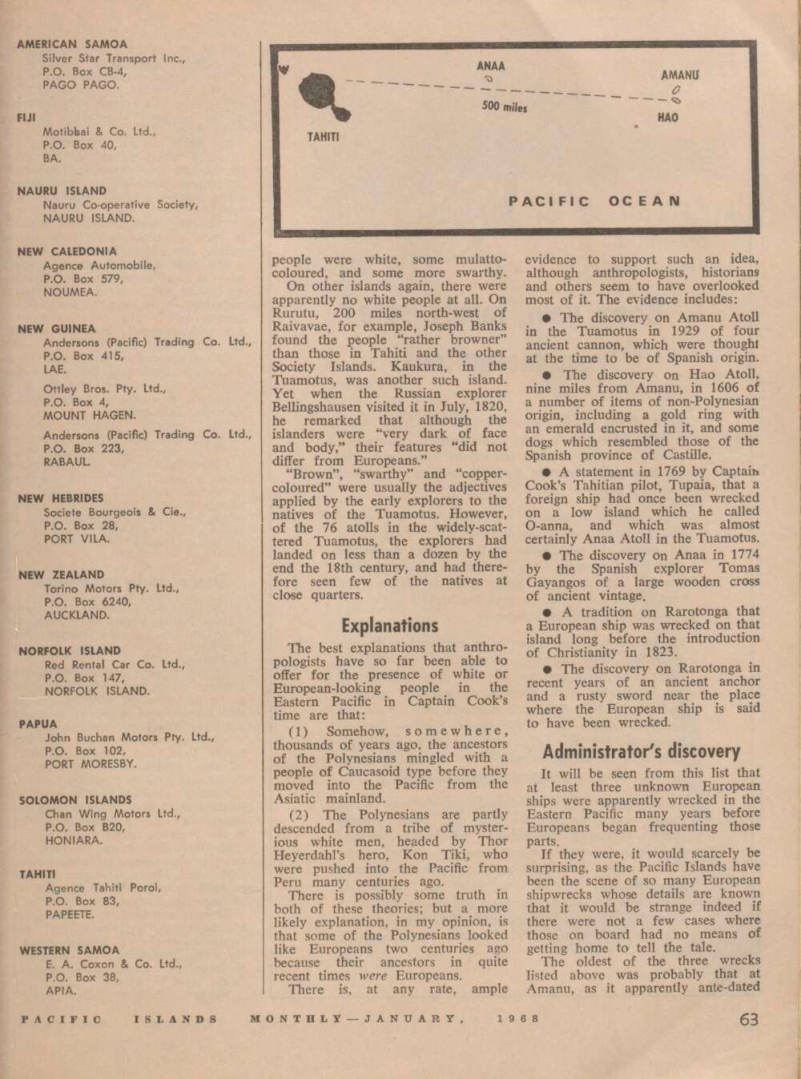
evidence to support such an idea, although anthropologists, historians and others seem to have overlooked most of it. The evidence includes; • The discovery on Amanu Atoll in the Tuamotus in 1929 of four ancient cannon, which were thought at the time to be of Spanish origin. • The discovery on Hao Atoll, nine miles from Amanu, in 1606 of a number of items of non-Polynesian origin, including a gold ring with an emerald encrusted in it, and some dogs which resembled those of the Spanish province of Castille. • A statement in 1769 by Captain Cook’s Tahitian pilot, Tupaia, that a foreign ship had once been wrecked on a low island which he called O-anna, and which was almost certainly Anaa Atoll in the Tuamotus. • The discovery on Anaa in 1774 by the Spanish explorer Tomas Gayangos of a large wooden cross of ancient vintage. • A tradition on Rarotonga that a European ship was wrecked on that island long before the introduction of Christianity in 1823. • The discovery on Rarotonga in recent years of an ancient anchor and a rusty sword near the place where the European ship is said to have been wrecked.
Administrator's discovery
It will be seen from this list that at least three unknown European ships were apparently wrecked in the Eastern Pacific many years before Europeans began frequenting those parts.
If they were, it would scarcely be surprising, as the Pacific Islands have been the scene of so many European shipwrecks whose details are known that it would be strange indeed if there were not a few cases where those on board had no means of getting home to tell the tale.
The oldest of the three wrecks listed above was probably that at Amanu, as it apparently ante-dated
Quires’ visit to the Tuamotus in 1606 by quite a few years.
The Amanu wreck was discovered by the late Francois Herve (1879- 1939), who was French administrator of the Tuamotu Archipelago for 11 years from 1925.
In 1929, Herve was making a chart of rarely-visited Amanu with the island’s chief when he happened to remark that, unlike most other atolls, Amanu had no wrecks on its reef.
The chief replied that there was, in fact, a wreck; and Herve asked him to show it to him.
The chief then took him to a spot on the atoll’s eastern (or South American) side, where, in the water, embedded in the reef, he found four cannon and a pile of alien stones that had apparently been the ballast of a ship.
One of the cannon was raised from the reef and taken to Papeete in the Government schooner Mouette and placed in the museum of the Societe d’Etudes Oceannienes.
The Societe, however, never reported this interesting acquisition in its quarterly journal; and when I visited Papeete in November and made a special trip to the museum to see the cannon, I found that the Societe (having forgotten the details of its origin) had recently given it away to the Tahitian Battalion of the French Army.
Described by yachtsman
The Societe’s secretary, Miss Aurora Natua, immediately made an effort to relocate the cannon, but was unable to do so during my stay in Papeete.
So far, therefore, the only details I know about the cannon are those to be found in the only two books that happened to record its discovery —Gifford Pinchot’s reminiscences of a yachting voyage called To The South Seas, and Samuel Russell’s valuable guidebook of the 1930’5, Tahiti and French Oceania.
Pinchot, who was a Governor of Pennsylvania, saw the cannon in the Papeete Museum in September, 1929, in the presence of its discoverer.
He described it as “a very old short iron cannon (carronade)” and said that Herve thought it had probably belonged to “a Spanish ex ploring ship sent out from Peru”.
Russell described the cannon in his book as “extremely old” and “supposed to be of Spanish make”.
He added that there was “no record to show how it came to be embedded in the coral at Amanu”.
Neither Pinchot nor Russell
What Ouiros saw
realised that the wreck at Amanu very probably had some connection with the mysterious discoveries which the Spanish explorer Quiros made at neighbouring Hao Atoll in 1606.
Quiros was making his way west wards across the Pacific in search of the southern continent when he came to a large atoll (now identified as Hao), which he called La Conversion de San Pablo.
Being in need of water and fresh food, some of his men went ashore, and they there met an old woman dressed only in a loin cloth, whose “hair was dressed in the Spanish fashion”.
Wearing gold ring
The woman was taken aboard Quiros’ flagship where Quiros and his fellow officers observed that she was wearing a gold ring on her finger with an emerald set in it.
Quiros tried to persuade the woman to give him the ring in exchange for one of brass. But the woman knew a bad bargain when she saw it and refused.
Quiros also recorded that when the woman was given some wine to drink “she knew well” how to handle it; and that when she was shown the ship’s goats, she looked at them “as if she had seen them before”.
After the Spaniards had given the woman some presents, they took her ashore again, where 72 natives, who had just arrived from another part of the atoll, greeted them peacefully.
Presently, the native chief pro duced a head-dress of black feathers and sent it out to Quiros who was still on board his ship.
“To our great amazement,” one of Quiros’ associates recorded, “it con tained, also, tresses of very fair hair”.
Quiros’ pilot, Gonzales de Leza, was equally astonished by the head dress, describing it as a turban of feathers, with “a tress of women’s hair arranged like a diadem, long and very golden”.
But that was not all. The Spaniards also found a cedar pole on shore, which one of them thought had been “worked on the coast of Nicaragua or Peru”. They also saw some dogs “like those of Castille”.
All in all, Hao Atoll, whose in habitants were said to have “a tawny complexion like mulattoes”, was a most intriguing place for Quiros and his men.
But they sailed away apparently
Feasible theory
without suspecting that the Spanish coiffures, Castilian dogs, and Nicara guan cedar poles were almost certainly relics of one of their own ships that had come to grief in those parts; and that the tawny islanders were probably descendants of their own shipwrecked countrymen who had intermarried with the local women.
As Hao was not seen again by European explorers until 1768, and as Amanu was not “officially” dis covered until 1774, there is no other contemporary evidence to help elucidate this theory.
However, the discovery of the four ancient cannon at neighbouring Amanu in 1929 makes the theory highly feasible; and if one works on the assumption that what probably happened at Amanu-Hao might also have happened at Anaa and Raro tonga then a whole new field of speculation is opened up in the never ending controversy on the Poly nesians’ origin.
Ships lost in 1525
I have not gone into the question of what the ships could have been that were apparently wrecked on Rarotonga and Anaa, as not enough is known about them to be able to pinpoint the period in which they were lost (see panel).
However, I can make two sug gestions on the Amanu wreck, which apparently occurred sometime before 1606.
One is that it was the ship of Captain Diego Hurtado de Mendoza, which Cortez sent from Acapulco, Mexico, in May, 1532, to make dis coveries in the South Seas. “Neither Hurtado nor his vessel was ever heard of again,” according to the Spanish historian Bernal Diaz de Castillo.
Another, even more likely sug gestion is that the ship wrecked at Amanu was the 86-ton caravel San Lesmes, which disappeared after passing through the Straits of Magellan in 1526 with the expedition of Garcia Jofre de Loaisa the second man to attempt to sail round the world.
Whatever Amanu’s wreck was, not much arithmetic is needed to discover that her crew could have made a major contribution to the population of Eastern Polynesia by Captain
250,000 possible descendants
Cook’s time if they had intermarried with the local women.
Theoretical population figures for Amanu over the 2i centuries from 1606 to 1775 can, in fact, be shown to be quite staggering. For even if only five Spaniards took wives and multiplied, these original 10 people could have produced more than 250,000 descendants by 1775—as suming that each couple had three children, that each of their children had the same number; and that every generation was of 25 years.
If at the end of each generation, some children with predominantly European features mated with others of their kind, and those with pre dominantly islands features mated with their kind, two separate races would have grown up on Amanu along the lines of those seen by the first European visitors to Tahiti.
However, as the fathers would have been in a minority at the start, their culture would have had no (or little) impact on the culture of the islanders. (A parallel example is that of the Prussian seaman Martin Buschart, who was put ashore on the isolated Polynesian island of Tikopia in 1813. Buschart has left a legacy of Prussian-looking Tikopians on Tikopia—so an Australian doctor
once told me—but the Tikopians do not speak German or march the goose-step).
On a barren, unproductive atoll such as Amanu, an expanding, vigorous population would naturally not be able to survive indefinitely.
So some members of the population would emigrate from time to time, taking with them such things of value as they had. Others, no doubt, would drift to other islands in their canoes when caught in bad weather while fishing, etc.
By the end of three generations, some part of the community would undoubtedly have made the nine-mile journey from Amanu to Hao. And there, with their Spanish coiffures, Castilian dogs, Nicaraguan cedar poles, and gold and emerald rings, they would have been on hand to greet Quiros as he passed through the Tuamotus in 1606.
Many traditions
Either by the direct route or otherwise, and either by accident or otherwise, some of the Hao-Amanu people would almost certainly have eventually reached Tahiti, Raivavae and other islands to the south and west.
There are many accounts of migrations of this kind from the Tuamotus.
One well-known Tahitian family which originated in the Tuamotus is the Pomare family. The Pomares established a royal dynasty on Tahiti in the early 19th century which lasted for nearly 100 years.
The history of the Pomare family throws interesting light on the theory that there was European blood among the people of the Tuamotus.
The first member of the family whose name has come down to us was a famous warrior, Tunuiaeitetua, who was known for short as Tu.
Tu is said to have settled on Fakarava, a large atoll 45 miles north of Anaa, after conquering all the surrounding islands in the Tuamotus.
He is estimated to have arrived in Tahiti towards the end of the 17th century or early in the 18th. After settling at Taaone, near the present capital of Papeete, he and his descendants gradually gained power and influence.
A great-grandson of Tu, known to history as Pomare I. was a pro minent figure when the first European explorers reached Tahiti; and it was
Pomare I’s great-grandson, Pomare V, who was the last of the Tahitian kings.
From Tu to Pomare V, there were eight generations; and in none of those generations was there any known admixture of European blood.
Yet photographs of Pomare V and of his brother Tamatoa show them to have been so European in appearance that anyone who did not know, would almost certainly have taken them for Spaniards, Italians or Portuguese.
This extraordinary fact, and many similar ones that could be cited, cannot be accounted for, in my opinion, by invoking the aid of some mysterious Caucasoid people in ages past, nor in theorising about the white Kon Tiki people of Peru.
The fact that Pomare V, Tamatoa, and many other Tahitians and Eastern Polynesians looked like Europeans was because their ancestors in the not very distant past were Europeans!
Footnote: The only European ship that is positively known to have been wrecked in the Eastern Pacific before Captain Cook’s time is the African Galley of the Dutch explorer Roggeveen. This was lost on Taka poto Atoll in the Tuamotus in 1722.
Except for five sailors who deserted, the African Galley’s crew were transferred to Roggeveen’s other two ships. One of the five deserters could have fathered the red-haired “Flemmen,” seen by Pickersgill in Tahiti 50 years later.
King Pomare V. He died in 1891.