travel
pp. 56-58 · Read in the full issue
In NG, they're still waiting for cargo
• American writer and correspondent Ben Lucien Burman, author of a number of books including the Catfish Bend series, has been travelling the South Pacific on a writing tour. His activities have occasionally got a mention in RIM. On a visit to New Guinea Ben Burman was particularly impressed by reports of Cargo Cult. Here is his account of what travellers are likely to hear and find there. New Guinea, he told us, is "a fascinating country for travellers who want to see something different". We concur.
By Ben Lucien Burman
The plane gave a violent lurch as we flew blindly through the black storm-cloud hiding the Bismarck Sea. The deep-tanned Australian sitting next to me, a Government doctor on his way to a new assignment, tightened his seat belt.
“You can’t mix the stone age and the space age without complication,” he said. “You’ll learn that before you’ve been in these islands a week.”
A patch of green showed moment arily through a break in the cloud.
The doctor continued, “Below us is a perfect example of what I’m saying. It’s New Hanover Island.
That’s where the natives have been wanting to buy President Johnson.”
The lean, blond man sitting across the aisle, an English engineer long in the islands, nodded in agreement.
“It’s part of the belief called Cargo Cult that’s all over this black part of the South Pacific,” he said. “It’s so crazy it’s unbelievable but, un fortunately, it’s all too true.”
The doctor surrendered his empty tea cup to the passing stewardess.
“The whole weird business started when Europeans arrived and brought with them the inventions and luxuries of the West. The natives, who were still living in the stone age, seeing all these wonders, thought they were magic. Since everything came on ships as what the white man called cargo, everything the white man owned became known by that name.
And so the new religion of Cargo was born.”
Came the Americans
The Englishman took up the story.
“The way you Americans became involved is jolly queer. In the old religion of the blacks there was a legend that some day their ancestors, their colour changed to white, would come back with all sorts of miraculous creations and give them to everyone in the islands free. The Europeans tried to tell them that these things were obtained only by hard work. But the natives didn’t believe a word.
travel
“Then came World War II and the Americans with their hundreds of ships bringing their millions of tons of supplies. Much of what they brought the Americans gave to the natives to win their goodwill and to reward them for often valuable ser vices. They left huge quantities of goods on the beaches when the war ended. Now no one can convince the black men that their legend wasn’t true.”
The plane began its descent and
I craned my neck for a last look at New Hanover Island, ending in a palm-fringed beach curving along a blue-dyed sea, and now receding in the distance.
“The Johnson Cult down there was a direct result of the war,” the doctor said. “The time came around for the tiny tax the natives paid each year, and the authorities found that the money wasn’t coming in as usual. They investigated and, to their amazement, learned the reason. The natives were saving up their money to buy President Johnson.
“After all, it was quite logical.
America was the richest country in the world, and since Johnson was its president, he was just the one to give them Cargo. About this time a ship ment of Johnson outboard motors arrived to power some government boats. The natives, protested bitterly when the authorities wouldn’t hand the motors over. The natives said that this was some of the Cargo being sent by President Johnson.”
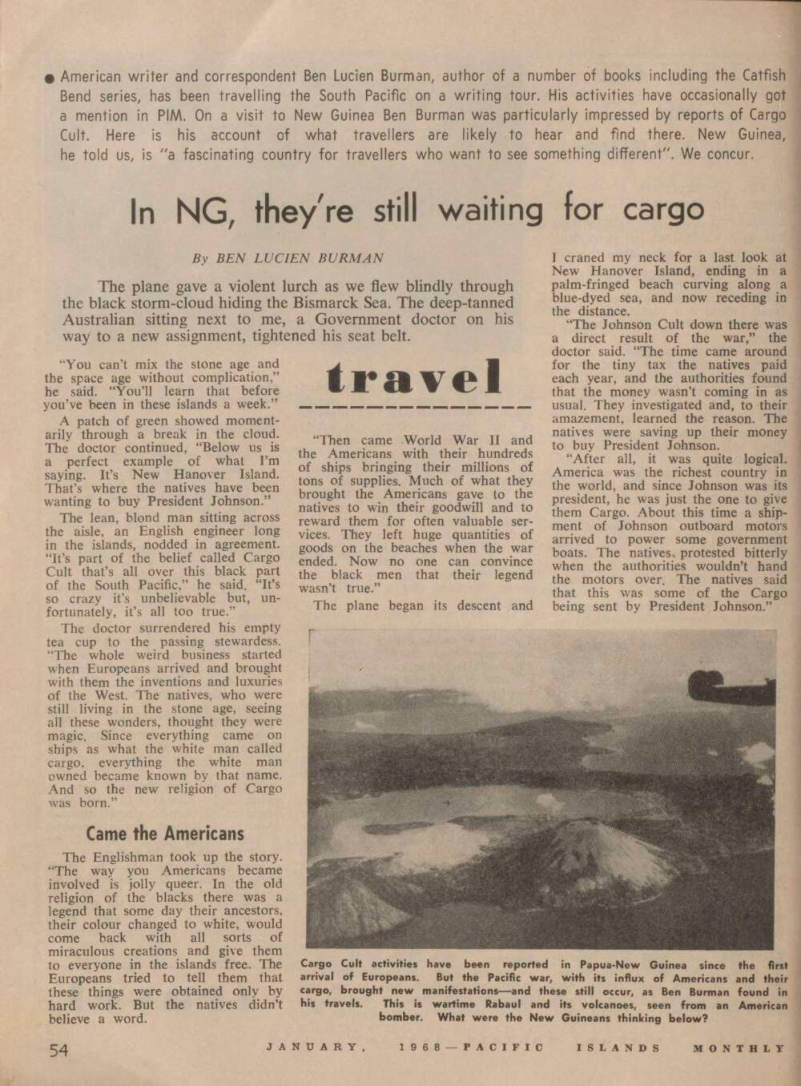
Cargo Cult activities have been reported in Papua-New Guinea since the first arrival of Europeans. But the Pacific war, with its influx of Americans and their cargo, brought new manifestations —and these still occur, as Ben Burman found in his travels. This is wartime Rabaul and its volcanoes, seen from an American bomber. What were the New Guineans thinking below?
“There was an incident like that motors business before the war,” the engineer said. “A native leader named Batari started a cargo cult in the islands that won thousands of followers. About this time a big shipment of cases arrived marked ‘Batteries’. Batari was furious when the whites wouldn’t give him the boxes. Anybody could see that they were his property, sent him by the gods of his ancestors across the sea.”
Towards Rabaul
The No-Smoking sign appeared on the panel at the end of the cabin.
The plane began to descend sharply.
A few minutes later we landed at the airport of Kavieng, on the green shores of New Ireland.
New passengers came aboard: hard-bitten traders fresh from some leaky smallship plying the coast, missionaries on leave with their families, weather-beaten planters on their way home to look after their harvests of cocoa or copra. Soon we took off again. The water below us became an iridescent rainbow studded with green-tinted jewels, the famous atolls of the South Pacific.
A great volcano came in sight, smoking faintly. Near it spread the buildings of a large town, gleaming in the bright sun. It was Rabaul on the island of New Britain, not far from Bougainville, and several hours by plane from Guadalcanal of the Solomon Islands, known to thousands of Americans as the scene of bloody fighting in World War 11. We landed quickly.
A planter I had met on the plane drove me through the streets, alive now with fuzzy-haired black men wearing bright lava-lavas. With us was a specialist from the local agri cultural college who pointed out the superb hospital and schools built by the Australians in a herculean at tempt to bring self-government to the primitive inhabitants.
“Cargo is the old have-not philosophy, and these schools and the chaps who graduate from them and start their own plantations and busi nesses are the best cure,” said the agriculturist.
“But the others are a terrible problem. The leader of a recent Cargo Cult spread news that a big American submarine was coming, bringing the natives all they could wish for, and it would all be free.
Nightly a crowd of natives followed him as he went to the beach carry ing a soap box painted like a radio, from which he sent out signals to guide the submarine to shore.
“When the submarine didn’t show
up the natives said the white people had misdirected it to keep it away.
And not long ago villagers near here destroyed all their crops and all their pigs and burned down their houses.
They believed that if they showed their faith in Cargo this way the gods would send them something a hundred times better.”
Egg story
The planter nodded. “The Cargo Cult breaks out here as regularly as an Australian has his five o’clock beer. Only yesterday I heard the latest Carg': story which is spreading like a bush fire; according to this story, sometime this week hundreds of American airplanes will drop giant eggs into the house of every black man in Rabaul.
“Each egg will break open and out will walk a squad of American soldiers, loaded down with canned meat, and washing machines, and Mercedes automobiles.”
That night we dined with a group of the black leaders of the island, solemn, serious men, some speaking excellent English, some only pidgin, that curious language widespread in the South Pacific. The diner next to me, a statuesque black figure with hair that seemed to rise a full foot above his head, spoke regretfully.
“Cargo is one of the sad illusions of my people,” he said in flawless
travel
accents. “Over on Manus Island, they put all their money in paper rolls and then planted these in the ground.
They thought the rolls would grow money, just like a sweet potato plant grows potatoes.”
We started back to Rabaul. The agriculturist looked out across the starlit sky towards the distant Solomons. “I served there during the war,” he said. “One day our photo graphic planes began to pick up something odd in their pictures of a certain place. As the days passed the mysterious dots increased.
“We thought they might be some new type of Japanese secret weapon.
And then the Allies took the island and we found out. The Bougainville natives had been building little ware houses for the cargo they believed they’d get soon.”
Port Moresby
The man beside him nodded. “Not far from here we tried for weeks to persuade the people to build a school house. But they always answered that they were too busy. They were putting up a big warehouse to receive cargo.”
Next day we flew to Port Moresby,
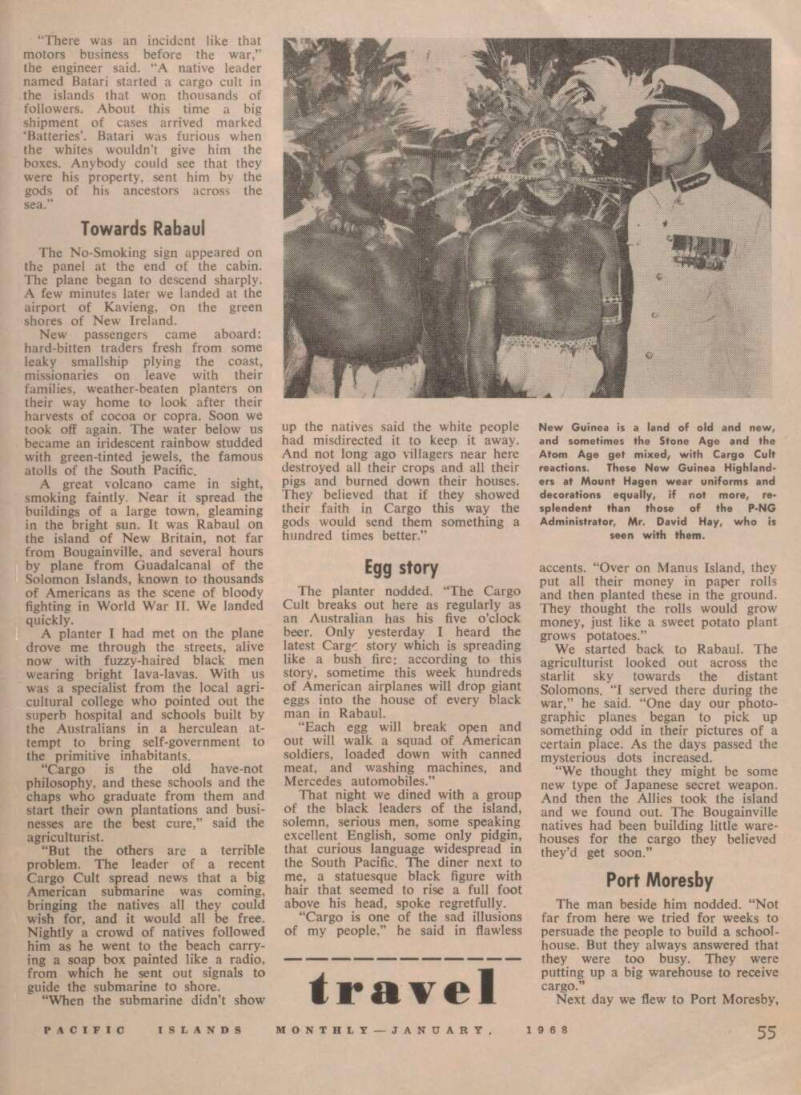
New Guinea is a land of old and new, and sometimes the Stone Age and the Atom Age get mixed, with Cargo Cult reactions. These New Guinea Highland ers at Mount Hagen wear uniforms and decorations equally, if not more, re splendent than those of the P-NG Administrator, Mr. David Hay, who is seen with them.
Contradictions of ancient and modern
capital of the Territory of Papua- New Guinea, that huge island which is one of the world’s last frontiers.
Everywhere strange-looking tribes men whose skins varied from glisten ing black to delicate brown sauntered idly, some with bizarre tattooing on their chests. On every hand were strange mixtures of the old and the new.
In the ultra-modern parliament house built by Australia to help the island become a democracy, I heard of a candidate, just defeated, whose sole campaign promise had been that for every man, woman and child in New Guinea he would make the miracles of Cargo a reality.
I set off towards the border of the former Dutch New Guinea, now controlled by Indonesia and arriving at Wewak, which is in Australian New Guinea, changed to a tiny plane carrying only the pilot and Colin, a government official on a tour of inspection.
“It must be difficult for someone from the outside to understand Cargo,” he said. “Those of us who live here have come to accept it— if not expect it.”
We flew over a wide valley, criss crossed by a muddy river, then came down on an airstrip beside a minute native settlement. The district officer was a young man of perhaps 24, who, with a few native policemen, was the sole representative of the law for 1,000 black men, many of them perhaps still cannibals.
Cargo "freezers"
“The Cargo Cult here took a queer form,” he said as he served us tea.
“Some of the men had been to Wewak and seen electric refrigerators. So they made what they thought looked like refrigerators out of scraps of timber we had brought here by plane and connected them up with vines for electric wires. Then they sat down in front of their handiwork and prayed to their ancestors and waited.
“They were sure that if they prayed hard enough, the wood would turn into metal, the motors would appear in the top, and all they had to do would be to open the doors and take out all the ice cream and cold drinks they wanted, just the way they had seen the white men do in Wewak.”
We took off at dawn in a tiny plane across forbidding peaks and dense jungle of the Western High lands, a vast area whose very
existence was unknown to Europeans until 30 years ago.
“The Cargo Cult has never developed here as it did on the coast,”
Colin remarked, “probably because the black men haven’t known the whites long enough. But you find it now and then.
“We’re about 150 miles as the crow flies from the nearest salt water, with enormous 13,000 foot mountains in between. Yet I once saw a big dock here that the natives had built for the ocean liners that were going to steam up with cargo. In another place I saw their version of an air field, full of thousands of tree stumps, and near it a road two or three miles long, but leading no where.
“They didn’t know whether the cargo was coming by truck or by air, so they wanted to be ready either way.”
Curious weapon
We landed at a cluster of native huts so remote that on the other side of the low mountain no white man had ever set foot. As we climbed down from the plane, fantastically-painted figures stood watching, some carrying stone axes, some a curious weapon made of a single huge cassowary claw set in a hardwood handle, designed to tear out an enemy’s vitals. Now and then, one native more curious than the rest would come up to feel my clothes and to touch my skin.
A serious young District Officer told me, “The Cargo we had here was the Bank Cult. All through the jungle the natives make little build ings of bamboo in the shape of banks they had seen when they went down to the coast, complete even to tellers’ windows. The natives believed they had only to wait for money to come out.”
A glorious sunrise next morning found us on the way to Mt. Hagen, administrative centre of the High lands. Here the contrasts and con tradictions of the ancient and modern ways of life that had been notice able elsewhere reached an absurd climax. Outside the store selling the latest American-style comic books and soft drinks lounged fierce-look ing savages, their nostrils distended
travel
by boars’ tusks, their faces painted in terrifying masks.
I learned that the mountain dwel lers, because of the deep gorges which often separate their villages, com municate with each other by yodel ling, much in the fashion of the inhabitants of the Swiss Alps. As a result, among those near a town, Swiss yodelling records are enor mously popular.
Outside the small but modern hotel at Mt. Hagen a tall, naked figure bedecked with mother of pearl and brilliant bird-of-paradise headdress waited near the doorway. As I ap proached he held out a piece of paper. “You-fellow master givem me-fellow plenty money,” he said.
I looked at the paper, probably fished out of somebody’s wastebasket, the sort of paper on which he had seen the white man make a few magical marks at a bank and be given in return great mounds of dollars. It was a blank cheque on the Commonwealth Bank of Aus tralia. It was South Seas cargo!
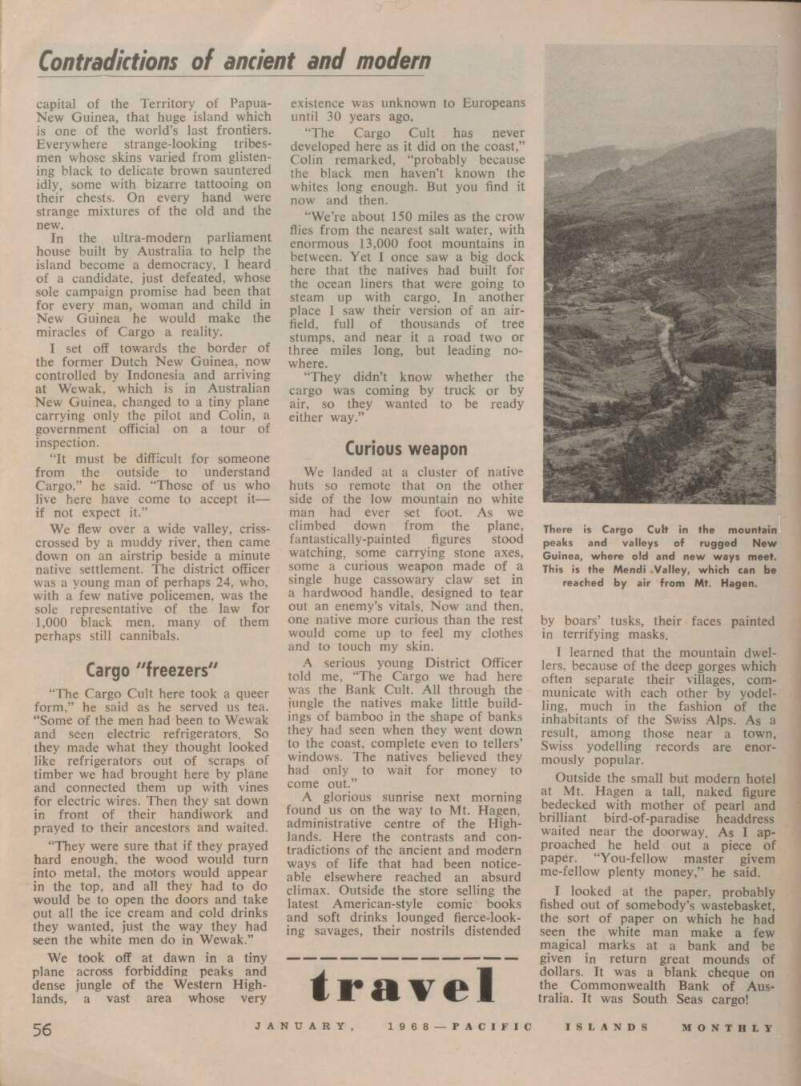
There is Cargo Cult in the mountain peaks and valleys of rugged New Guinea, where old and new ways meet.
This is the Mendi .Valley, which can be reached by air from Mt. Hagen.