T ropicalities
pp. 30-32 · Read in the full issue
The tragic disappearance of Australian Prime Minister Harold Holt while swimming near Melbourne on December 17 brought the South Pacific islands closer to Australia in one week than they had been in years. Messages of con dolence poured in from Islands leaders, some of whom made immediate moves to attend the memorial service in Melbourne, despite the short notice and the approach of Christmas.
IT was announced early that West ern Samoa would be represented by Prime Minister Fiame Mataafa; Tonga by Deputy Premier and Finance Minister Mahe Tupouniua; Fiji by Chief Minister Ratu K. K. T.
Mara; P-NG by Administrator, David Hay; and Nauru by Head Chief Hammer Deßoburt.
Mataafa and Mahe were unable to get there on time, Mr. Hay and Ratu Mara made it, and Head Chief Deßoburt, although he was in Mel bourne on the day of the service, couldn’t get to the cathedral be cause of the traffic congestion. He instructed his Commonwealth car to turn around when it was obvious he would be late.
Ratu Mara had been planning to holiday in his home islands of Lau when he decided to go to Melbourne.
His aircraft was delayed at Nadi, so he transferred to another airline, arriving too late in Sydney to catch a special VIP flight to Melbourne.
But he was given official red carpet treatment and with Mr. R. M. Major, Fiji’s representative in Australia, he boarded a last-minute domestic flight in time to be at the service. Later he was able to present to the Australian Governor-General, Lord Casey, in Melbourne’s Government House, a tahua, or whale’s tooth, as a solemn act of respect from Fiji.
Normally prohibited
It is customary within Fiji to make such a presentation, as a declara tion of highest respect, on occasions of great moment, such as births and deaths, but it is most unusual for such an act to be performed by a Fijian outside of Fiji. Export of tahua is normally prohibited.
The particular ceremony performed by Ratu Mara, in private audience with Lord Casey, is known as ai reguregu. This is a duplication of the verb regu, “to kiss”, and it takes
Islands Leaders
Pay Homage
To Mr. Holt
its name from the fact that after presentation he who has presented the tabua is permitted to touch noses with the deceased.
The Melbourne service was a high ranking affair. Prince Charles flew from London to represent the Queen.
World leaders, including British Prime Minister Harold Wilson and President Johnson, attended the service (no body had been found so there could be no funeral).
The President, who was a personal friend of Mr. Holt, had made a special flight from Washington via Pago Pago, thus making his second visit to American Samoa within 14 months. He became the first President to visit American Samoa when he made his first visit there in October, 1966.
The December visit was hurried— the presidential jet touched down at Tafuna at 10 minutes to midnight and remained an hour—but the President received a colourful Poly nesian welcome from about 3,500 people—about one fifth of the entire population of the main island of Tutuila.
A White House security team had arrived on the island a few hours beforehand. About 30 minutes before the arrival of Air Force One, con taining the President, a chartered aircraft with more than 70 newsmen arrived from the States. Soon after, the presidential “back-up” aircraft landed (it goes along in case any thing happens to Air Force One).
Meanwhile, three Hercules C-130 Search and Rescue aircraft were in
operation along the President’s flight path.
A 300 ft long tapa stretched from Air Force One to a hastily built podium in the terminal, which was gaily decorated with flowers. Power ful floodlights were installed for news photographers and special teletype machines were installed in the ter minal for visiting newsmen.
Governor Owen Aspinall and Mrs.
Aspinall (a Samoan) headed a receiving line made up of ranking chiefs. Two small Samoan girls placed ulas around the President’s neck and both girls kissed him on
the cheek. The President chatted briefly with those in the receiving line, and later watched with enjoy ment the programme of Samoan siva dances.
In his address of welcome to the President, Governor Aspinall said American Samoa respected the solemnity of the occasion of his visit.
“The people of Australia are close to our hearts here in American Samoa,” he said. “Next to the people of California, there are more people that visit us from Australia than from any other place in the world.
We are most pleased that our own President should take time from his busy schedule to help bolster our friends in Australia in this, their hour of grief.”
Governor Aspinall also took the opportunity to tell the President that the people of American Samoa were solidly behind him in his stand on Vietnam. He said that on a per capita basis, there were more Samoans fighting in Vietnam, “and being wounded and dying for freedom, than any other race that claims the dignity of calling themselves Ameri cans”.
“We are all volunteers,” he said.
“There is not a draft card burner among us. Where some Americans might express their independence by ‘love-ins’, you will find American Samoans, Mr. President, beside you in fight-ins.”
On his way back to Air Force One, hundreds of Samoan hands were thrust at the President over restrain ing ropes. President Johnson grasped as many as he could before setting off on his pilgrimage to Melbourne.
Jack Woodmansey
leaves Nauru
THE Director of Police in Nauru, Mr. Jack Woodmansey, has returned to the Commonwealth Police Force, from which he has been on loan to Nauru for 18 months. At the November meeting of the Nauru Legislative Council he was farewelled with appreciative speeches from both sides of the House. Councillor A. Bernicke, on behalf of the Nauruans, said, “We would like to have him stay longer”.
With three teenage children at school in Australia, Jack and his wife Noreen find the pull of keeping a family together a strong one. He returns to Canberra as Inspector Ist Class, the rank he formerly occupied as second-in-charge of the N.S.W. section of the Commonwealth Police.
Jack Woodmansey was well-known in the Royal Papua-New Guinea Constabulary, where he spent nine years prior to 1957. His 6 ft 5 in. make him a landmark in any com munity.
The most important development affecting Jack Woodmansey’s depart ment during his term on Nauru was the lifting of the prohibition on liquor for Nauurans. The changeover was smoother than he expected.
It resulted in an abrupt cessation of crimes of housebreaking and stealing, for these were mostly con nected with the search for drink. But offences resulting from excessive drinking are now higher than before.
The police chief believes there will be improvement if there is a firm policy towards persistent offenders and general education towards moderate drinking habits.
Inspector Albert Harris, a Nauruan, has been in charge between police chiefs. The new man is Mr. David Mathers (see p. 121).
Famous novelist
surveys Noumea
OUR man in Noumea, Fred Dunn, meets his share of VlP’s, but the recent visit to Noumea of Erie Stanley Gardner really sent him for a loop. Fred has been a Gardner fan since the US invasion of New Caledonia in World War 11, when the Yanks brought with them bombs.
Coca Cola and that famous Gardner creation, Perry Mason.
Fred was one of the first aboard the Mariposa to give Gardner a special warm handshake, and to have a chat about his books, which sell well in New Caledonia both in
French and English. Gardner was taking a Pacific cruise on a working holiday.
Gardner told Fred: In the US and Canada 20,000 Gardner books are sold every day. They also sell in 40 other countries. He wrote his first book in 1921; the first Perry Mason appeared in 1932; 78 of his 136 books have been Perry Masons; he has written half-a-dozen travel books, mostly about Mexico, with which country he is enchanted.
Gardner also told Fred that he had always been interested in the better administration of justice (for 25 years he was a lawyer), and that he had been one of the organisers of the Court of Last Resort, which handled cases of suspected mis carriage of justice. The organisation was now defunct, although it had dealt with many cases.
The author’s hobby is exploration.
His delight is to set off for the wilds of Mexico with a few friends.
They travel by helicopter to some inaccessible spot, taking supplies and light transport. There the plane leaves them and they fan out explor ing. When they have had enough, they call in the helicopter, which whisks them back to civilisation.
Nice work ... if you can pay for it.
Cocking a wise eye at the stark mountains around Noumea, Gardner ventured that “there must be many spots in New Caledonia where man has never set foot” (he is right at that, as the New Caledonian is not over fond of footing).
As Fred left Gardner, the officer on the Mariposa’s gangway com mented: “Did you know when Einstein died they found a Perry Mason story on his desk?” Fred didn’t, but he could believe it.
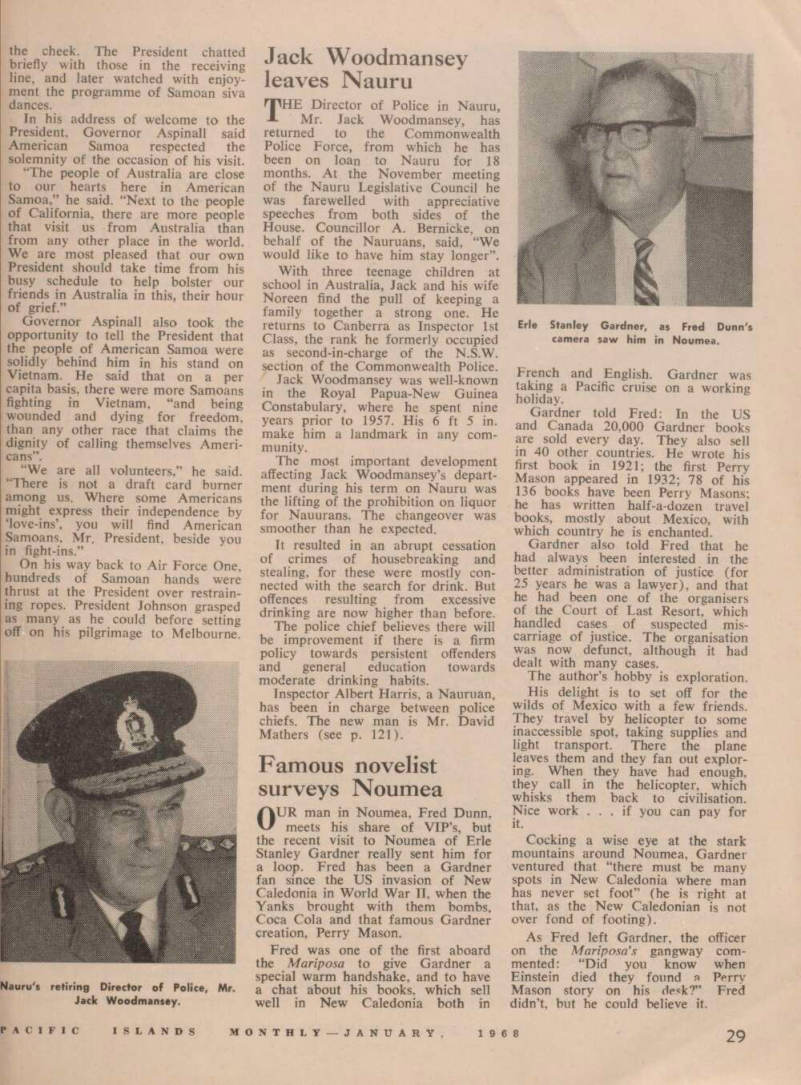
Nauru's retiring Director of Police, Mr.
Jack Woodmansey.
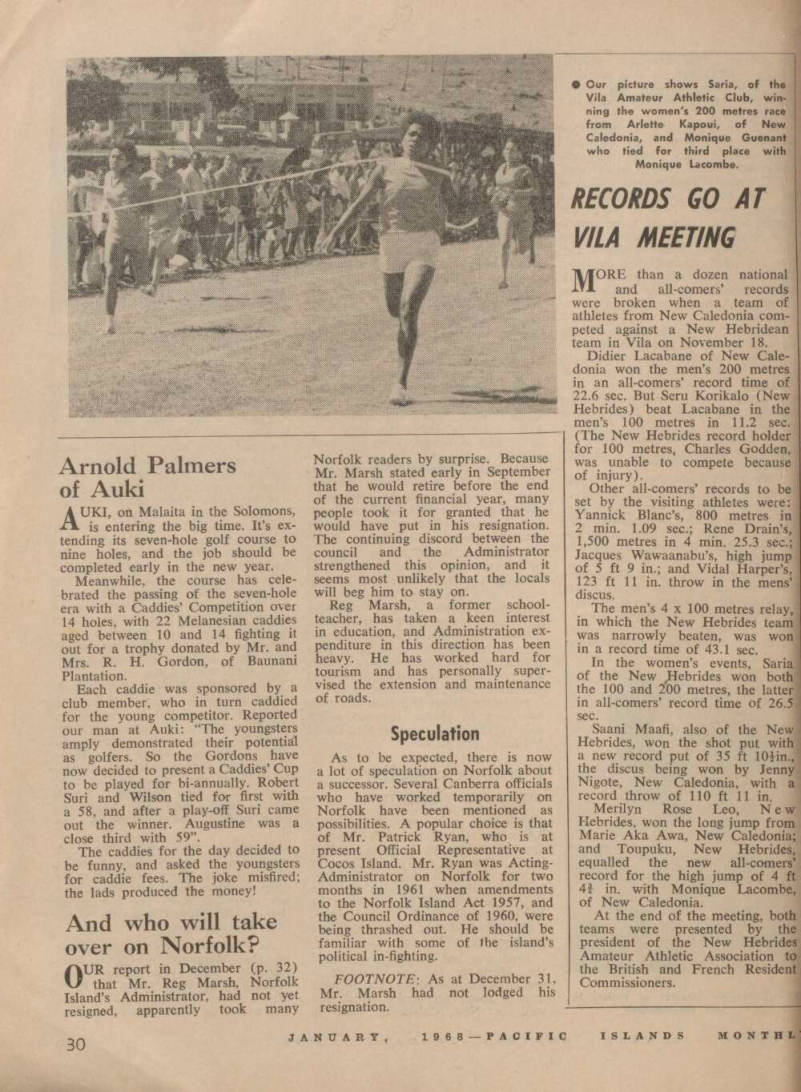
Erie Stanley Gardner, as Fred Dunn's camera saw him in Noumea.
Arnold Palmers
of Auki
AUKI, on Malaita in the Solomons, is entering the big time. It’s ex tending its seven-hole golf course to nine holes, and the job should be completed early in the new year.
Meanwhile, the course has cele brated the passing of the seven-hole era with a Caddies’ Competition over 14 holes, with 22 Melanesian caddies aged between 10 and 14 fighting it out for a trophy donated by Mr. and Mrs. R. H. Gordon, of Baunani Plantation.
Each caddie was sponsored by a club member, who in turn caddied for the young competitor. Reported our man at Auki; “The youngsters amply demonstrated their potential as golfers. So the Gordons have now decided to present a Caddies’ Cup to be played for bi-annually. Robert Suri and Wilson tied for first with a 58, and after a play-off Suri came out the winner. Augustine was a close third with 59”.
The caddies for the day decided to be funny, and asked the youngsters for caddie fees. The joke misfired; the lads produced the money!
And who will take
over on Norfolk?
OUR report in December (p. 32) that Mr. Reg Marsh, Norfolk Island’s Administrator, had not yet resigned, apparently took many
Norfolk readers by surprise. Because Mr. Marsh stated early in September that he would retire before the end of the current financial year, many people took it for granted that he would have put in his resignation.
The continuing discord between the council and the Administrator strengthened this opinion, and it seems most unlikely that the locals will beg him to stay on.
Reg Marsh, a former school teacher, has taken a keen interest in education, and Administration ex penditure in this direction has been heavy. He has worked hard for tourism and has personally super vised the extension and maintenance of roads.
Speculation
As to be expected, there is now a lot of speculation on Norfolk about a successor. Several Canberra officials who have worked temporarily on Norfolk have been mentioned as possibilities. A popular choice is that of Mr. Patrick Ryan, who is at present Official Representative at Cocos Island. Mr. Ryan was Acting- Administrator on Norfolk for two months in 1961 when amendments to the Norfolk Island Act 1957, and the Council Ordinance of 1960, were being thrashed out. He should be familiar with some of the island’s political in-fighting.
FOOTNOTE : As at December 31, Mr. Marsh had not lodged his resignation.
• Our picture shows Saria, of the Vila Amateur Athletic Club, win ning the women's 200 metres race from Arlette Kapoui, of New Caledonia, and Monique Guenant who tied for third place with Monique Lacombe.