P-NG’s new Assembly
p. 27 · Read in the full issue
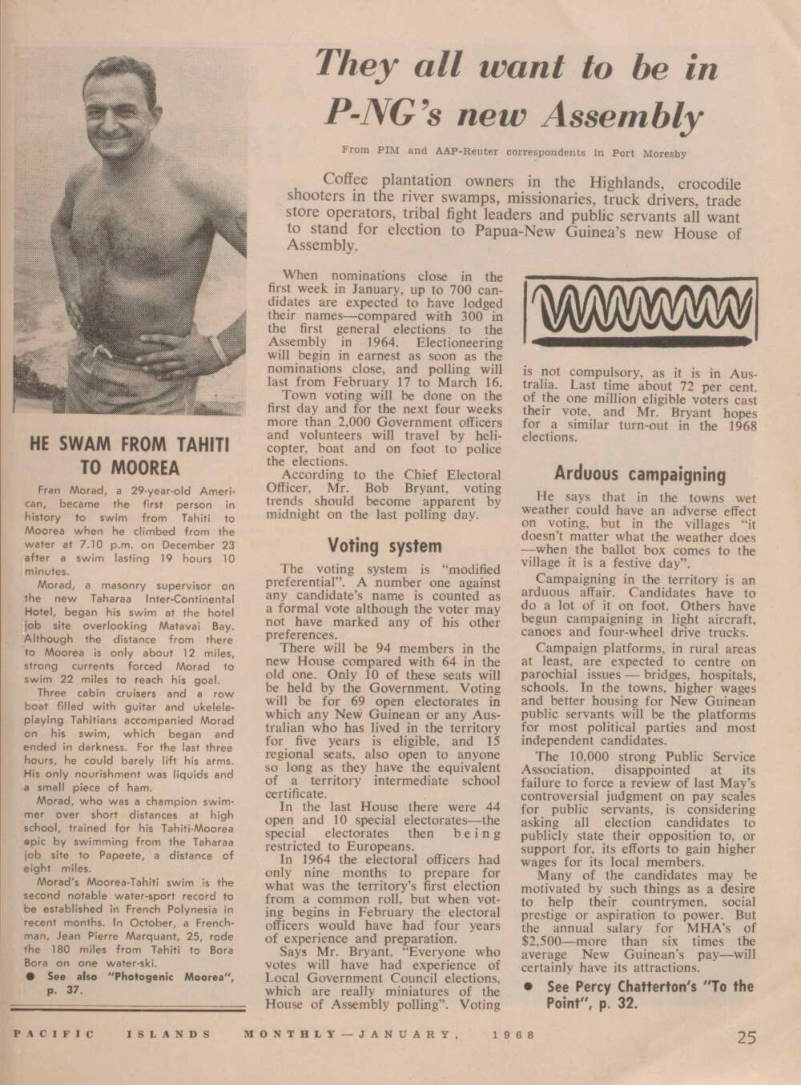
They all want to be in P-NG’s new Assembly
From PIM and AAP-Reuter correspondents in Port Moresby Coffee plantation owners in the Highlands, crocodile shooters in the river swamps, missionaries, truck drivers, trade store operators, tribal fight leaders and public servants all want to stand for election to Papua-New Guinea’s new House of Assembly.
When nominations close in the first week in January, up to 700 can didates are expected to have lodged their names—compared with 300 in the first general elections to the Assembly in 1964. Electioneering will begin in earnest as soon as the nominations close, and polling will last from February 17 to March 16.
Town voting will be done on the first day and for the next four weeks more than 2,000 Government officers and volunteers will travel by heli copter, boat and on foot to police the elections.
According to the Chief Electoral Officer, Mr. Bob Bryant, voting trends should become apparent by midnight on the last polling day.
Voting system
The voting system is “modified preferential”. A number one against any candidate’s name is counted as a formal vote although the voter may not have marked any of his other preferences.
There will be 94 members in the new House compared with 64 in the old one. Only 10 of these seats will be held by the Government. Voting will be for 69 open electorates in which any New Guinean or any Aus tralian who has lived in the territory for five years is eligible, and 15 regional seats, also open to anyone so long as they have the equivalent of a territory intermediate school certificate.
In the last House there were 44 open and 10 special electorates—the special electorates then being restricted to Europeans.
In 1964 the electoral officers had only nine months to prepare for what was the territory’s first election from a common roll, but when vot ing begins in February the electoral officers would have had four years of experience and preparation.
Says Mr. Bryant, “Everyone who votes will have had experience of Local Government Council elections, which are really miniatures of the House of Assembly polling”. Voting
is not compulsory, as it is in Aus tralia. Last time about 72 per cent, of the one million eligible voters cast their vote, and Mr. Bryant hopes for a similar turn-out in the 1968 elections.
Arduous campaigning
He says that in the towns wet weather could have an adverse effect on voting, but in the villages “it doesn’t matter what the weather does —when the ballot box comes to the village it is a festive day”.
Campaigning in the territory is an arduous affair. Candidates have to do a lot of it on foot. Others have begun campaigning in light aircraft, canoes and four-wheel drive trucks.
Campaign platforms, in rural areas at least, are expected to centre on parochial issues bridges, hospitals, schools. In the towns, higher wages and better housing for New Guinean public servants will be the platforms for most political parties and most independent candidates.
The 10,000 strong Public Service Association. disappointed at its failure to force a review of last May’s controversial judgment on pay scales for public servants, is considering asking all election candidates to publicly state their opposition to, or support for, its efforts to gain higher wages for its local members.
Many of the candidates may be motivated by such things as a desire to help their countrymen, social prestige or aspiration to power. But the annual salary for MHA’s of $2,500 —more than six times the average New Guinean’s pay—will certainly have its attractions. • See Percy Chatterton's "To the Point", p. 32.