Cheap foreign labour' charge
p. 39 · Read in the full issue
sparks shipping fight
By a staff writer
Crew members protesting against alleged plans of Bums Philp and Co. Ltd. to use foreign labour on three of its ships delayed the departures of the MV Moresby and the Bulolo from Sydney in November.
The crew members, representing out 300 Australian seamen em- Dyed by BP’s on its ships, alleged it BP’s planned to register three its ships—the Bulolo, Malekula d Moresby in non-Australian rts and use cheap foreign labour ;tead of Australian crews in them.
The MV Moresby, due to sail at .30 p.m. on November 6, was layed until shortly before midnight lile the Moresby’s crewmen demon ated for an hour, holding a protest nner “We Demand Aussie Union ews for Aussie Ships” over the e of the ship.
They carried a resolution which d: “The combined maritime unions the MV Moresby condemn the ilt Government and Burns Philp their attitude towards the displace nt of Australian crews from the ?resby, Malekula and Bulolo”.
Moresby then sailed for Port jresby, Milne Bay, Madang, haul and other NG ports.
October announcement
3n November 15 the Bulolo sailed NG after exactly a day’s delay, oard were about 40 passengers, 1 a full cargo for NG ports.
Sulolo’s crew members, who nted to extend the strike, were suaded by maritime union icials that their actions would barrass later Federal union talks h senior BP executives, fhe trouble emanates from the tober announcement from the Aus lian Government that BP's will lose $400,000 annual subsidy which y are receiving from the Govern nt to compensate them for the erence between Australian wages I overtime costs and those paid to sign crews on competitors’ vessels the trade {PIM, Nov., p. 24). fhe Government also withdrew the cial privileges granted to BP for carriage of copra from New inea to Australia and the Govern nt-controlled stores from Aus ia to New Guinea. spokesman for the seamen em yed on BP ships, Mr. J. R.
Cleworth, told PIM that because BP’s had not protested at losing the subsidy, there was a possibility of collusion between the company and the government.
“We have no actual evidence that Burns Philp is trying to re-register its ships or employ overseas seamen, probably Papuan,” he said. “But we are reasonably certain this is what they are planning to do.”
Mr. Cleworth said his solution to the problem was that the subsidy be resumed to Burns Philp and orders be placed for ships capable of carry ing NG cargo to be built for the Australian National Line.
The ANL would run to Japan within two years and by this time the new ships could be built and put working the BP NG run—with Aus tralian seamen.
BP’s should continue running its NG services—with the subsidy back —until the ANL ships were ready to take over.
Even without the subsidy, BP’s could afford to continue their runs because of their “huge financial re serves” and in the light of last year’s profit in excess of $5 million, Mr.
Cleworth added.
"Government to blame"
Meanwhile, BP's attitude to the protests aboard their ships is that the Australian Government, by waiv ing the subsidy, is more to blame for the uncertainty over the seamen’s jobs.
To claims that the company and the government have “got together” over the dropping of the subsidy, the company says that it made applica tion for the subsidy to be renewed for three years in November, 1966.
If the subsidy had been forthcoming, there would have been no need to drastically review the position, BP’s say.
They claim that to substitute for an income of $400,000, it would need an extra turnover of about $2 million in trading—a pretty tall order.
A Singapore offer to buy the
Bulolo, reported last month, fell through. However, the ship was still for sale and BP’s were anxious to sell her before her vital registration ticket runs out in June, 1968. Her crew have been told of this.
Presumably the company would not risk a general outcry and strong Federal union opposition from Aus tralia by trying to put New Guinean seamen on her now.
"Bulolo" sold?
On December 1, there were new negotiations to sell the vessel over seas, which look like coming off, although they had not been com pleted on that date.
A seamen’s union spokesman told PIM that Mr. A, E. Monk, president of the Australian Council of Trade Unions, had said that he had been informed by BP that the company had been asked by the Australian and New Guinea governments to “explore the possibilities” of trans ferring one or two of BP’s ships to the Port Moresby register. Papuan labour could be employed on these ships, the Government had said.
And the fact is BP’s have not— as yet—made any moves to register their ships overseas and recruit cheaper labour.
One is entitled to assume they will, for they have pointed out that their ships are running at a big dis advantage in competition on NG runs to the Karlander New Guinea Line and the China Navigation Company, which both employ Papuans at cheap rates of pay on some of their ships.
While the ANL, which is, in fact the Australian Government, has not made any overtures to get a hand in the NG shipping business, it is likelv ANL would want a good cut of preferences and agencies in the terri tory to make a run economical.
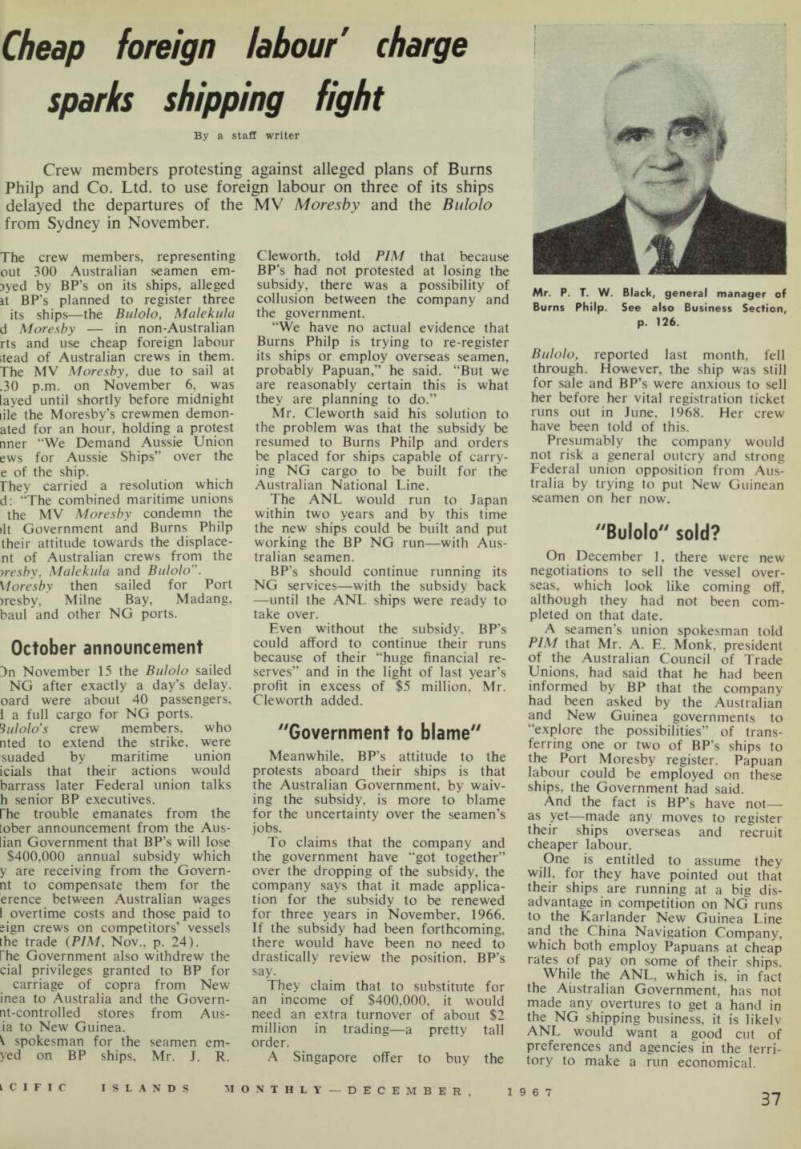
Mr. P. T. W. Black, general manager of Burns Philp. See also Business Section, p. 126.