But some of the young are restless
p. 38 · Read in the full issue
young are restless
flourishes. But life memberships, loans and gifts from the more in fluential members of the Chinese populace soon reached the stage where three residential blocks could be leased from the Barker Estate; all too soon these were outgrown and after intensive efforts the excellent premises which all Suva today recognises on the front near Suva Point, were officially opened in May, 1962.
There, the young people from Chinese families, together with their friends of all other races in Fiji, play basketball, soccer, tennis. . . . An invitation to a party at the China Club is always welcome for the festivities are of a high order, the food is delicious and the atmosphere hospitable. Currently, and sig nificantly, there are plans afoot for yet further expansion.
What of the future?
But, at this point, a slight element of doubt enters the story.
During close on 70 years the Chinese community in Fiji has lived quietly among its neighbours, has worked hard, and has prospered.
Now, some of the livelier spirits among the younger genera tion are restless. Opportunity on the islands seems to them limited and they are already beginning to look to distant horizons.
The Chinese, perhaps almost more than any other race, understand the value of hard work, and now that their diligence has won for them a measure of prosperity, a respected place, and a list of notable personali ties who have contributed much to Fiji’s development, it would be a tragedy if the present generation, highly intelligent, law-abiding, pro gressive and well-educated as they are . . . and supremely endowed with the priceless gift for co-existence in a multi-racial society . . . should take their talents elsewhere. Fiji needs her Chinese citizens as never before.
One cannot help but ask, if these young people leave who for example will fill such respected places in society as let us say, Mr. Cheng him self . . . consul for 20 years, a IP, a leading amateur photographer and a man whose knowledge and courtesy, and gentle good humour, combine to make him a valued citizen by any standard?
Who could succeed that popular
founder of the flourishing business concern Honson Limited, for instance, and Rotary member, Gordon Honson, who, among a myriad other activities, plays a leading part in organising Fiji’s “Miss Hibiscus Festival”?
Who could take up where Mr. Yee of Legco might leave off? Or Ming Ting, veteran member of Suva City Council and still going strong?
Where might one look for a woman to carry on the work begun by Dr. Annie Low, Fiji’s first Chinese woman doctor and a notable specialist in children’s illnesses? Or who would become a second Lavinia Ah Koy, currently the Government’s official Hansard reporter, a position involving tremendous concentration and skill?
Where might Fiji look for a second Fong Lee, who out of the wealth he amassed after his arduous early start,
donated a fighter plane to the Chinese Government as well as supporting generously Fiji’s own war effort? It is worth noting, incidentally, that a number of Chinese voluntarily joined the Allied cause during the 1939-45 war.
If the abler, more ambitious and more capable of the younger Chinese living in Fiji should leave the islands in any numbers, who will carry on the work of the Honson family, for instance, who are at present engaged in the construction of what is to be Suva’s tallest building?
“It is to be an office block,” Mr, Cheng told me, with quiet pride, “and we are putting into its tower, a large clock . . . big enough to be seen easily by passengers arriving in the tourist ships at the dock.”
I thought of that famous Honolulu dockside clock which symbolises Hawaii to millions of travellers . , . a shrewd move to ensure that Suva has just such a memorable landmark. • • and then, too”, my informant was continuing, “we’d like to have a roof-garden, where visitors could sit and have a drink and look at the ‘swinging Suva of the eighties’.”
Such vision and enterprise need younger shoulders to drop their mantles upon.
Meanwhile, it is good that banks in Suva today ask specifically for Chinese girls with their diligence and flair for detail and accuracy to join their staffs; it is remarkable to find a community, anywhere in this globe, with no crime and virtually no juvenile delinquency . . . and it is good to know that, after a certain amount of quiet ostracism through the years ... oh yes, there were clubs the Chinese couldn’t join, there were societies where they were not welcome ... an increasingly impor tant part is being played by Chinese in the life and organisation of Fiji.
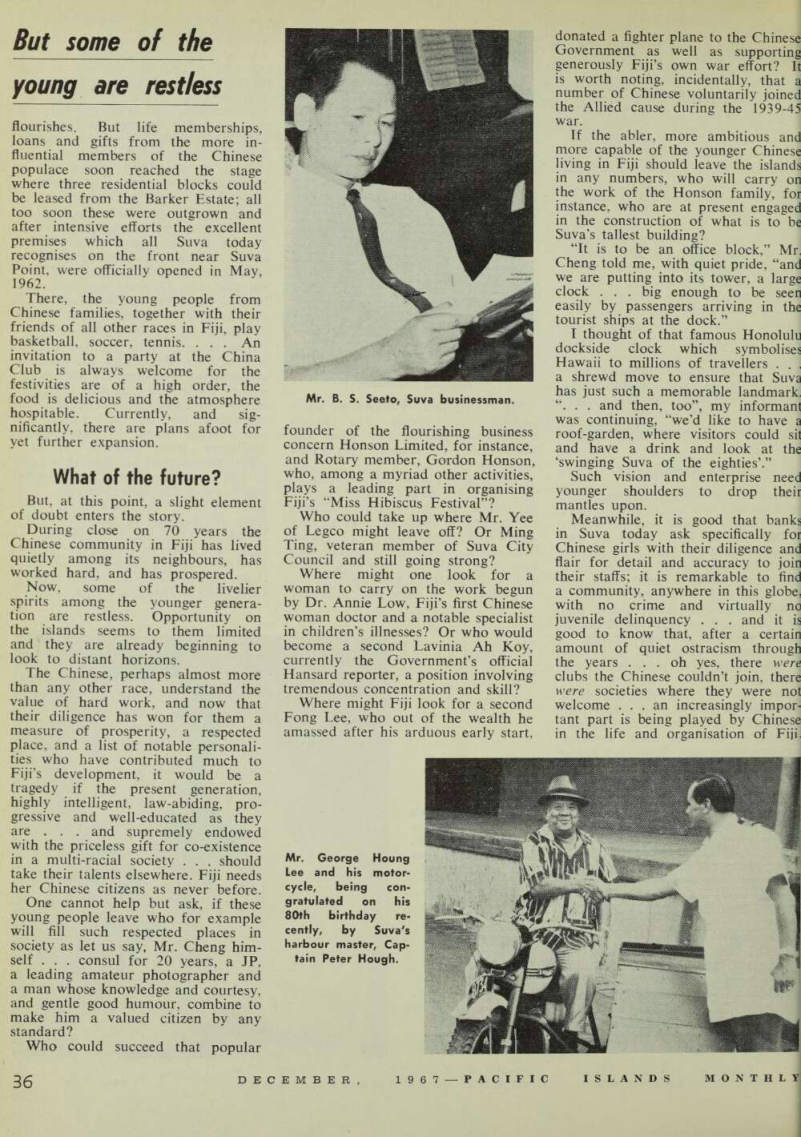
Mr, B, S. Seeto, Suva businessman.
Mr. George Houng Lee and his motor cycle, being con gratulated on his 80th birthday re cently, by Suva's harbour master. Cap tain Peter Hough.