ithout incident
p. 37 · Read in the full issue
ssimilated ithout incident
mity was in 1920, when an attempt introduce indentured coolies was terly resented by the established linese residents.
Fhe newcomers worked diligently, obtrusively, at any job they could d, initially, but as soon as they ?an to save a little money, they ickly bought stores and businesses small-holdings. They lived humbly i by their dignity and wisdom, )ped into the life of their new ind Pacific home without incident.
Phey followed their own customs 1 were allowed to practise their igion, whether Confucianism or ddhism, without hindrance. It was, haps, an entirely inward-looking ', concentrated intensely upon nily and ancient tradition.
Nowadays, it seems, things are mging.
More prominent
"rom about 15 or 20 years ago, mbers of the Chinese people have ;un to play a more prominent part the life of Fiji. Some of the mger people have become ristians and small businessmen 'e begun to grow into prosperous 1 important merchants. Chinese Idren are naturally quick and dligent and as soon as they re zed educational opportunities, it s noticeable how fitted they were hold responsible positions in the nmunity. socially, too, the Chinese have ;un to mingle far more freely with other races who live in Fiji and vadays, although they are not nmon, marriages between Chinese 1 other races, notably Indians, are longer a rarity. sdr. Cheng gave me a wise, some at quizzical look, as he told me t although Chinese had always n spoken in the home until re tly, nowadays, with the emergence the younger members of his people > a more prominent part in the nd’s life, so there has been a :kening of the use of their mother gue.
Magazines and books in Chinese come into the colony from Hong ng, and the American Consulate 'cry helpful in distributing Chinese rature as well as American books islated into Chinese, a scheme iated in 1962 by the then Ameri i Vice-Consul and his wife, Mr. 1 Mrs. Petersen.
Mr. Cheng said, “I remember when nothing but Chinese was spoken except when dealing with those who did not know the tongue. This is now vanishing.
“Chinese is, of course, taught in the Chinese school at Flagstaff, but many of the younger Chinese are coming to think of their mother tongue as something of a ‘dead’ language ... in just the way that your boys think of Latin”, he added with a characteristic chuckle.
“However,” he went on, “as a race
we have a reputation for being scholars, and it is certainly true to say that among the Chinese in Fiji there is now no lack of university degrees and higher educational qualifications. It was not always easy ... for instance, at one time only the Catholic schools would tolerate multi-racial classes and indeed, it was 1950 before Suva’s grammar school opened its doors to other than European children.”
Mr. Cheng, himself a small, spry man with a gay manner, is now a director of the Honson business; he came to Fiji for one year, as a member of the consulate-general . . . but that was 37 years ago and now he is a venerable and beloved figure in Suva. He preferred not to be photographed for this article.
The observer soon realises that in spite of early difficulties, the Chinese community prospered to the point where, while still guarding its high regard for family closeness, and the veneration for age and experience which goes hand in hand with obedience from children, it kept sufficiently abreast of modern trends to give its young people a legitimate safety valve for their energies . . . and, perhaps, to mark their own sense of a place in the colony, to found, in 1955, the China Club.
At first there was not even a club premises until Dean Figgis loaned them the hall where, today, Harry Charman’s “All Races Club”
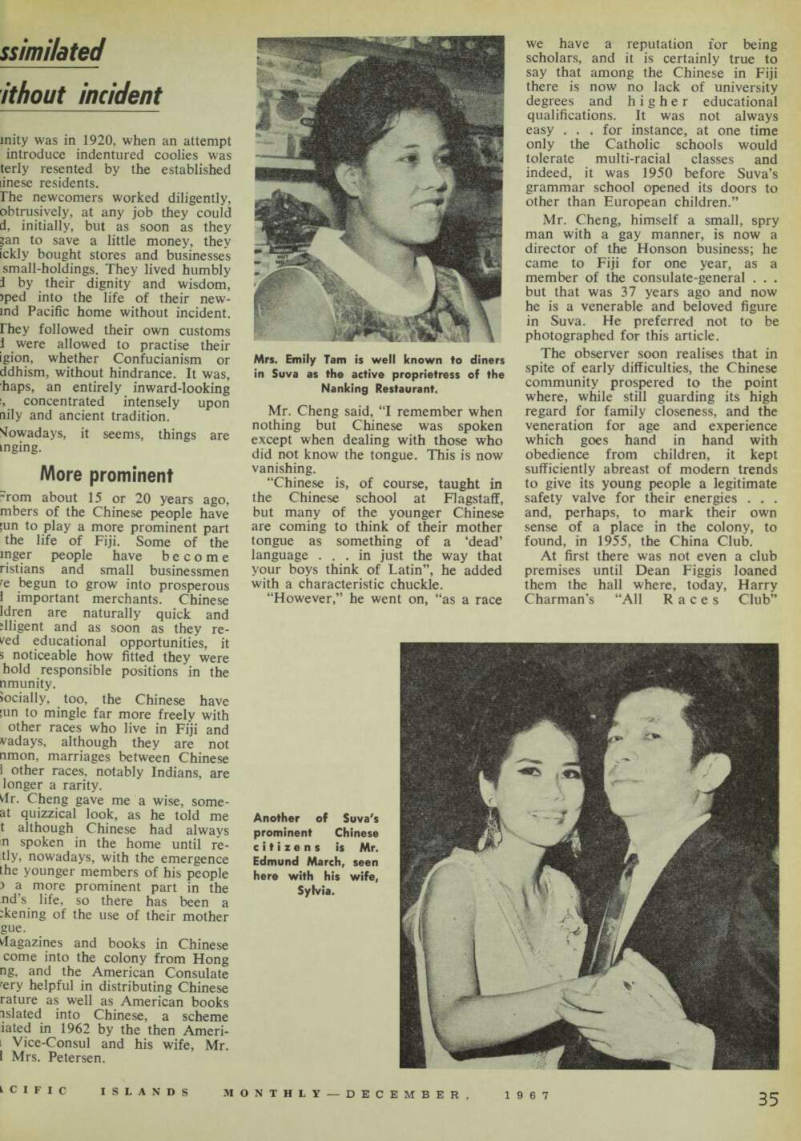
Mrs. Emily Tam is well known to diners in Suva as the active proprietress of the
Nanking Restaurant.
Another of Suva's prominent Chinese citizens is Mr.
Edmund March, seen here with his wife,
Sylvia.