No Crime. ; No Juvenile
p. 36 · Read in the full issue
A Fiji Community With
Delinquency
By Jane Gregor
Nobody talks much about the Chinese in Fiji.
And there is certainly no Chinese “problem”.
Newcomers to the colony are inclined to ask, hopefully, with happy memories of exquisitely run homes in various parts of the Orient, “Are there any Chinese servants in Fiji? Or any Chinese gardeners you can hire?”
ON learning that the answer to both these questions is “No”, most of the newly arrived Fiji resi dents quickly come to take for granted the quiet, courteous and efficient work of the 6,000-odd Chinese who can be observed in most walks of Fiji’s daily life.
They are scattered throughout the group; some are country storekeepers, others grow vegetables in the Sawani district, or other fertile areas, and some, a few, like Fong Lee, have grown into legends—vivid figures in Fiji’s history. Fong Lee, who died a much respected and wealthy merchant in March of this year, arrived in Fiji just as the Vatukoula mine began working. He laboriously trekked up the mountain with goods on a pack horse and because of his helpfulness to those pioneer miners, was later given a concession for him self.
Story of Fiji
Others whose lives are interwoven with the story of Fiji’s early days are George Houng Lee who, arriving around the turn of the century, is still to be seen riding his motorcycle around Suva, and Mr. C. F. Cheng now a director of Honson Limited, who arrived in Fiji as long ago as 1907.
The most obvious Chinese, to the casual visitor at least, are, of course, those who run the various food in dustries on the island, whether a stall in a market or a sophisticated res
taurant such as Luk Bo’s in Lautoka.
Most of the greengrocers’ shops both in towns and in the country hamlets are owned and run by Chinese citizens; so too are the majority of the bakeries and butcheries and some of these are, today, complex modern businesses. Contrary to popular imagination, however, Chinese are not laundry workers ... at least, not in Fiji!
The visiting businessman who has occasion to call on a variety of offices soon notices that the best secretaries are Chinese girls; neat, pretty and with a knack of combining efficiency with a self-effacing graciousness, they are increasingly in demand.
And going about their duties in every town in the Fiji group you will come across Chinese lawyers, govern ment officials, doctors, teachers . . . almost every profession you can name, in fact, except, oddly enough for such a dextrous people, dentistry, as yet.
The younger Chinese
The younger Chinese of Fiji are as lively as those anywhere; they read the latest books, dance the newest dances and are alert to all that goes on. The older members of the community are conservative and more stay-at-home, preferring to cherish the old ceremonies and traditions which the most avant-garde of their young compatriots are fast abandoning.
In a short space, one can
necessarily do no more than sketcl an outline of the story of some o these dignified people; I hope som day that a full history will be written although few records exist.
I started by talking to Mr. Charle Cheng, known as the doyen o Chinese society and for many year the Chinese Consul in Fiji.
It seems that the first Chinese t< arrive in Fiji were some 1,50( immigrants who began to trickle ii around the turn of the century.
Details of this period are ban to come by; there is no officia history of the Chinese community ir Fiji and the inquirer must rely oi the memories of some of the earliei arrivals.
It is known, however, that thos< first travellers came, somewhere be tween 1900 and 1911, from Hon* Kong and the Canton area, the natives of that part of China bein* more venturesome in leaving theii native shores than the inhabitants oi the landlocked areas, so Mr. Chen* told me.
Those early Chinese, who were voluntary immigrants of the “petit bourgeois” class—never being in dentured labour and certainly not coolies—quickly settled in to work hard and live quietly. In fact the only time that there was ever an> uproar among Fiji’s Chinese com-
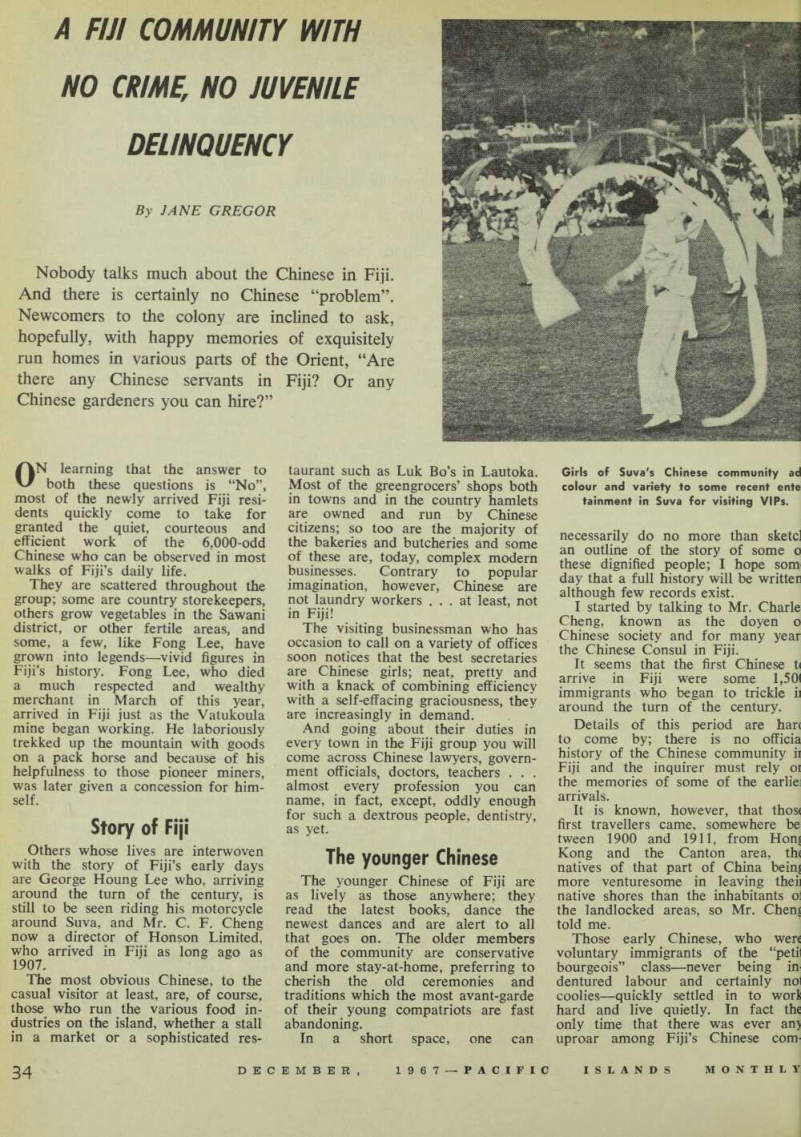
Girls of Suva's Chinese community ad colour and variety to some recent ente tainment in Suva for visiting VIPs.