To The Point
pp. 40-42 · Read in the full issue
With
Percy
Chatterton
To The Point
My pre-war school at Hanuabada wasn’t much by the standards of 1967, but it wasn’t too bad for its era, and being in Port Moresby it had a lot of visitors.
.OOME of these visitors were passengers on ships passing through Moresby on their way to various destinations. We even had our occasional tourist ship, which gave my pupils an opportunity of hearing the English language spoken with strange accents, and, on at least one occasion, of making some easy pocket money by selling poinciana pods as “Papuan boomerangs”.
Then there were the VlP’s who stayed at Government House. The programmes arranged for their en tertainment usually included a visit to my school, and not infrequently Sir Hubert Murray brought them down himself.
The first group rarely presented any problems, though sometimes their habit of making audible per sonal comments on the children’s per sonal appearance, much as if they were animals in a zoo, caused em barrassment.
That was one reason why I liked American tourists. Their comments were often more devastatingly frank than that of their Australian counter parts and were made in much more penetrating voices, but luckily the kids could rarely understand what they said. The Americans were popular with my pupils, too; they were easier to touch for largesse than the Aussies.
The day I fell in
Only on one occasion did I fall in badly. The ship was one which in those days called at Port Moresby on its way from Australia to Batavia (Djakarta, nowadays), and the nice elderly couple who appeared at the front door of the school were obviously Dutch. I showed them round and gave them the spiel I usually offered to tourists, a sort of tabloid lecture on native education in words of one syllable.
They were tremendously interested and when at last I showed them out they thanked me warmly. “You see,” said the grey-haired man gently, “I am very interested. I am Director of Education for the Nether-
Thoughts on the education systenr
lands East Indies”. By the time I surfaced they had gone.
The VlP’s fell into several classes.
There were those who were frankly bored, and were impatient to reach a point in the itinerary at which they would be offered a drink. There were those who were genuinely and in telligently interested, and who be haved charmingly toward both teachers and children.
There were the well-clued, from whom one could imbibe new ideas.
And finally there were those who wanted the school to be given a holiday in honour of their visit.
Old English custom
This, of course, is an old English custom, based on the belief that children hate school and welcome any opportunity of getting away from it. I imagine that there are very few schools and very few children of which this is true nowadays, and
perhaps fewer in New Guinea tha anywhere. Certainly my pupils in pn war Papua liked going to school, an felt no obligation to pretend the didn’t.
However, this urge to be n membered as a benefator rarel caused us any trouble at Hanuabadj It was generally possible to chann< the proposal into one for a holida on the next Friday. We never ha school on Fridays anyway.
In those days our school holiday were geared, not to the white man calendar, but to the agricultural yea They were taken to coincide wit planting time, the yam harvest an so on. The departure and return c the Hiri, the annual trading exped tion of the Gulf of Papua, were als occasions for holidays. And to thes were added the holy days of th Christian year.
The only curb on our individualit was the annual arrival of the scho<
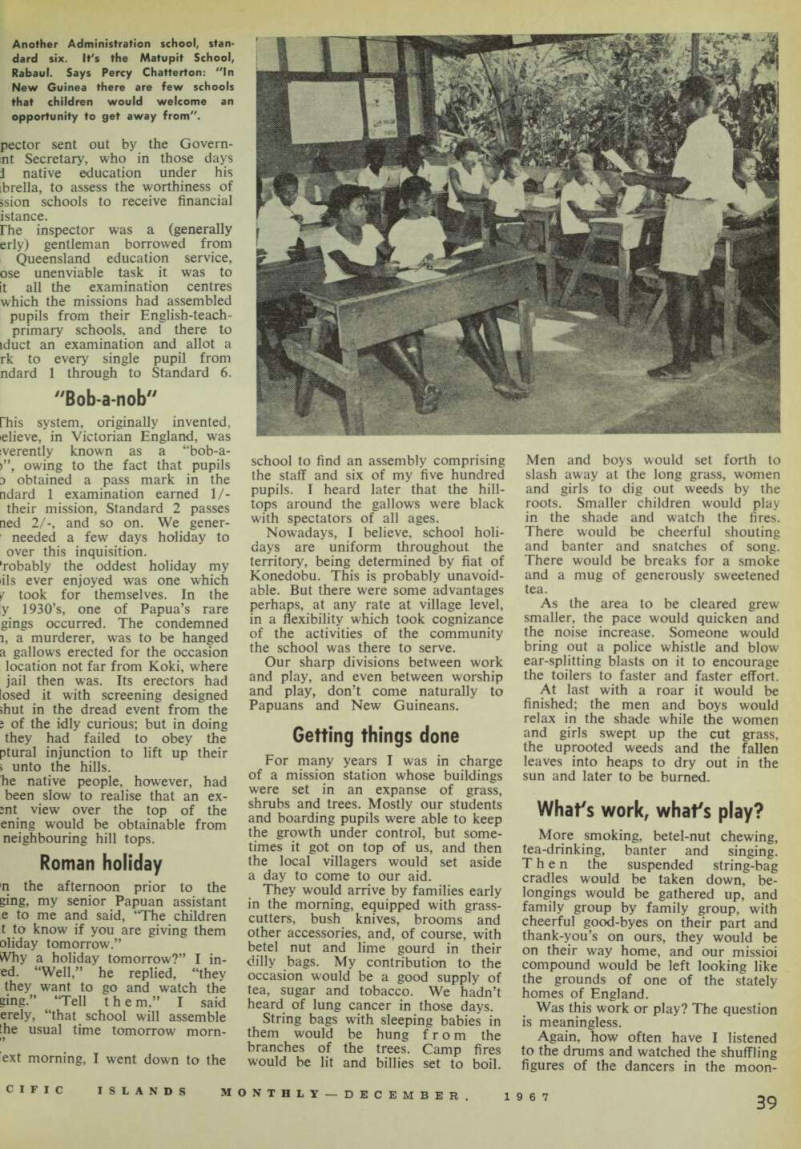
The Court Street School, in Rabaul, New Guinea, is an example of today's P-NG Administration primary schools.
pector sent out by the Govern nt Secretary, who in those days 1 native education under his ibrella, to assess the worthiness of ssion schools to receive financial istance.
Phe inspector was a (generally erly) gentleman borrowed from Queensland education service, ose unenviable task it was to it all the examination centres which the missions had assembled pupils from their English-teach primary schools, and there to iduct an examination and allot a rk to every single pupil from ndard 1 through to Standard 6.
"Bob-a-nob"
fhis system, originally invented, idieve, in Victorian England, was iverently known as a “bob-a owing to the fact that pupils d obtained a pass mark in the ndard 1 examination earned 1/their mission, Standard 2 passes ned 2/-, and so on. We gener needed a few days holiday to over this inquisition. ’robably the oddest holiday my iils ever enjoyed was one which / took for themselves. In the y 1930’5, one of Papua’s rare gings occurred. The condemned i, a murderer, was to be hanged a gallows erected for the occasion location not far from Koki, where jail then was. Its erectors had losed it with screening designed shut in the dread event from the ; of the idly curious; but in doing they had failed to obey the ptural injunction to lift up their > unto the hills. he native people, however, had been slow to realise that an ex ;nt view over the top of the ening would be obtainable from neighbouring hill tops.
Roman holiday
n the afternoon prior to the ging, my senior Papuan assistant e to me and said, “The children t to know if you are giving them oliday tomorrow,”
Why a holiday tomorrow?” I in ed. “Well,” he replied, “they they want to go and watch the ging.” “Tell them,” I said erely, “that school will assemble the usual time tomorrow morn ext morning, I went down to the
school to find an assembly comprising the staff and six of my five hundred pupils. I heard later that the hill tops around the gallows were black with spectators of all ages.
Nowadays, I believe, school holi days are uniform throughout the territory, being determined by fiat of Konedobu. This is probably unavoid able. But there were some advantages perhaps, at any rate at village level, in a flexibility which took cognizance of the activities of the community the school was there to serve.
Our sharp divisions between work and play, and even between worship and play, don’t come naturally to Papuans and New Guineans.
Getting things done
For many years I was in charge of a mission station whose buildings were set in an expanse of grass, shrubs and trees. Mostly our students and boarding pupils were able to keep the growth under control, but some times it got on top of us, and then the local villagers would set aside a day to come to our aid.
They would arrive by families early in the morning, equipped with grass cutters, bush knives, brooms and other accessories, and, of course, with betel nut and lime gourd in their dilly bags. My contribution to the occasion would be a good supply of tea, sugar and tobacco. We hadn’t heard of lung cancer in those days.
String bags with sleeping babies in them would be hung from the branches of the trees. Camp fires would be lit and billies set to boil.
Men and boys would set forth to slash away at the long grass, women and girls to dig out weeds by the roots. Smaller children would play in the shade and watch the fires.
There would be cheerful shouting and banter and snatches of song.
There would be breaks for a smoke and a mug of generously sweetened tea.
As the area to be cleared grew smaller, the pace would quicken and the noise increase. Someone would bring out a police whistle and blow ear-splitting blasts on it to encourage the toilers to faster and faster effort.
At last with a roar it would be finished; the men and boys would relax in the shade while the women and girls swept up the cut grass, the uprooted weeds and the fallen leaves into heaps to dry out in the sun and later to be burned.
What's work, what's play?
More smoking, betel-nut chewing, tea-drinking, banter and singing.
Then the suspended string-bag cradles would be taken down, be longings would be gathered up, and family group by family group, with cheerful good-byes on their part and thank-you’s on ours, they would be on their way home, and our missioi compound would be left looking like the grounds of one of the stately homes of England.
Was this work or play? The question is meaningless.
Again, how often have I listened to the drums and watched the shuffling figures of the dancers in the moon
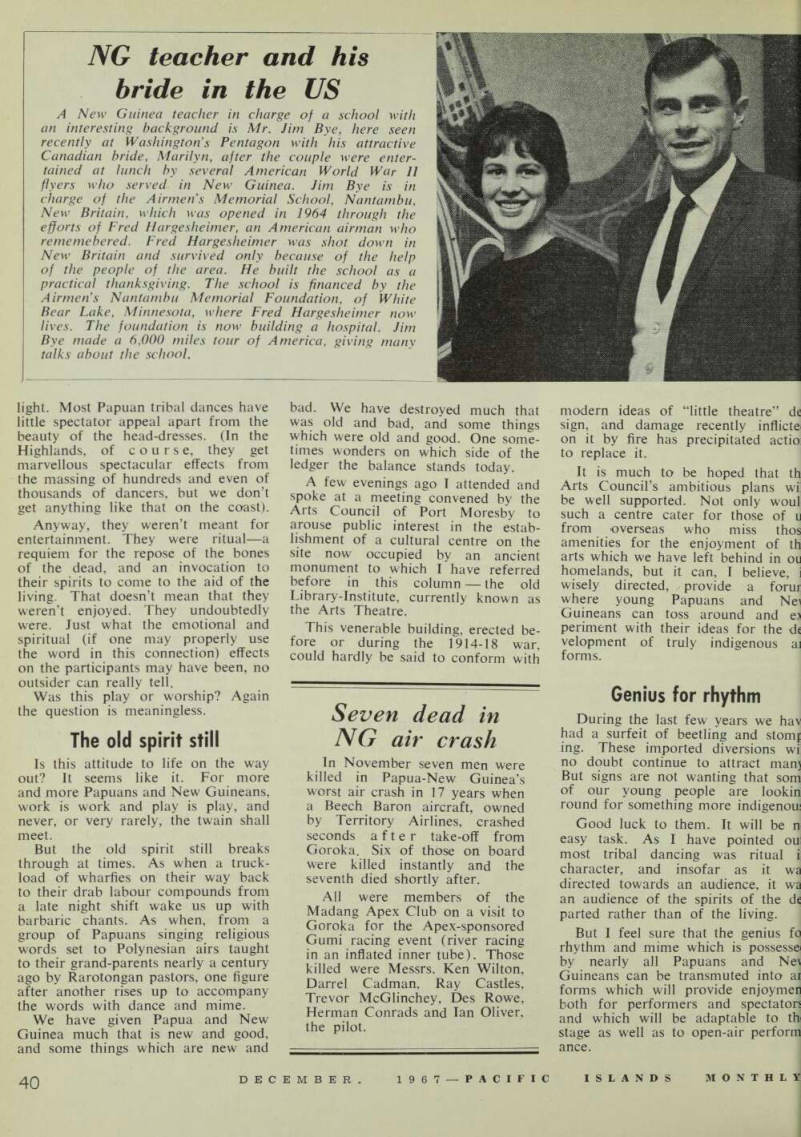
Another Administration school, stan dard six. It's the Matupit School, Rabaul. Says Percy Chatterton: "In New Guinea there are few schools that children would welcome an opportunity to get away from".
light. Most Papuan tribal dances have little spectator appeal apart from the beauty of the head-dresses. (In the Highlands, of course, they get marvellous spectacular effects from the massing of hundreds and even of thousands of dancers, but we don’t get anything like that on the coast).
Anyway, they weren’t meant for entertainment. They were ritual—a requiem for the repose of the bones of the dead, and an invocation to their spirits to come to the aid of the living. That doesn’t mean that they weren’t enjoyed. They undoubtedly were. Just what the emotional and spiritual (if one may properly use the word in this connection) effects on the participants may have been, no outsider can really tell.
Was this play or worship? Again the question is meaningless.
The old spirit still
Is this attitude to life on the way out? It seems like it. For more and more Papuans and New Guineans, work is work and play is play, and never, or very rarely, the twain shall meet.
But the old spirit still breaks through at times. As when a truck load of wharfies on their way back to their drab labour compounds from a late night shift wake us up with barbaric chants. As when, from a group of Papuans singing religious words set to Polynesian airs taught to their grand-parents nearly a century ago by Rarotongan pastors, one figure after another rises up to accompany the words with dance and mime.
We have given Papua and New Guinea much that is new and good, and some things which are new and
bad. We have destroyed much that was old and bad, and some things which were old and good. One some times wonders on which side of the ledger the balance stands today.
A few evenings ago I attended and spoke at a meeting convened by the Arts Council of Port Moresby to arouse public interest in the estab lishment of a cultural centre on the site now occupied by an ancient monument to which I have referred before in this column the old Library-Institute, currently known as the Arts Theatre.
This venerable building, erected be fore or during the 1914-18 war, could hardly be said to conform with
modern ideas of “little theatre” de sign, and damage recently inflictei on it by fire has precipitated actioi to replace it.
It is much to be hoped that th Arts Council’s ambitious plans wi] be well supported. Not only woul such a centre cater for those of u from overseas who miss thos amenities for the enjoyment of th arts which we have left behind in ou homelands, but it can, I believe, i wisely directed, provide a forur where young Papuans and Ne\ Guineans can toss around and ea periment with their ideas for the de velopment of truly indigenous ai forms.
Genius for rhythm
During the last few years we hav had a surfeit of beetling and stomp ing. These imported diversions wil no doubt continue to attract man) But signs are not wanting that som of our young people are lookin round for something more indigenous Good luck to them. It will be nj easy task. As I have pointed oul most tribal dancing was ritual ii character, and insofar as it wa directed towards an audience, it wa an audience of the spirits of the de parted rather than of the living.
But I feel sure that the genius fo rhythm and mime which is possessei by nearly all Papuans and Nev Guineans can be transmuted into ar forms which will provide enjoymen both for performers and spectators and which will be adaptable to thi stage as well as to open-air perform ance.