Message for the Yanks: "Great
pp. 44-148 · Read in the full issue
opportunities in New Guinea!”
An invitation for American capital to invest in Papua- New Guinea development has been made to American business men by Mr. Steven Rich, chairman of the Australia New Guinea Corporation. Mr, Rich, Sydney-based, made the invitation in a long and carefully prepared paper on New Guinea investments which he presented to a seminar arranged by the American Management Association in New York in September.
Mr. Rich surveyed the whole progress—political and economic— of Papua-New Guinea since the war and detailed specific opportunities for overseas investment.
He said that the USA held out the best prospects as a potential source of investment funds for New Guinea, and there were good oppor tunities for American capital. He discussed the attitude of New Guineans to foreign investment.
Among the points that Mr. Rich made were: • In their own environment the New Guineans live a relatively affluent and comfortable existence.
Subsistence production comprises an estimated 38 per cent, of total supplies produced in the territory, and provides basic supplies for many indigenes in the monetary sector. • By far the highest rates of growth within the monetary sector itself have been in the non-primary production fields. The economy is thus becoming less dependent on primary production, which contri buted an estimated 36 per cent, of the gross territory product in 1964/65, compared with 43 per cent, in 1960/61. • Together with direct expendi ture by Australian Government departments in the territory, the Aus tralian Government’s financial con tribution to territory development in 1966/67 was SlO7 million, and this year it is estimated at about $l2O million. This represents approxi mately $5O per head of population —a higher level of outside aid than that received by most other develop ing countries. However, if the terri tory’s development is to be speeded up in conformity with the World Bank’s recommendations, there will be need for further increases in the financial aid from outside. • The Government and the terri tory people realise that local capital
is inadequate to meet the require ments of development, and that over seas capital is essential if the territory’s development plans are to be successful. • To make a country attractive to foreign capital, three conditions are of foremost importance—political stability, favourable attitudes to foreign investment and a fast rate of economic growth. All these pre requisites for sound investment can be found in P-NG.
Investment attitudes
Mr. Rich said there appeared to “be no reason why this climate (of stable politics) should not continue future”, and he added: “The attitudes of the indigenous people to foreign investment have been free of the extremes evident in some other newly developed nations. There is a growing aware ness among indigenes of the benefits flowing from economic development and of the need to attract overseas capital to step up the development process.
“This awareness was recently demonstrated by the Development Capital Guarantee Declaration, which was adopted by the territory House of Assembly in September, 1966. . . .
I would like to quote it in full: “This House, recognising that the economic development of the Terri tory of Papua and New Guinea is dependent upon the steady inflow of outside capital, and, representing the people of the Territory of Papua and New Guinea, determines that such inflow shall be encouraged for the benefit of the territory and its peoples and invites and welcomes capital investment for developmental purposes and guarantees to the world that expatriate capital invested in the Territory of Papua and New Guinea for establishment of new in-
dustries, or the development of existing industries, shall not be subject to expropriation, nor to dis criminatory taxation or other like levies, nor to oppressive trading legislation, nor to unreasonable limitations on its repatriation, and solemnly charges future parliaments of the Territory of Papua and New Guinea with the obligation not to legislate in a manner inconsistent with this declaration unless that posed legislation has support of the majority of the electors of the terri tory expressed by a referendum, and resolves that this resolution, which shall be transmitted to the United Nations Organisation and to the Parliament of the Commonwealth of Australia, shall be known as the Development Capital Guarantee Declaration.”
Joint ventures
Mr. Rich said no restrictions were imposed in the territory on the pay ment of dividends or the repatriation of capital overseas.
He stressed, however, that the New Guinea Administration was also aware of the need for joint ventures with the New Guinea people, to avoid future trouble should all major investments be controlled by ex patriate and overseas capital. The Government was trying to encourage local participation in development projects financed by overseas capital, particularly development of natural resources.
Since the present ability of the New Guineans to take part in major projects was limited, the Government had sought local participation in large-scale investments by taking up a share of equity on behalf of the territory people, to be disposed to them later when their savings had increased sufficiently, or as a future
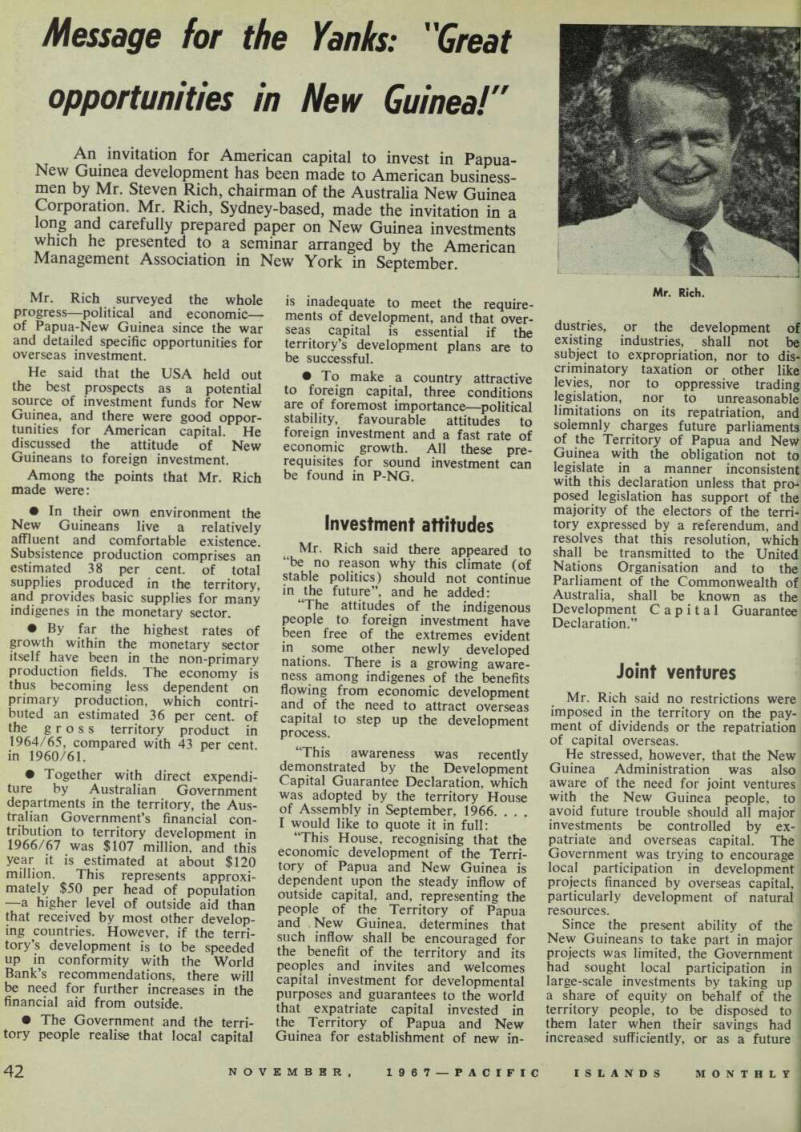
Mr. Rich.
itory government might deter le.
"he Administration was a partner a forestry venture, an oil palm ustry and had an option of 20 cent, interest in Conzinc’s
jgainville copper project,
rtr. Rich said most of the private estment in P-NG at present came m Australia. The UK was now second largest source of overseas lital, and there were also invest nts from Japan, Malaysia, North lerica and Europe, but in his view,
orth America, particularly the
A, holds out the best prospects a potential source of investment ids”.
Hie territory’s proximity to Aus lian and South-East Asian markets
»vided good opportunities for
icrican capital, and he understood it American investment there uld not be subject to the interest lalisation tax, which applied to estments in more developed jntries.
World bank decisions
In outlining some of the strong ints of the territory’s developing momy, Mr, Rich said many of the commendations of the World Bank ssion which visited the territory 1963 had already been imple mted, including; a Papua and New Guinea Development Bank; the appointment of an economic adviser with a small professional staff; the Pioneer Tax Incentives Ordinance 1965 —to encourage secondary industry; a Tourism Board to promote tourism;
• a Harbours Board and a Co ordinator of Transport; • recruitment and training of local teachers; • setting of salary levels in the Public Service in line with living standards and costs in the terri tory.
Opportunities listed
Mr. Rich told the American businessmen that a five-year develop ment plan based on the mission’s report was being prepared, and in cluded proposals to increase produc tion of major agricultural com modities by 80 per cent, and double the value of exports of all territory products. There were also plans to treble log production and the value of timber exports between 1965 and 1972.
A further mission had visited the territory this year to review progress since 1964 and examine ways of financing development. New projects being considered included a compre hensive transport survey of the terri tory by the UN, a telecommunica tions scheme, agriculture and livestock schemes and development of the hydro-electric potential of the Upper Ramu River.
Discussing investment opportunities in detail Mr. Rich said the main ones were in primary industry and mineral exploration and development. The territory’s vast timber resources as yet were little developed, and the
territory could become a major ex porter im the Asian Pacific region.
The availability of concession areas, low taxation rates and the stable political climate made it one of the most attractive timber investment areas in the South Pacific.
In agriculture both tea and oil palm offered good investment, and about 10 million acres of natural grasslands were suitable for cattle raising.
On mineral exploration. Mr. Rich said that at June 30 this year, 19 prospecting authorities were in force and a further 17 applications were being considered. Much interest had been aroused by the dis covery of low grade copra on Bougainville by Conzinc Riotinto, and present indications were that within a few years after mining had started mineral exports from Bougainville would be worth about $5O million, which was about equivalent to total territory exports in 1965/66.
Other prospects now being in vestigated included: • A gold-silver mineral lode on Misima Island, Papua—companies involved are Pacific Island Mines Ltd. (of Australia) and Cultus Exploration Ltd. (of Canada); • A low-grade copper deposit at Worangoi in New Britain (Ameri can Metal Refining Co. Ltd., have an interest); • A copper prospect near Bundi in the Eastern Highlands of New
(Continued on p. 146)
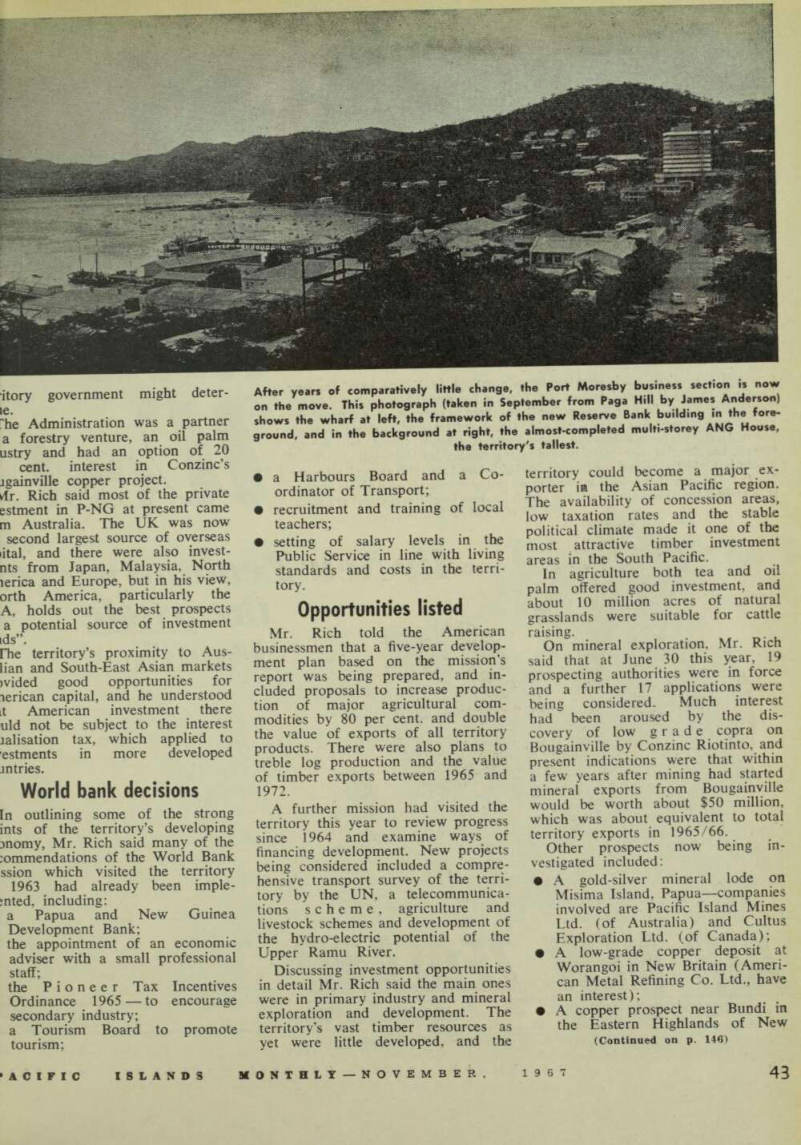
After years of comparatively little change, the Port Moresby business section is now on the move. This photograph (taken in September from Paga Hill by James Anderson) shows the wharf at left, the framework of the new Reserve Bank building in the fore ground, and in the background at right, the almost-completed multi-storey ANG House, the territory's tallest.
Guinea (Kennecott Explorat: Pty. Ltd.); • Nickel occurrences in the Pap basic belt region north of Owen Stanley Ranges (Ir national Nickel Co. of Can have done some work). • Offshore oil drilling was i starting in the Gulf of Papua.
Mr. Rich said the manufactu: industry was one of the fastest gr ing sectors, with a growth rate hi| than for the economy as a whole, In the year ended June 30, 1! there were 407 factories employ 10,786 workers and producing gc to the value of about $2l mill Ten years earlier there were factories, 3,394 workers in fad employment and the value of proc tion was only $4 million.
He said the great majority secondary industries were those ] ducing for the local market. T included the manufacture of cigare and tobacco, paints, industrial ga wire products, building mater concrete products, oil drums, bisc and cordials; the assembly electrical appliances; boat-build furniture-making, joinery, light gineering and the brewing of b These industries used in the it imported raw or semi-proces materials.
During 1965/66 output of dustries producing for local consul tion was about $37 million out c total output of $4B million.
Mr. Rich said that industries 1 appeared to have the best prosp< were those serving the growing 1c market.
Mr. Rich added: “Capital < ployed in the territory by and la has yielded, or hopefully will yh sufficient return to the investor make New Guinea a very attract proposition, and this same cap and enterprise has at the same ti contributed to the economic devel ment of the country in provid industry, jobs and opportunities the emerging nation. This two-v street seems to represent a good bi for the future”. • Polataivao Fosi, former hea weight boxing champion and MP the Gagaifomauga No. 3 in Sav Western Samoa, left Apia on Octol 10 by air for Uganda to attend thirteenth Commonwealth Pari mentary Conference.