Corps-Potlatch revolution
p. 43 · Read in the full issue
Western Samoa girds its loins for the Peace Corps-Potlatch revolution
From an Apia correspondent The first two weeks of October may well be remembered as the fortnight that changed the course of Western Samoa’s history. In this period, legislation allowing the giant US firm of Potlatch Forests Inc. to set up business in Samoa was tabled in Parliament, and the first 85 United States Peace Corps volun teers arrived in Apia.
Potlatch plans to invest up to US 10,000,000 over the next five ;ars in developing a major timber dustry on the island of Savaii, but unoan leaders are being very cagey )out the whole deal.
Faced with the necessity of provid g improved living standards for an [ploding population when each year e costs of administration and welopment are growing faster than venue, the Government is aware at the proposed timber industry ill go a long way towards solving e country’s economic problems, at nobody likes the thought of the ain from the country in the years lead of the profits that will accrue om the exploitation of this natural source.
Social revolution
With the choice apparently be 'een foreign capital developing the nber industry, and inevitable onomic hardship under financial dependence, there is not much )übt that, after a lot of argument, Dtlatch will soon be setting up busi es in Samoa.
While Potlatch promises some sort economic revolution, the Peace orps holds the seeds of social volution.
Despite the 60 years of European Iministration before independence re years ago, European influence is been largely restricted to the pia area, and village life is still uch as it has been for the past mdreds of years. Few seconded ficers have lived anywhere but in wn and the great majority ended eir terms without ever having spent night in a village.
The Peace Corps will change all lis. Another 90 volunteers are ex ited in January, and most of the SO or so Peace Corps personnel will >end their two-year term in the
villages, living in a Samoan fale, eating Samoan food, speaking Samoan and being integrated into village life.
There is not much doubt that this intimate contact with well-educated and well-meaning Europeans will do much to provide the broadened out look needed to ease the transition now taking place from the narrow constraints of primitive village life to the confusing role of citizens of the world.
Nearly all the volunteers are uni versity graduates and those in the districts are being employed mainly in mission schools and on Govern ment projects such as rural health and public works.
They have been enthusiastically welcomed in Apia and have impressed everyone as a particularly fine group of young people. Their average age is 23.
There is, of course, some specula tion as to how well they will succeed.
“The only danger is that our people will spoil them too much,” said one Samoan official.
Market for fruit
PRODUCE marketing officials see a bright future for the marketing in New Zealand of fresh fruit and vegetables air-freighted from Western Samoa to Auckland.
Large quantities of papaws and other fruit and vegetables from Western Samoa are already being flown to New Zealand in the tem perature-controlled holds of Air New Zealand’s DC-8 jets for selling in Auckland’s produce markets. This produce is flown to New Zealand every Sunday on the weekly Pago Pago-Auckland service and is sold fresh to New Zealand merchants.
All the Western Samoan produce so far sent air cargo has arrived in ex cellent condition. It is exported from
Apia by the Produce Marketing Division of Western Samoa’s Depart ment of Agriculture, and by one pri vate Apia exporter.
Results of these early trial ship ments by air have been so encourag ing that the quantity and range of fruit and vegetables sent to Auck land will be greatly increased by next year. At present, the produce is flown from Apia to Pago Pago by Poly nesian Airlines DC-3 aircraft for trans-shipping to the Air NZ ser vice. But with the operation by PAL shortly of a DC-4, the capacity for moving air cargo between Apia and Auckland will be increased.
Big hydro scheme
WHILE Western Samoan depart mental estimates are being slashed; education faces retrench ment; reading and other develop ment works being restricted; and agri culture scraping the bottom of the barrel for more finance, it was re vealed in Apia at the end of Sep tember that the Public Works De partment is planning a new hydro scheme that would almost treble the country’s output of electricity and cost between li to 2 million tala.
The scheme involves tunnelling a water race through about a mile of mountain to divert water from Lake Afulilo and the Salani river to a power station situated on the shore of Fagaloa Bay.
A United Nations hydro-electric engineer is being recruited to assist in planning the scheme. He is ex pected to arrive in Apia in January.
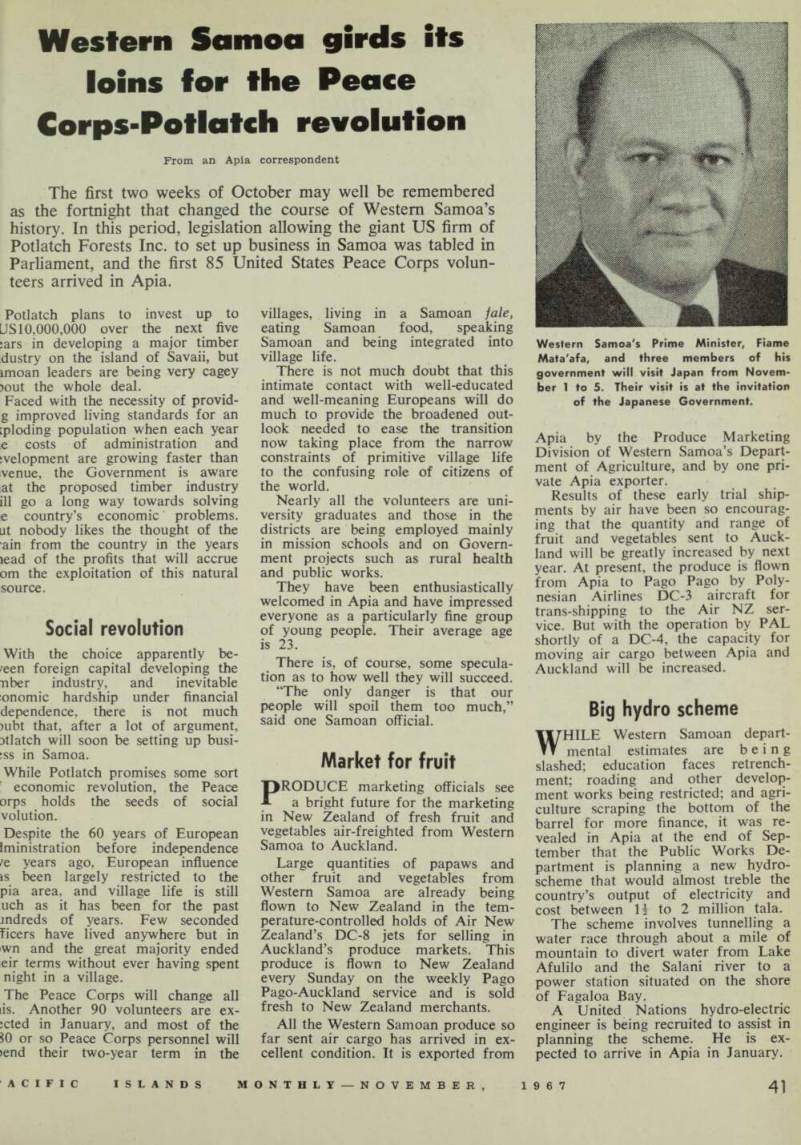
Western Samoa's Prime Minister, Fiame Mata'afa, and three members of his government will visit Japan from Novem ber 1 to 5. Their visit is at the invitation of the Japanese Government.