Bougainville's Boudoir
pp. 32-33 · Read in the full issue
She wants to play Crusoe in Bougainville's Boudoir
By Robert Langdon
Reports from Tahiti in early October that a 28-year-old Frenchwoman, Mrs. Jeannou Rouillere, planned to live the life ot a Robinson Crusoe on uninhabited Mehetia Island, 60 miles east of Tahiti, has pushed into the limelight a speck of Pacific r r a L C , S i? te that has not P revi °usly made news in the 38 years of PIM s existence.
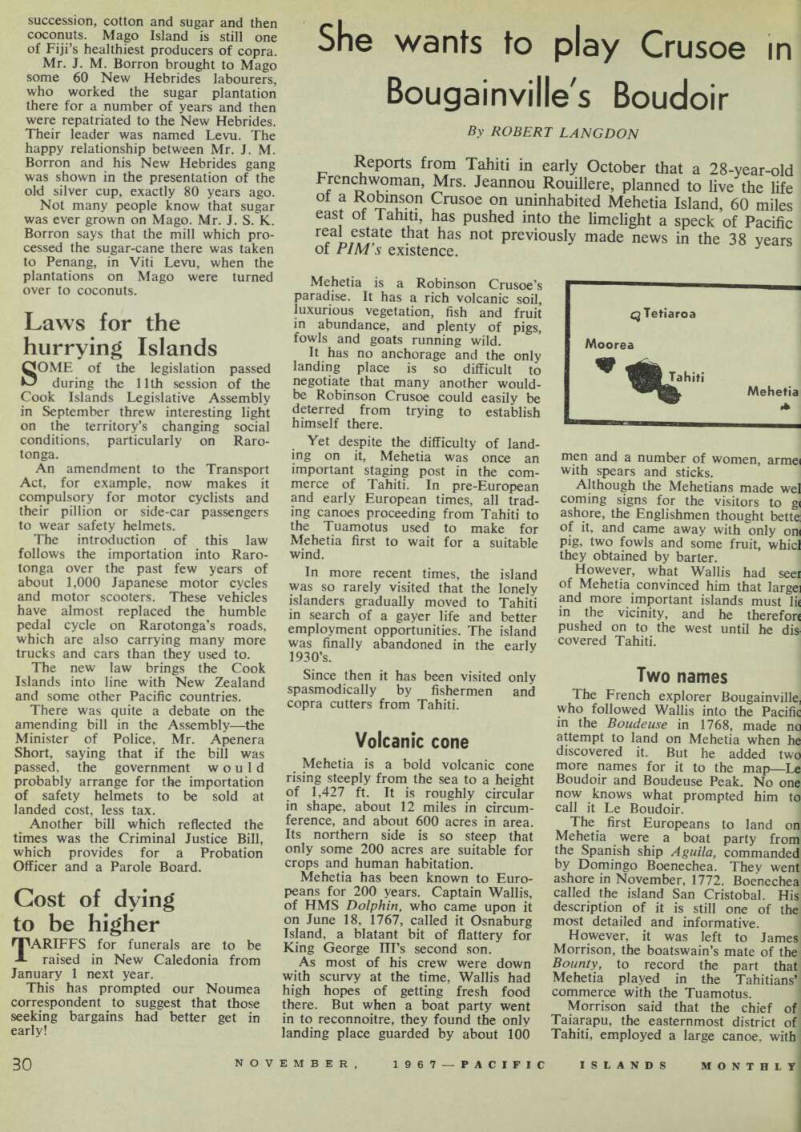
Mehetia is a Robinson Crusoe’s paradise. It has a rich volcanic soil, luxurious vegetation, fish and fruit in abundance, and plenty of pigs, fowls and goats running wild.
It has no anchorage and the only landing place is so difficult to negotiate that many another would be Robinson Crusoe could easily be deterred from trying to establish himself there.
Yet despite the difficulty of land ing on it, Mehetia was once an important staging post in the com merce of Tahiti. In pre-European and early European times, all trad ing canoes proceeding from Tahiti to the Tuamotus used to make for Mehetia first to wait for a suitable wind.
In more recent times, the island was so rarely visited that the lonely islanders gradually moved to Tahiti in search of a gayer life and better employment opportunities. The island was finally abandoned in the early 1930’5.
Since then it has been visited only spasmodically by fishermen and copra cutters from Tahiti.
Volcanic cone
Mehetia is a bold volcanic cone rising steeply from the sea to a height of 1,427 ft. It is roughly circular in shape, about 12 miles in circum ference, and about 600 acres in area.
Its northern side is so steep that only some 200 acres are suitable for crops and human habitation.
Mehetia has been known to Euro peans for 200 years. Captain Wallis, of HMS Dolphin, who came upon it on June 18, 1767, called it Osnaburg Island, a blatant bit of flattery for King George IH’s second son.
As most of his crew were down with scurvy at the time, Wallis had high hopes of getting fresh food there. But when a boat party went in to reconnoitre, they found the only landing place guarded by about 100
men and a number of women, arme< with spears and sticks.
Although the Mehetians made wel coming signs for the visitors to g( ashore, the Englishmen thought bette: of it, and came away with only on< pig, two fowls and some fruit, whicl they obtained by barter.
However, what Wallis had seei of Mehetia convinced him that large] and more important islands must li( m the vicinity, and he therefore pushed on to the west until he dis covered Tahiti.
Two names
The French explorer Bougainville, who followed Wallis into the Pacific in the Boudeuse in 1768, made no attempt to land on Mehetia when he discovered it. But he added two more names for it to the map—Le Boudoir and Boudeuse Peak. No one now knows what prompted him to call it Le Boudoir.
The first Europeans to land on Mehetia were a boat party from the Spanish ship Aguila, commanded by Domingo Boenechea. They went ashore in November, 1772. Boenechea called the island San Cristobal. His description of it is still one of the most detailed and informative.
However, it was left to James Morrison, the boatswain’s mate of the Bounty, to record the part that Mehetia played in the Tahitians’ commerce with the Tuamotus.
Morrison said that the chief of Taiarapu, the easternmost district of Tahiti, employed a large canoe, with
many as 100 paddlers, to ply ularly between Tahiti and Mehetia.
In her,” Morrison said, “he sends i work and what European com dities he can raise as presents to chiefs, who, in return, send back , rls, pearl shells, stools for seats, □ws and pudding stools made of lanu, with dishes and trays of the le wood, matting, cloth, oil, hogs, , etc. —and she seldom returns lout a cargo.
By means of this island, they : Tahitians] have communication h. several others to the NE of dti, and taking advantage of northerly wind, reach Myetoo ;hetia] where they watch wind ting to stretch to the northward a group of small islands, the ital of which is called Tapoo 4ot much was added to the rature on Mehetia until the mid -o’s, when a rich English couple, d and Lady Brassey, called there ;heir private steam yacht Sunbeam. n her Voyage of the “Sunbeam ” ly Brassey said that the sailing ;ctories of the day had little to about how or where to land the island, and that when a boat ty from the Sunbeam tried to find anding place, both she and a lady npanion became quite sick because the “violent motion” of the boat the heavy swell.
Grave reception
however, it was evident from the t that the Mehetians had had nty of contact (indirect or other «) with Europeans, for when y saw the boat coming ashore they ed to the landing place in all ts of European clothes. 3n stepping ashore, the Brasseys re escorted to the house of a chief, o, with his pretty wife, received :m gravely and with much dignity.
The chief lavished gifts upon :m, while the rest of the natives Dught them pearls, shells, mother pearl, small canoes, fish-hooks, ung boobies, and all sorts of other ngs for barter.
“Perhaps, the greatest curiosity ;y offered us,” Lady Brassey wrote,
“was about six fathoms of fine twine, made from human hair.
“Before these islands were visited by Europeans, this was the material from which fishing lines were made; but it is now rarely used, and is consequently very difficult to pro cure.”
Lady Brassey said the natives seemed to know all about money and the ruling exchange rates.
However, most of the Mehetians seemed puzzled over why the Brasseys had visited their island at all.
“No sell brandy?” they asked.
“No.”
“No stealy men?”
“No.”
“No do what then?”
Lady Brassey added that the Mehetians’ knowledge of English was too limited for her to make them understand that she and her husband were “only making a circumnaviga tion in a yacht”.
Visit by scientist
After Lady Brassey’s descriptions, the literature on Mehetia is again pretty sparse until the early 1930’s when Dr. Kenneth Emory, of Hono lulu’s Bishop Museum, and a friend, Clifford Gessler, visited the island to see what maraes and other stone relics of the ancient Polynesians they could find.
Mehetia had no Mehetians by that time, but a group of unpainted, iron roofed houses still stood, with limes, oranges, bananas and papaws ripen ing around them on overgrown trees.
“Over Mehetia,” Gessler wrote, “hung an atmosphere of silence and desertion—silence despite the crow ing of cocks that have run wild in its forests, the song of innumerable mosquitoes, and the steady rumble of the surf.”
If the mosquitoes are still there, they will presumably welcome the arrival of Mrs. Rouillere with eager anticipation.
Mrs. Rouillere, who comes from Nice, on the French Riviera, is described as a “beautiful grev-eyed blonde”. She plans to live on Mehetia alone, without any link with civilisa tion.
She will get a boat to drop her off on the island, and will then live on what she can find there.
By all accounts, it should be a good hunting season for all parties!
Escapists * Footnote: Mehetia is privately owned. Mrs. Rouillere pre sumablv has the owners’ permission to go there.
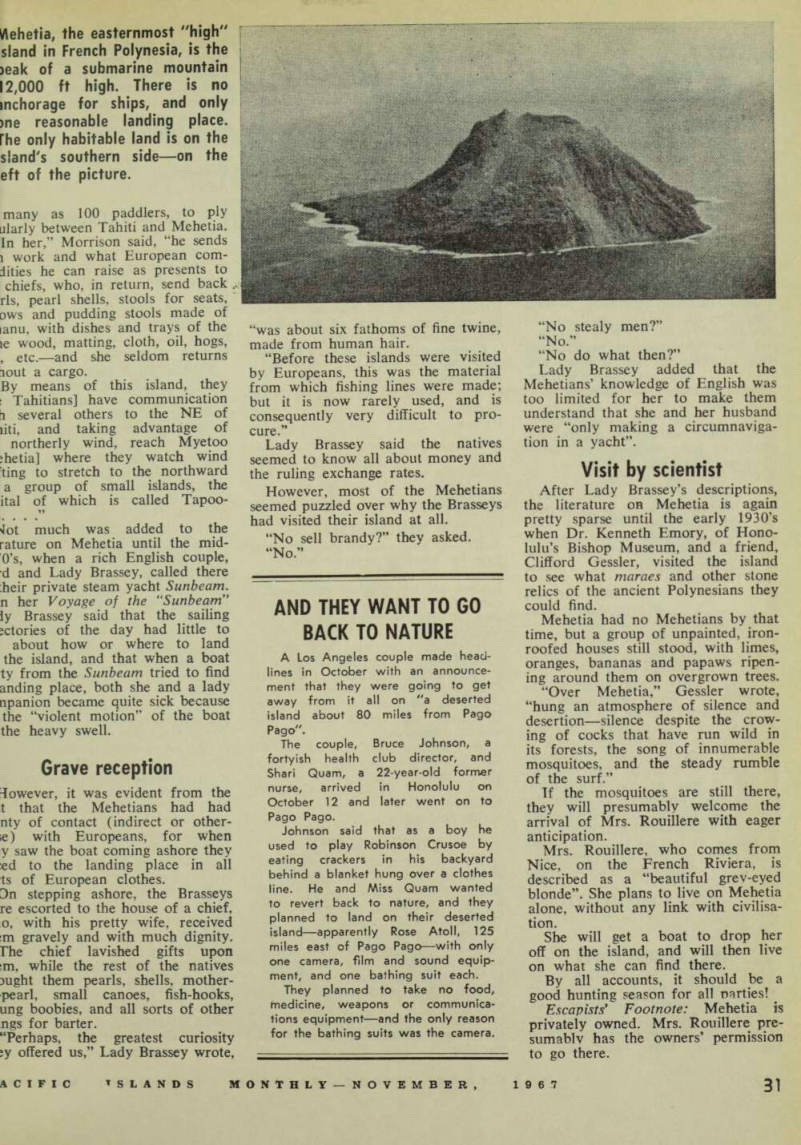
Mehetia, the easternmost "high" stand in French Polynesia, is the [?]eak of a submarine mountain 12,000 ft high. There is no anchorage for ships, and only one reasonable landing place.
The only habitable land is on the Island's southern side—on the left of the picture.