T ropicalities
pp. 30-32 · Read in the full issue
The Papua and New Guinea annual reports once used to state that there was no problem of prostitution in the territory because there was no system of organised brothels in the territory. They no longer make this naive statement, the Administration having perhaps learned that prostitution and brothels are not interdependent.
AS the Oxford English Dictionary makes it clear, prostitution does not necessarily entail hire or pay ment, and looked at this way there has always been some prostitution in Melanesia. In Port Moresby, sex has been available at moderate prices to men away from home since the end of the war.
But the trade has now moved from canoes and dark village houses into the town, and, as an inevitable adjunct to the revision of the liquor laws, into the pubs and taverns. It has, in short, become more open in Port Moresby.
Girls may be seen on Port Moresby’s street corners in two’s or three’s. While this sight does not represent any wild and sudden emula tion of Paris, or of the Susy Wong district of Hong Kong, it is a change from the days not so far back when the Papuan girl worked through a male procurer, and did not herself solicit. They now openly indicate to you in a bar or lounge that they are available.
Of course the old form of pro curing still goes on, in exactly the same words as are used in Rome, Paris or London. You can hear it on the steps of the Louvre, or in the bar of one of Moresby’s taverns.
“You are a nice man, I have sister
Yes, even Port
Moresby has
open sin now
at home . . . And much of the old unpaid prostitution still exists.
Relationships between males is not an uncommon Melanesian pastime.
It is only of very recent times that the male prostitute has become noticeable in public places in Port Moresby, leaning on the bar or mak ing a suggestive movement in the toilet. It appears that these New Guineans are interested in expatriates almost to the exclusion of their own race. Why is this? Perhaps some form of distortion in the sexual pattern can be expected because of the large, unmarried male population of Moresby, both expatriate and Melanesian.
Life of the Frisbies
on film—perhaps
pEOPLE in the Cook Islands and A elsewhere who have enjoyed reading the books of the late Robert Dean Frisbie and his daughter Johnny (now Mrs. Carl Heben streit, of Dunedin, New Zealand) will be interested in a New Zealand report that Universal Pictures, of Holly wood, is thinking about bringing out a film based on four of the Frisbie books.
The books are The Book of Buka Buka and Mr. Moonlight’s Island by Frisbie pere, and Johnny Frisbie’s Miss Ulysses from Buka Buka and The Frisbies of the South Seas.
The four books tell the story of the Frisbie family on various islands in the South Seas, but particularly in the Cook Islands.
Frisbie pere, an American, migrated to the Islands soon after World War I, He married a Poly nesian woman, had five children, and lead a dreamy, impecunious life in all sorts of out of the way places until his death on Rarotonga in November, 1949.
Frisbie, or Ropati, as the Islanders i knew him, always lived in the hope that he would one day write the Great South Seas Novel and make lot of money out of it for his family.
He never succeeded on either
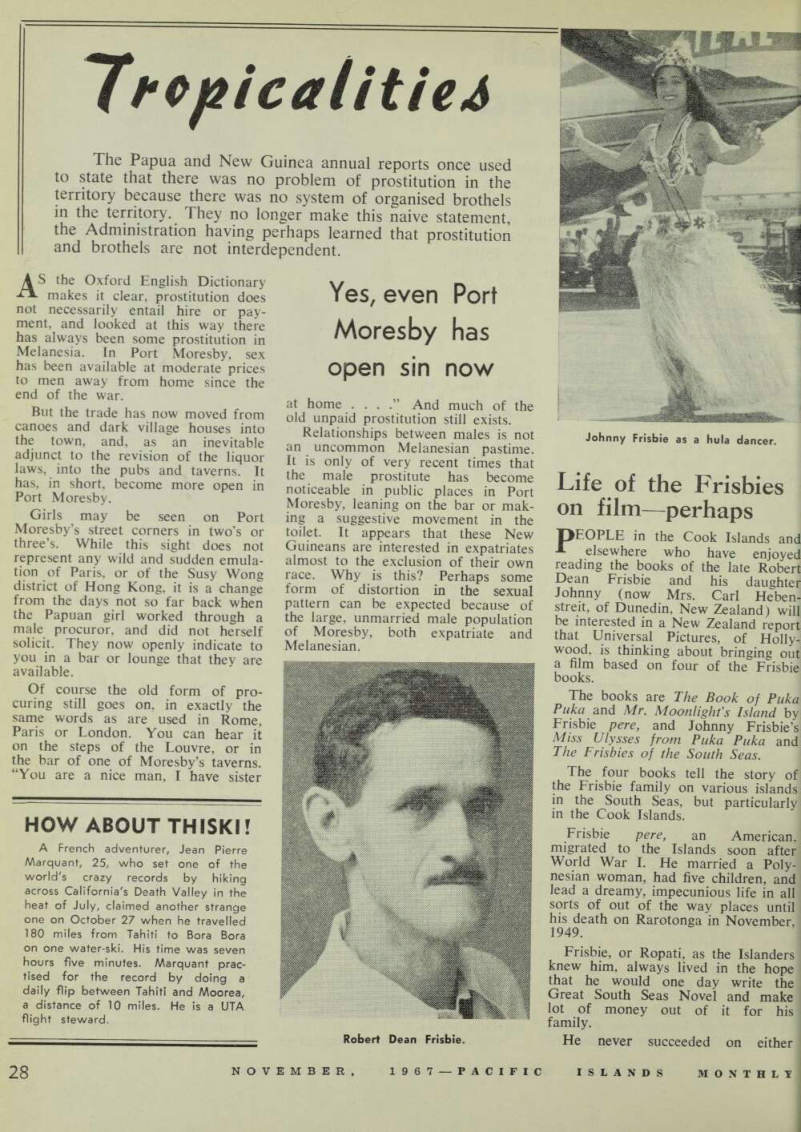
Johnny Frisbie as a hula dancer.
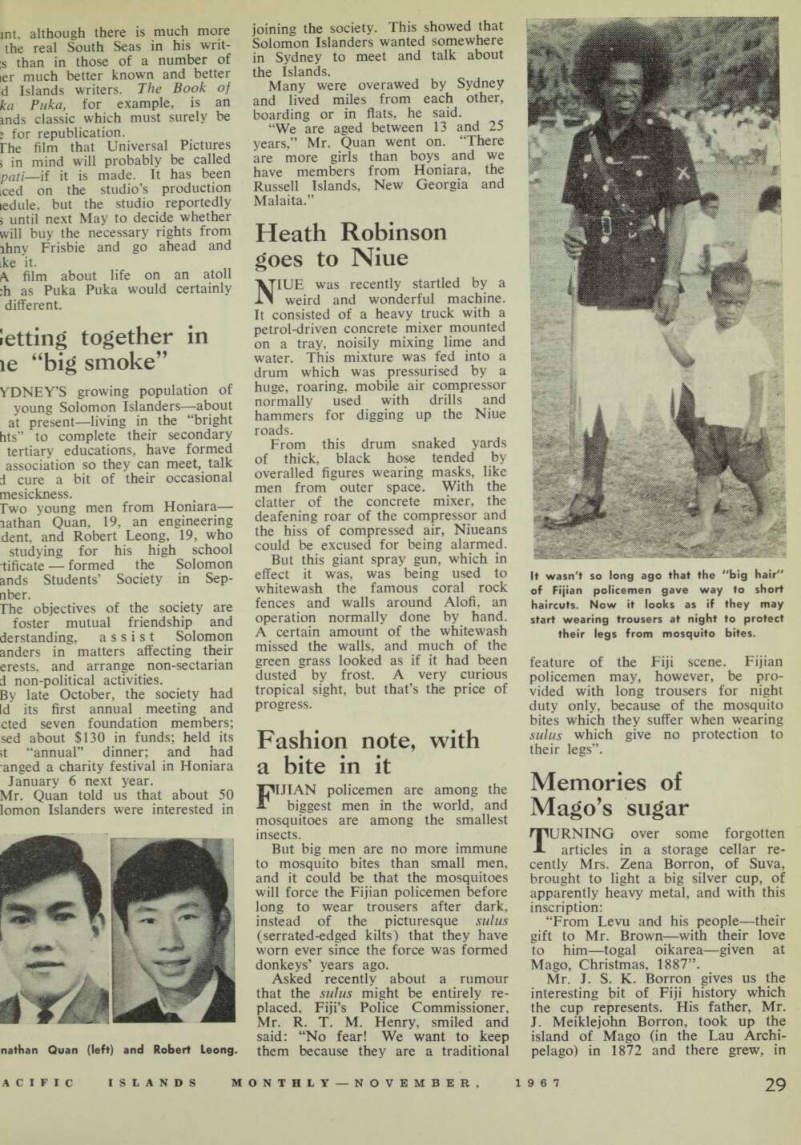
Robert Dean Frisbie.
int, although there is much more the real South Seas in his writ ;s than in those of a number of ier much better known and better d Islands writers. The Book of ka Buka, for example, is an mds classic which must surely be ; for republication.
Fhe film that Universal Pictures > in mind will probably be called pati —if it is made. It has been iced on the studio’s production icdule. but the studio reportedly > until next May to decide whether will buy the necessary rights from ihny Frisbie and go ahead and ike it.
A, film about life on an atoll :h as Puka Puka would certainly different.
letting together in
le “big smoke”
YDNEY’S growing population of
young Solomon Islanders —about at present —living in the “bright tits” to complete their secondary tertiary educations, have formed association so they can meet, talk 1 cure a bit of their occasional mesickness.
Fwo young men from Honiara — lathan Quan, 19, an engineering dent, and Robert Leong, 19, who studying for his high school tificate formed the Solomon ands Students’ Society in Sep nber.
The objectives of the society are foster mutual friendship and derstanding, assist Solomon anders in matters affecting their crests, and arrange non-sectarian d non-political activities.
By late October, the society had id its first annual meeting and cted seven foundation members; sed about $l3O in funds; held its >t “annual” dinner; and had anged a charity festival in Honiara January 6 next year.
Mr. Quan told us that about 50 lomon Islanders were interested in
joining the society. This showed that Solomon Islanders wanted somewhere in Sydney to meet and talk about the Islands.
Many were overawed by Sydney and lived miles from each other, boarding or in flats, he said.
“We are aged between 13 and 25 years,” Mr. Quan went on. “There are more girls than boys and we have members from Honiara, the Russell Islands, New Georgia and Malaita.”
Heath Robinson
goes to Niue
NIUE was recently startled by a weird and wonderful machine.
It consisted of a heavy truck with a petrol-driven concrete mixer mounted on a tray, noisily mixing lime and water. This mixture was fed into a drum which was pressurised by a huge, roaring, mobile air compressor normally used with drills and hammers for digging up the Niue roads.
From this drum snaked yards of thick, black hose tended by overalled figures wearing masks, like men from outer space. With the clatter of the concrete mixer, the deafening roar of the compressor and the hiss of compressed air, Niueans could be excused for being alarmed.
But this giant spray gun, which in effect it was, was being used to whitewash the famous coral rock fences and walls around Alofi, an operation normally done by hand.
A certain amount of the whitewash missed the walls, and much of the green grass looked as if it had been dusted by frost. A very curious tropical sight, but that’s the price of progress.
Fashion note, with
a bite in it
FIJIAN policemen are among the biggest men in the world, and mosquitoes are among the smallest insects.
But big men are no more immune to mosquito bites than small men, and it could be that the mosquitoes will force the Fijian policemen before long to wear trousers after dark, instead of the picturesque sulus (serrated-edged kilts) that they have worn ever since the force was formed donkeys’ years ago.
Asked recently about a rumour that the sulus might be entirely re placed, Fiji’s Police Commissioner, Mr. R. T. M. Henry, smiled and said: “No fear! We want to keep them because they are a traditional
feature of the Fiji scene. Fijian policemen may, however, be pro vided with long trousers for night duty only, because of the mosquito bites which they suffer when wearing sulus which give no protection to their legs”.
Memories of
Mago’s sugar
TURNING over some forgotten articles in a storage cellar re cently Mrs. Zena Borron, of Suva, brought to light a big silver cup, of apparently heavy metal, and with this inscription: “From Levu and his people—their gift to Mr. Brown—with their love to him—togal oikarea—given at Mago, Christmas, 1887”.
Mr. J. S. K. Borron gives us the interesting bit of Fiji history which the cup represents. His father, Mr.
J. Meiklejohn Borron, took up the island of Mago (in the Lau Archi pelago) in 1872 and there grew, in
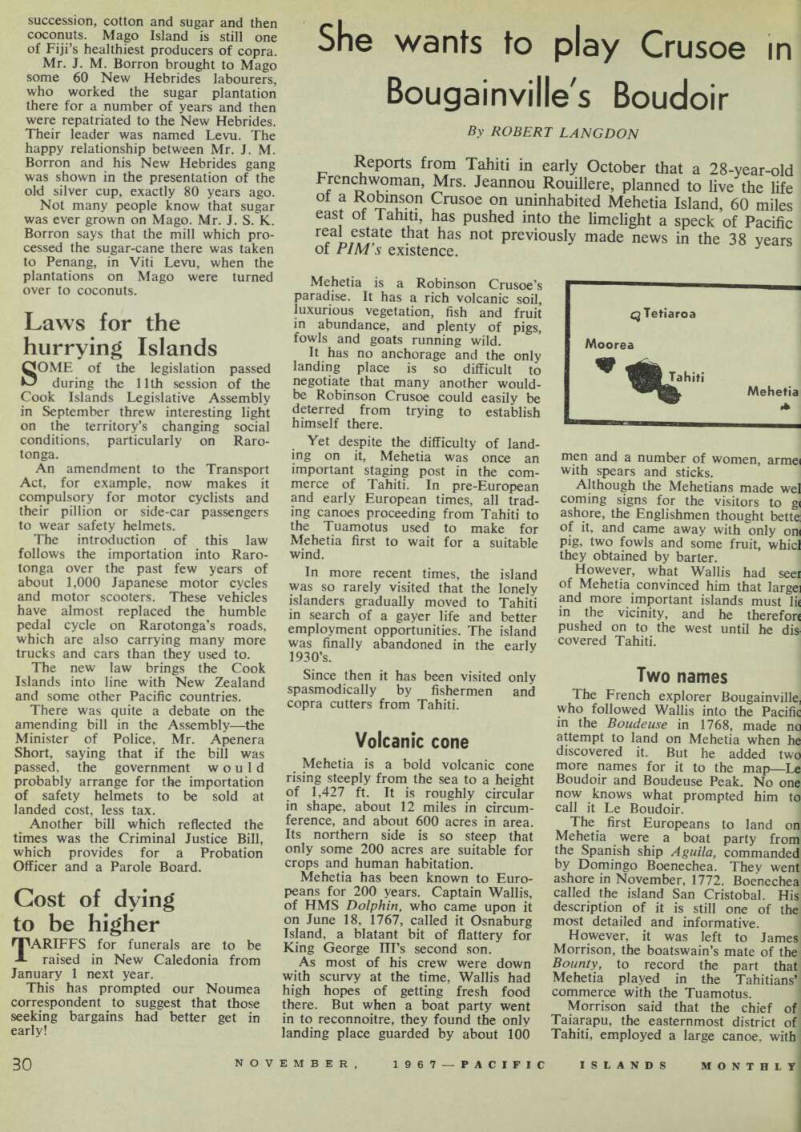
[?]nathan Quan (left) and Robert Leong.
It wasn't so long ago that the "big hair" of Fijian policemen gave way to short haircuts. Now it looks as if they may start wearing trousers at night to protect their legs from mosquito bites.
succession, cotton and sugar and then coconuts. Mago Island is still one of Fiji’s healthiest producers of copra.
Mr. J. M. Borron brought to Mago some 60 New Hebrides labourers, who worked the sugar plantation there for a number of years and then were repatriated to the New Hebrides.
Their leader was named Levu. The happy relationship between Mr. J. M.
Borron and his New Hebrides gang was shown in the presentation of the old silver cup, exactly 80 years ago.
Not many people know that sugar was ever grown on Mago. Mr. J. S. K.
Borron says that the mill which pro cessed the sugar-cane there was taken to Penang, in Viti Levu, when the plantations on Mago were turned over to coconuts.
Laws for the
hurrying Islands
SOME of the legislation passed during the 11th session of the Cook Islands Legislative Assembly in September threw interesting light on the territory’s changing social conditions, particularly on Raro tonga.
An amendment to the Transport Act, for example, now makes it compulsory for motor cyclists and their pillion or side-car passengers to wear safety helmets.
The introduction of this law follows the importation into Raro tonga over the past few years of about 1,000 Japanese motor cycles and motor scooters. These vehicles have almost replaced the humble pedal cycle on Rarotonga’s roads, which are also carrying many more trucks and cars than they used to.
The new law brings the Cook Islands into line with New Zealand and some other Pacific countries.
There was quite a debate on the amending bill in the Assembly—the Minister of Police, Mr. Apenera Short, saying that if the bill was passed, the government would probably arrange for the importation of safety helmets to be sold at landed cost, less tax.
Another bill which reflected the times was the Criminal Justice Bill, which provides for a Probation Officer and a Parole Board.
Cost of dying
to be higher
TARIFFS for funerals are to be raised in New Caledonia from January 1 next year.
This has prompted our Noumea correspondent to suggest that those seeking bargains had better get in early!