Republicans Of Nauru
pp. 20-21 · Read in the full issue
It's All Over Bar The
Shouting For The
Years of effort by Naum’s Head Chief Hammer Deßoburt culminated in the announcement in Canberra on October 24 that the phosphate island will get “full and unfettered” inde pendence as soon as legal arrangements can be made. It is almost certain the Nauruans will be able to declare January 31, 1968, as Independence Day. Nauru will thus become the second Trust Territory in the South Pacific to have been given independence. Western Samoa has been independent since January, 1962
Nauru now has to complete a draft constitution, set up a Nauruan constitutional convention to approve it, and terminate the trusteeship agreement with the UN. A Nauru Independence Bill, to allow the Nauru Legislative Council to establish the convention, was passed by Federal Parliament on November 1, and in the same week talks were going on in Canberra to complete the draft constitution.
The constitution
The constitution will follow the framework of proposals submitted to a Canberra conference in May (details PIM, June, p. 57). It will create the Republic of Naum with a President who will also be Chief Minister. There will be a Cabinet and an Assembly; a Nauru judiciary (with, possibly, appeals to the Aus tralian High Court); and a Public Service that will come under the Chief Minister’s control. Elec tions to the Assembly will be by universal suffrage, and the President will be elected by the Assembly, to hold office during the Assembly’s life.
If the complete machinery measures cannot be carried out in time for January 31 (and there is every chance that they won’t be) then the current Canberra talks will try to evolve a make-shift scheme which will allow independence celebrations to go ahead on that date, but with the establishment of a caretaker government to operate until the full details can be carried through.
The Nauruans could have had the details approved months ago, if the Head Chief had been willing to settle for partial independence, with Nauru linked to Australia by a Treaty of Friendship, giving Australia the right to run ISfauru’s defence
and external affairs. But Deßoburt held out for all or nothing ( PIM , July, p. 23, for a full report).
There might well be a treaty, but the Head Chief says it is up to Aus tralia to make the move. He told a Canberra news conference that he wanted Nauru to retain links with the Commonwealth, and hoped to apply for Commonwealth member ship after independence (Western Samoa has never applied).
He also told the conference that it was not Nauru’s intention to join the UN, as the country was too small. Nauru would have Australian currency if Australia would agree to this.
There would be five ministers besides the President/Chief Minister —the Ministers for Finance, Health/ Education, Justice, Works/Com munications, and Island Development.
Nauru had already begun to search for a Secretary for Island Develop ment, at a tax-free salary of $8,500, with free accommodation (and there are no duties or sales tax on goods landed in Naum).
Deßoburt's statement
To questions about the ability of the island to handle any trouble with the immigrant labour force, such as developed during the recent strike on Nauru, the Head Chief said he had no worries that the Nauruan police could maintain law and order.
No outside help had yet been needed.
He said that with independence there would be more than enough jobs for the island’s young people “for the next 25 years”, and there would be no problems about the Islanders having to leave for Aus tralia to find employment. But Nauru was short of trained people.
Asked whether he had any doubts
that independence could be esta lished by January 31, in view the technical difficulties, Deßobi replied: “I always have hopes, un a thing is proved impossible”.
Which, in a sentence, is t] Head Chiefs whole philosophy.
In Parliament
The independence announceme came as an anti-climax in Feder Parliament on October 24. The Ar tralian Minister for Territories, M C. E. Barnes, was an hour late wi his prepared statement because tl Prime Minister and the House we occupied with a domestic politic squabble about the misuse of Go eminent aircraft.
When this debate was adjourne most of the members on both sid of the House lost any further intere and adjourned too, leaving M Barnes to talk to only 19 member most of them on the Oppositic benches. But the visitors’ galleri were packed. Visitors included tl Head Chief, councillors Josep Detsimea and Buraro Detudamo, ar Professor J. W. Davidson, tl Nauruans’ constitutional adviser.
Mr. Barnes told the House thi the decision by the trusteeship powei —Britain, Australia and NZ—t grant Nauru full independence wi an historic one, and the choice w i theirs.
“We wish them well,” he said. “] after independence the Nauruan Goy eminent wishes to continue clos links with Australia, as forecast b the Nauruan delegation, the Au! tralian Government will be read to respond and to conside sympathetically any requests that ma be made for assistance.”
He said the Nauruans wished t maintain a Nauruan Office in Am tralia and would be happy to se an Australian Office established ii
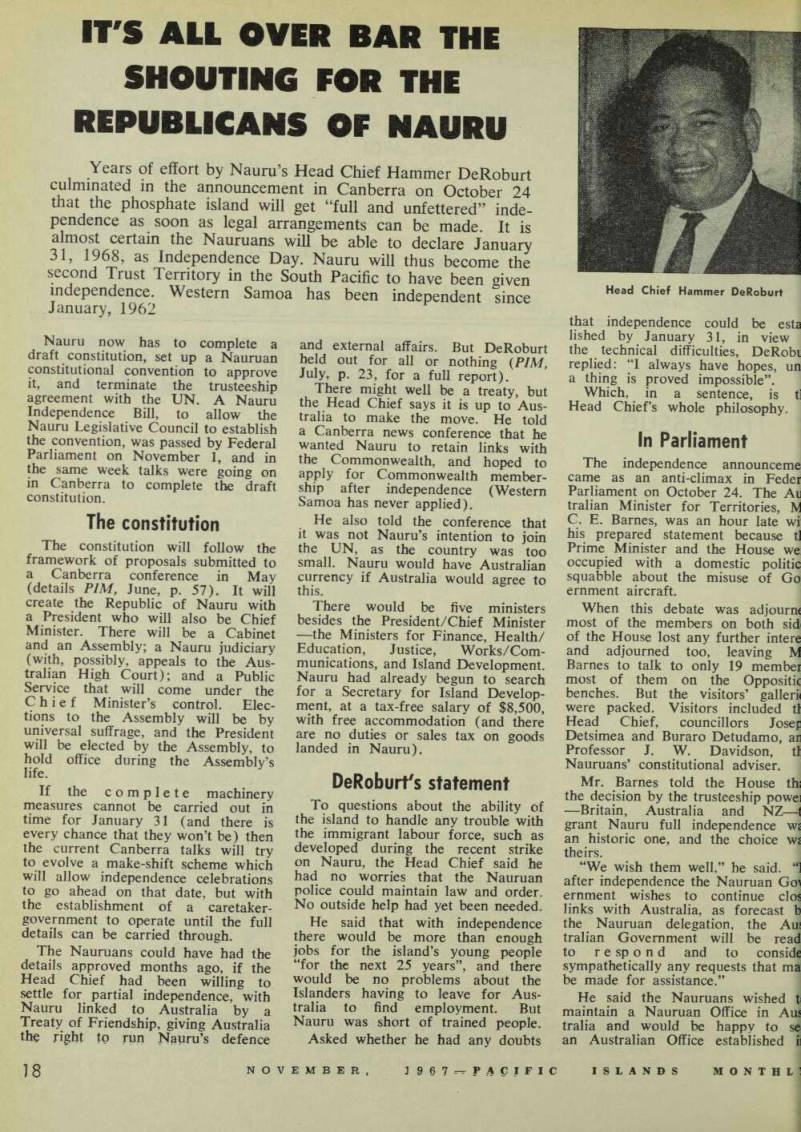
Head Chief Hammer DeRoburt
iru. They hoped Nauruan lents would continue to come to itralia. he Leader of the Opposition, Mr. igh Whitlam, said it was ap priate Mr. Barnes should have le his “momentous statement” on ted Nations Day, and added: This is the first of the territories which Australia became respon -2 to which Australia has helped ;ive independence. The association veen Australia and Nauru has nded over half a century. The mgements which the Minister has announced are very satisfactory ;ed. The negotiations have been I, but they have been friendly, iru and Australia will always be jhbours and there is every reason believe that they will always be nds.
Dne can hope that in due course e will be a similarly satisfactory :ome for the New Hebrides, for ch Britain and France are jointly onsible; for the Solomons and for which Britain alone is onsible; for eastern Timor, for ch Portugal is responsible; and ve all, for Papua and New nea, for which Australia is re isible.”
Reasonable
Producing the Nauru Indepen ce Bill a couple of days later, Bames said he felt Australia’s r to undertake Nauruan defence external affairs commitments had i a responsible one, put forward the best arrangement for Nauru, since it had proved unacceptable the Nauruans the governments not persisted in it, and he ight this also was the right course, tralia had followed for Nauru policy of self-determination, he ed. bere are 3,100 Nauruans in the ?osed republic. Their island has area of only 8i square miles, has been administered by Aus ia since an Australian force took session of it from the Germans, )dlessly, in 1914. be island has phosphate reserves >9.5 million tons, which are being chased by the Nauruans from British Phosphate Commissioners r the next three years for about million. The Nauruans have a tract with the BPC to sell the sphate at the rate of two million i a year for Sll a ton, which give the Nauruans a return of ut $6 a ton after costs. >ee pp. 45-47 for a Nauru )icture record.