Problems galore
p. 57 · Read in the full issue
from Norfolk's tourist boom
The September meeting of the Norfolk Island Council was probably the shortest in its his tory. It met just long enough to move that the Australian Minis ter for Territories, Mr. C. E.
Barnes visit the island for discus sions with council, or, if this is not possible, to establish a visit
of inquiry by a parliamentary
select committee consisting of Government and Opposition members.
AT its August meeting council had agreed to ask the Minister to come to Norfolk for discussions, or, that he be asked to receive a dele gation of councillors in Canberra, but this motion was later rescinded.
The appeals to the Minister fol lowed growing dissatisfaction by the councillors of the delays in having Canberra pass legislation they have recommended.
One of the delayed ordinances is for the conversion of leasehold land to freehold, which was approved by a previous council about three years ago.
Another is the Immigration Ordin ance, which was re-drafted by council several months ago, and until it be comes law council is unable to con trol the rush of new settlers in the present boom of prosperity, which has brought many problems.
In early August there were 172 non-resident mainlanders working on the island and 143 new settlers who intended to stay permanently. These numbers had increased by mid-Sep tember.
Many new settlers have opened business and are competing with estab lished shopkeepers. Some of the busi ness people are concerned at the prospect of intensive competition.
They say that the number of tourists is not increasing in proportion to the number of shops catering for them.
Many more shops are yet to be erected.
The new settlers have problems of their own. Settling in on a small island where land prices are high, living costs high and fresh fruit and vegetables very scarce is not without difficulties. And the occasional notice in the Government Gazette pointing out that the purchase of land, or the transfer of a Crown lease, does not in itself create any right to permanent residency must give some new settlers a feeling of insecurity.
Out-of-date laws
With all these new problems, some of Norfolk’s laws are out-of-date.
Laws that a few years ago were quite adequate for a few hundred people living quietly and leisurely in an uncompetitive atmosphere need re vision to cope with the development taking place today, and the council is well aware of it.
Recently council has received a good deal of criticism from local people, but it is, after all, purely an advisory body, and the Administrator is not obliged to take its advice, though the Norfolk Island Act 1963 states that where the Administrator disagrees with the council’s advice, he should refer the matter to the Minister for final ruling.
There have been occasions during the past year when the Administrator, Mr. Reg Marsh, has not followed council’s advice and this has resulted in some friction.
A Norfolk correspondent says the answer to the current unrest might well be another change in the island’s constitution; preferably one that would restore to the council—or perhaps even augment—the powers it received under the Norfolk Island Act 1957, and the Norfolk Island Council Ord inance 1960, and which were rejected by a former council in 1960.
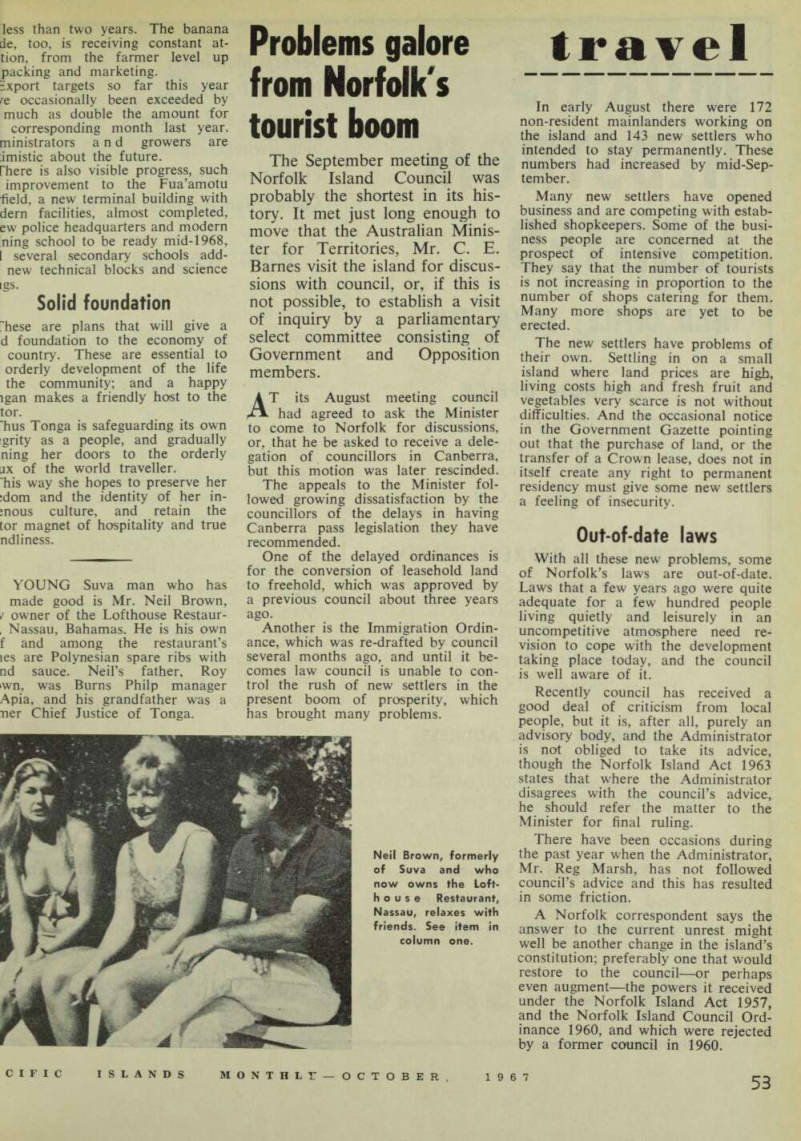
Neil Brown, formerly of Suva and who now owns the Loft house Restaurant, Nassau, relaxes with friends. See item in column one.