Tonga Aims At
pp. 55-57 · Read in the full issue
Orderly Development
Of Tourism
From a Nukualofa correspondent In the first six months of 1967, almost as many jurists arrived in Tonga as in the whole of 1966. This oes not include the many visitors for the coronation 'ho arrived later than June 30.
JOME of the cruise ships, the 7 Canberra among them, are now avelling direct from Auckland to ukualofa, by-passing the super larkets and duty-free shops of Suva id consequently giving a boost to ur cottage industries on which the immon people depend so mucti.
In the six months the total arrivals, irried by 106 aircraft of Fiji Air ays and Polynesian Airways, was 313. This is only 105 less than for ic whole of 1966, when 1,418 air assengers entered the kingdom. With ic coronation figures and the an cipated expansion of air services jring the next few months, air traffic lis year is expected to be double lat of 1966.
Every month now we have a good aota of New Zealanders calling here s the “banana boats”; the Matua nd Tofua always have a full
passenger list of round-trippers, approximately 70 each. It is a pleasant trip, calling at Suva, Pago Pago, Apia, Niue, Vava’u or Ha’apai, and Nukualofa. So popular has this trip become that it can be a four to five year wait for a winter booking.
Development plans
Fiji, with her international airport and positioned on the regular sea routes, is a mecca for tourists com pared with Tonga and Samoa, but now with the Dateline Hotel estab lished Tonga can supply some measure of sophisticated entertain ment that was lacking. As yet there are many needs—a golf course, public swimming pool, bowling greens, water sports and boating, and
other facilities for outdoor recrea tion, for our climate would be second to none in this area.
But these will come. Just now, when the visitor industry is taking shape, Tonga is greatly pre-occupied with her major economic develop ment plan. It is working out well water and electric power reticula tion, the expansion of her postal and communication services, new deep-water wharf soon to be opened, and better health services.
The 10-year coconut replanting scheme has made significant strides
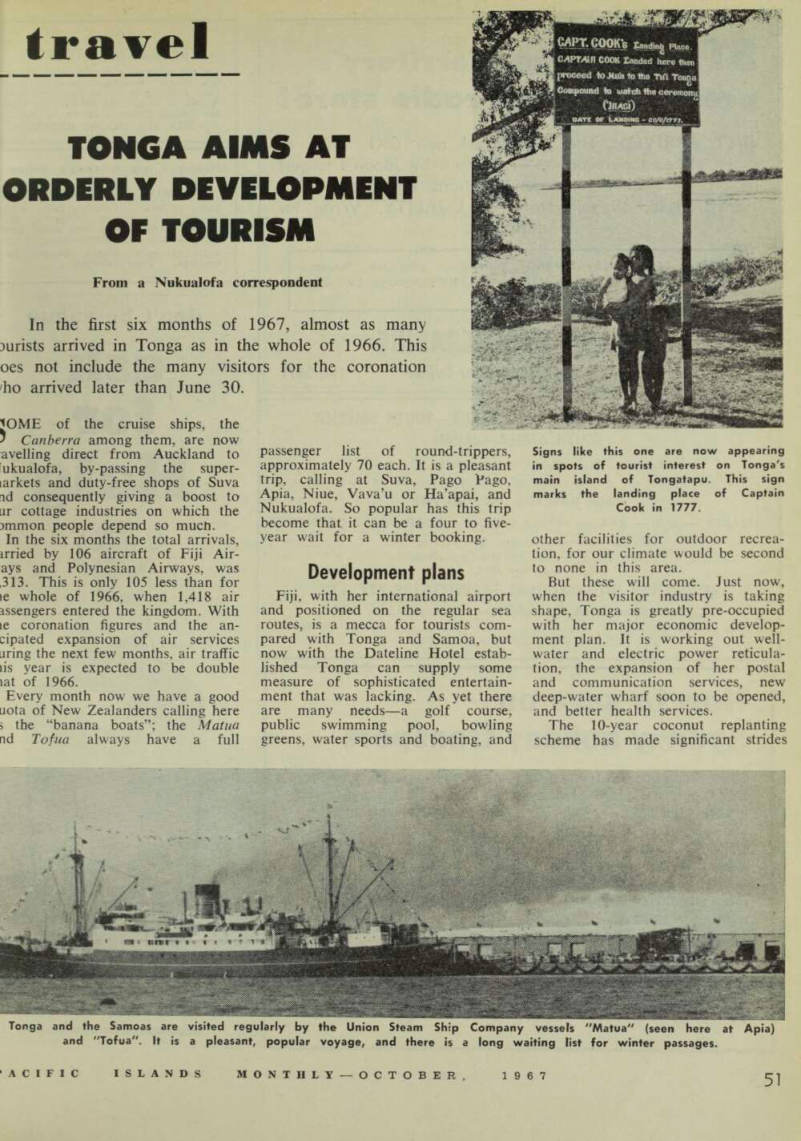
Signs like this one are now appearing in spots of tourist interest on Tonga's main island of Tongatapu. This sign marks the landing place of Captain Cook in 1777.
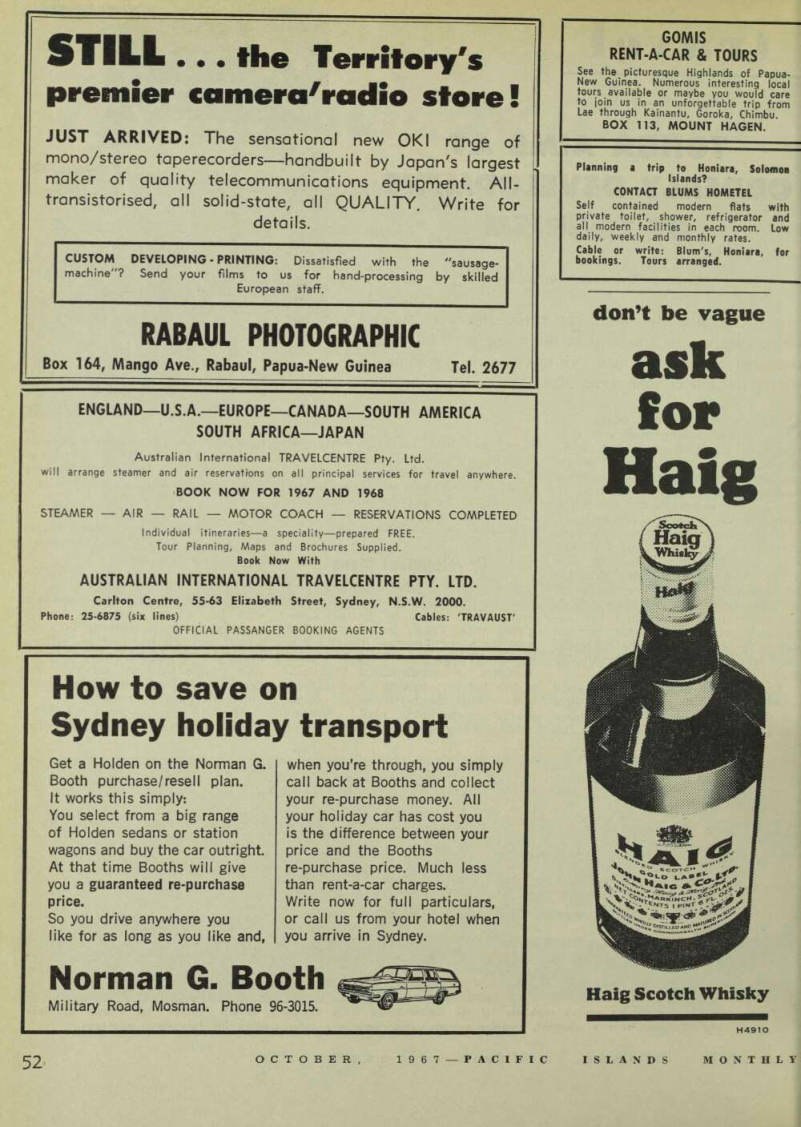
Tonga and the Samoas are visited regularly by the Union Steam Ship Company vessels "Matua" (seen here at Apia) and "Tofua". It is a pleasant, popular voyage, and there is a long waiting list for winter passages.
less than two years. The banana de, too, is receiving constant at tion, from the farmer level up packing and marketing.
Export targets so far this year rt occasionally been exceeded by much as double the amount for corresponding month last year, ministrators and growers are imistic about the future, fhere is also visible progress, such improvement to the Fua’amotu field, a new terminal building with dern facilities, almost completed, ew police headquarters and modern ning school to be ready mid-1968, I several secondary schools add new technical blocks and science igs.
Solid foundation
"hese are plans that will give a d foundation to the economy of country. These are essential to orderly development of the life the community; and a happy igan makes a friendly host to the tor.
'hus Tonga is safeguarding its own igrity as a people, and gradually ning her doors to the orderly ax of the world traveller.
'his way she hopes to preserve her :dom and the identity of her in mous culture, and retain the tor magnet of hospitality and true ndliness.
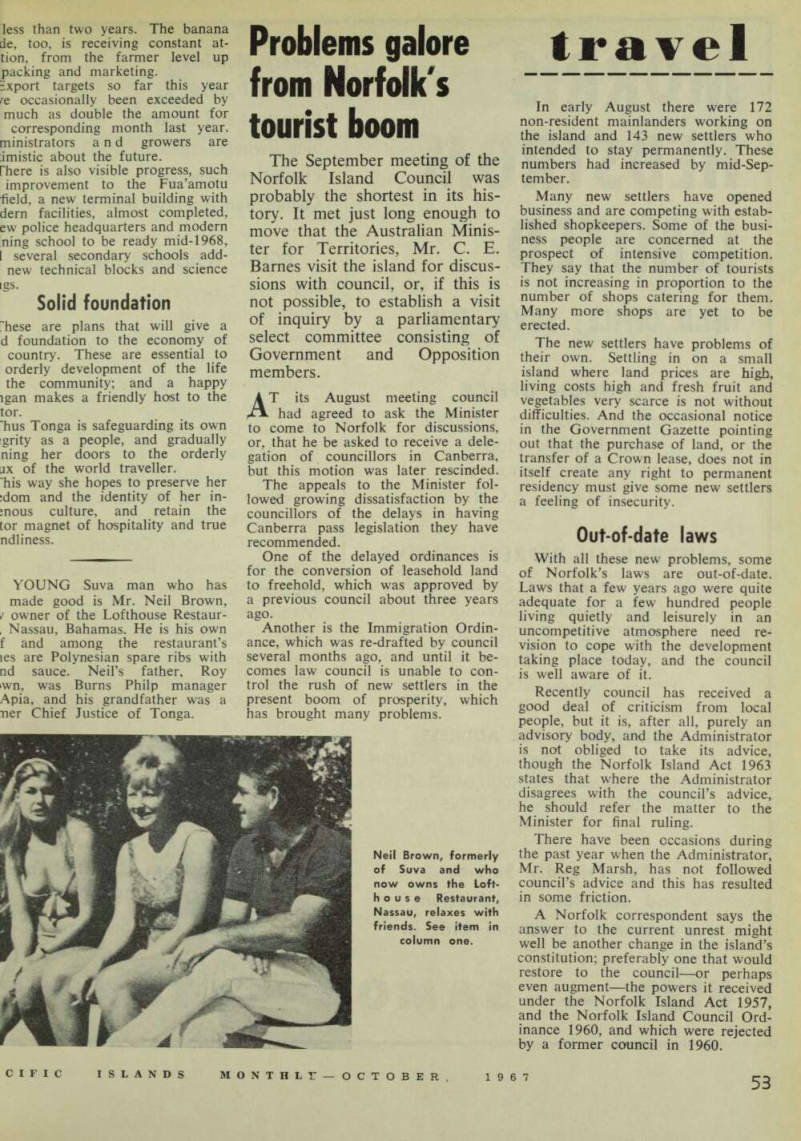
YOUNG Suva man who has made good is Mr. Neil Brown, / owner of the Lofthouse Restaur , Nassau, Bahamas. He is his own f and among the restaurant’s les are Polynesian spare ribs with nd sauce. Neil’s father, Roy wn, was Burns Philp manager Apia, and his grandfather was a ner Chief Justice of Tonga.