Oat among the remnants,
pp. 30-32 · Read in the full issue
The Solomons and New Hebrides
Oat among the remnants, east of Suez
By Judy Tudor
There is a television commercial in Australia that asks: “Are you smoking more but enjoying it less?” and to an extent this can be paraphrased to cover the British, east-of-Suez remnants in the South West Pacific where, superficially, they have never had it so good but where, publicly, the> think they have never been more miserable.
RECENTLY, in the course of col lecting material for the new edition of the Pacific Islands Year Book, I visited the British Solomon Islands Protectorate, the Condo minium of the New Hebrides, and New Caledonia, and although my visit was primarily an exercise in ex tracting statistics and hard facts, it was also one in which the visitor is expected to have some of the local answers.
Answers like what you think should be the future of the Solomons and how best to get its dragging economy off the ground; or how to import more wizards from London who will know how to perform these tricks, but fast.
A large slice of the European com munity of the Solomons seems to be perpetually exercised over these matters —without coming to any sort of conclusion. It is, more often than not, the opening gambit in any con versation and, after a few days, you, too, become infected and manufac ture a repertoire of suitably non committal answers to fit any problem that you are likely to have to face.
Or you wake, trembling, at night, from a nightmare, in which God has just made you a present of the Solomons and told you to get on with it—or else.
The Solomons problem
But how can one “get on” with the Solomons, stuck as it is in the wrong place, in the wrong century, psychologically handicapped by what I think is the growing distrust in the whole Australasian area of Eng lish global politics; and, worst of all, stuck with 140,000 indigenes who for the present want neither revolution nor independence.
Many of the problems of the BSIP could be more easily resolved if the Solomon Islanders were more politic ally aggressive. But out of shrewd ness, commonsense or plain laissez faire they sit blank-faced, inscrut able or dumb, biding their time and
watching civil servants invent schemes for promoting more civil servants, and the white minority in private business fulminate against the gov ernment.
I travelled from Fiji to Honiara with part of BSIP’s problem. It was July and all the other seats in the plane were occupied with kids re turning home for the long school holidays.
Aged between 10 and 16, all boys, they had travelled from London via New York and San Francisco, changed planes at Nadi, overnighted in Vila, filled in migration cards in two languages and coped with the
exigencies of travel like veters When I was that age, I did noth more adventurous than ride a b to the village school, so surely, 3 would think, the fathers of such i could cope with the problems of Solomons single-handed?
But no. The kids and their junl ings are mere symptoms of the curi( disease that afflicts the Solomons. ' to mix a metaphor, bribes in ever-lasting fight to snare civil 5 vants to work in this darkest c post of an empire that no lon exists.
The kids get two free trips ho a year (or Mum may go home England instead, on one occasic plus a large contribution to sch fees, while their families are accc modated in varying degrees austerity or splendour on the rid above Honiara.
No less than 40 per cent, of capi expenditure in the Solomons goes government housing—from that senior public servants to someth; a great deal simpler for nat labourers. Not only was Honis built from scratch, after the Pac: War, but it was built in an ai where there were few if any nat villages.
Two years ago when I stood these Honiara ridges I admired 1 new houses, each on its hillock, w sweeping views. Now the houses fi£ spread rash-like from the hillocks ir the hollows, where, in Honiar climate, they must be sweat-boxes.
New Government House
Down on the foreshores, work a new Government House has at 1; begun and should be completed son time in 1969 at a cost of 5270,0( to come out of the local budg Successive High Commissioners ha lived in the picturesque, difficult, : creasingly tumbledown, grass-thatch Government House that was left I hind by the Americans and which t reduced more than one First La to tears in its time.
Wh true British stiff-upper lip itude, however, the servants’ rters of the new estalishment have n completed first and can be sighted all their elegance from the rear he Secretariat building. They have n occupied—by the servants — e last year. iut despite school fees and holi flights, despite lavish leave ileges, tempting salaries and wances, there is still not enough lure the learned Britisher from home islands and the attractions only partly successful in luring sr fry from Australia or New land. So, in recent months, those » have control of these matters e upped the ante, üblic Service emoluments are le up of salary plus inducement wance, a large slice of the latter ig paid by the British taxpayer.
BSIP Treasury benefits from in ic-tax paid on salary, but income paid on that part of the allow ; provided by the United Kingdom s into the UK Treasury. Be rn the two countries this is mere kkeeping and no actual money nvolved. herefore, when it was announced as a further inducement to spective, short-term, high-quality I servants, tax on the inducement wance would be scrapped gether, and the person in question ;n a tax-free sum, it was also ed that BSIP revenue would not er in the slightest.
The critics at work
he proposal, however, made non lie servants in the Protectorate ping mad and in July-August this a red-hot issue. Critics were ous not only because tax-free iwances created a privileged section the community (or so it was ged) but because this was the first ffation about the bit of book ping that funnelled off the tax on UK component of the induce it-allowance into the UK Treasury, ad been assumed that BSIP revenue the full benefit of it.
Nonetheless, it is agreed by every one that some sections of the BSIP establishment do need new talent. The Department of Medical Services, for example, is desperately short of medical officers but finds it virtually impossible under existing circum stances to recruit experienced men or women in the United Kingdom, Aus tralia or New Zealand.
But it is arguable whether the means justified the end result in most cases and some aspects of the brain-drive are, to say the least, peculiar.
Among the trivia on government notice boards in August was one from the local Public Service Association, rejoicing, naturally enough, in the new tax-free allowance which, it said, would allow people with better quali fications to be recruited. But—the notice went on—in view of the greatly increased cost involved it was the duty of each and every officer to instruct indigenes quickly and to make him self REDUNDANT in the fastest time possible.
It conjured up a vision of a Brain, having deposited its tax-free induce ment in a London bank, rushing out by jet to Henderson Airfield armed with a large horse-syringe loaded with Knowledge, jamming it into the first Melanesian sighted, pumping th e
handle, leaping back into the jet and off back Home, mission completed.
But in spite of what my cynical, private enterprise friends in the Solomons say, I don’t think that the BSIP Civil Service is composed en tirely of ning-nongs who aren’t in terested in anything but a pension and a cottage in the Home Counties.
From personal, forced acquaintance with the public services of a score of different territories, of half-a-dozen different nationalities, with whom I periodically work closely, none to my knowledge has tried harder than those in the BSIP service to get its territory off the ground. And none has thought more fundamentally about it.
In territories where the economy is assured, the Public Service fades into the background; in places like the Solomons where the economy is a per petual headache, the Public Service becomes too important for its own good and thus the whipping-boy of the disgruntled.
If the BSIP service now appears to strangle itself in its own red tape it is largely through unhappy circum stance and not through lack of ability or even of good intentions. Funda mentally, there is nothing in the BSIP that a couple of good oil gushers or a mountain of nickel-ore wouldn’t fix.
Education strides
Meantime, statistics say that all is not lost in the BSIP. Exports fell in value by over SI million in 1966, com pared with 1965 while value of im ports rose by $2 million in 1966 com pared with 1965. But although traditional exports are virtually stationary, there is hope that timber will develop and that Guadalcanal Plains Ltd. will come good and pro duce that rice that the BSIP has been trying to produce since about 1947 in fact, 2,000 tons of it in 1968. The Commonwealth Development Cor poration, too, has been experiment ing with rice and still is with oil palms.
Great strides have been made in Melanesian education—but still have not gone far enough—and if English children are sent 12,000 miles to
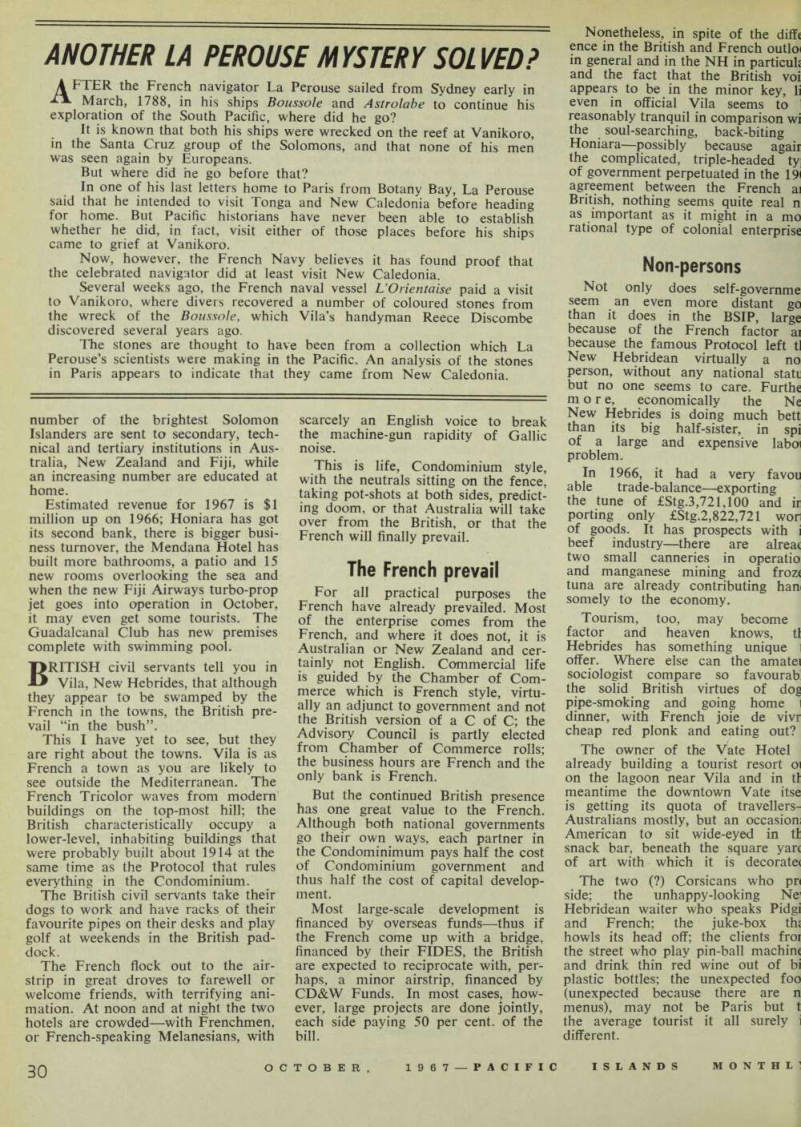
Sir Robert Foster, Western Pacific High Commissioner.
number of the brightest Solomon Islanders are sent to secondary, technical and tertiary institutions in Australia, New Zealand and Fiji, while an increasing number are educated at b o ™ 6 *. , . .
Estimated revenue for 1967 is $1 million up on 1966; Honiara has got its second bank, there is bigger business turnover, the Mendana Hotel has built more bathrooms, a patio and 15 new rooms overlooking the sea and when the new Fiji Airways turbo-prop jet goes into operation in October, it may even get some tourists. The Guadalcanal Club has new premises complete with swimming pool.
BRITISH civil servants tell you in Vila, New Hebrides, that although they appear to be swamped by the French in the towns, the British prevail “in the bush”.
This I have yet to see, but they are right about the towns. Vila is as French a town as you are likely to see outside the Mediterranean. The French Tricolor waves from modern buildings on the top-most hill; the British characteristically occupy a lower-level, inhabiting buildings that were probably built about 1914 at the same time as the Protocol that rules everything in the Condominium.
The British civil servants take their dogs to work and have racks of their favourite pipes on their desks and play golf at weekends in the British paddock.
The French flock out to the airstrip in great droves to farewell or welcome friends, with terrifying animation. At noon and at night the two hotels are crowded—with Frenchmen, or French-speaking Melanesians, with
scarcely an English voice to break the machine-gun rapidity of Gallic noise.
This is life, Condominium style w ith the neutrals sitting on the fence, taking pot-shots at both sides, predict jng doom, or that Australia will take over from the British, or that the French will finally prevail, ji C rOMr U *1
iTCnCII prevail
For all practical purposes the French have already prevailed. Most G f the enterprise comes from the French, and where it does not, it is Australian or New Zealand and cer tainly not English. Commercial life 18 B ui ded by the Chamber of Com n?.erce which is French style, virtu y n .^J unct government and not British version of a C of C; the Advisory Council is partly elected Jf on ? Chamber of Commerce rolls; business hours are French and the on y 18 Fren ch.
But the continued British presence has one great value to the French.
Although both national governments go their own ways, each partner in the Condominimum pays half the cost of Condominium government and thus half the cost of capital develop ment.
Most large-scale development is financed by overseas funds—thus if the French come up with a bridge, financed by their FIDES, the British are expected to reciprocate with, per haps, a minor airstrip, financed by CD&W Funds. In most cases, how ever, large projects are done jointly, each side paying 50 per cent, of the bill.
Nonetheless, in spite of the diffe ence in the British and French outlet in general and in the NH in particuh and the fact that the British voi appears to be in the minor key, li even in official Vila seems to 1 reasonably tranquil in comparison wi the soul-searching, back-biting Honiara—possibly because agair the complicated, triple-headed tyj of government perpetuated in the 191 agreement between the French ai British, nothing seems quite real n as important as it might in a mo rational type of colonial enterprise
Non-persons
Not only does self-governme seem an even more distant go than it does in the BSIP, large because of the French factor ai because the famous Protocol left tl New Hebridean virtually a no person, without any national statu but no one seems to care. Furthe more, economically the Ne New Hebrides is doing much bett than its big half-sister, in spi of a large and expensive laboi problem.
In 1966, it had a very favou
able trade-balance—exporting
the tune of £5tg.3,721,100 and ir porting only £5tg.2,822,721 won of goods. It has prospects with i beef industry—there are alreac two small canneries in operatic and manganese mining and froze tuna are already contributing ham somely to the economy.
Tourism, too, may become factor and heaven knows, tl Hebrides has something unique 1 offer. Where else can the amatei sociologist compare so favourab' the solid British virtues of dog pipe-smoking and going home 1 dinner, with French joie de vivr cheap red plonk and eating out?
The owner of the Vate Hotel already building a tourist resort oi on the lagoon near Vila and in tf meantime the downtown Vate itse is getting its quota of travellers- Australians mostly, but an occasioni American to sit wide-eyed in tt snack bar, beneath the square yarc of art with which it is decoratet The two (?) Corsicans who pr< side; the unhappy-looking Ne] Hebridean waiter who speaks Pidgi and French; the juke-box th* howls its head off; the clients fror the street who play pin-ball machine and drink thin red wine out of bi plastic bottles; the unexpected foo (unexpected because there are n menus), may not be Paris but t the average tourist it all surely i different.