Let's have education, roads,
pp. 29-161 · Read in the full issue
agriculture first, New Guinean MP's say
By ROBERT LANGDON, reporting on the New Guinea Budget.
If anyone in the United Nations or elsewhere is interested n learning what the native people of Papua-New Guinea •eally think about Australia’s presence in their territory, he hould invest in a copy of Hansard for the P-NG House of Assembly Budget session from August 28 to September 8.
lERE, in black and white for all the world to see, is a clear, un vocal statement that both the uans and New Guineans are most ous for Australians to stay, run invest in their country for many s yet, and that they would er their development to be slow sure rather than anything else, he native members’ speeches dur the 10-day Budget session re ited to the point of monotony the three subjects that interest i most for the time being are nation, road building and agricul —in that order.
Jive us more schools and teachers, e roads, and show us how to plant
more cash crops,” was the cry that echoed from speaker to speaker throughout the session.
Constitutional development, political parties, self-government, in dependence—all these things were unsettling and frightening subjects even to talk about in the view of many native members, and they could wait.
The speeches of the elected Euro pean members, on the other hand, suggested that the constant urging by the UN that Australia must give P-NG self-rule as soon as possible is beginning to hamstring Australia’s efforts to develop the territory to the satisfaction of the natives.
Inefficiency, confusion
Two results of the UN demands were referred to repeatedly by the European elected members. These are: • That an atmosphere of un certainty about the future of the territory has been created which has made business people reluctant to in vest or reinvest capital in the terri tory. • That the Government’s decision to abandon the recruitment in Aus tralia of permanent public servants for the territory has resulted in the Public Service degenerating into inefficiency and confusion.
Almost every elected European member spoke of the need for the Government to provide “investment guarantees” to attract capital to the territory; and almost everyone of them complained about the state of the Public Service.
Mr. Barry Holloway (Kainantu, Open) said, for example, that the Public Service was “duplicating its own work in an introverted frenzy in its own compact little cell at Konedobu and in the various district
headquarters.” Nothing short of “drastic reorganisation” could clean it up. He suggested that a team of overseas consultants should go to New Guinea “to implement a work able system.”
Mr. John Stuntz (East Papua, Special) said that although he had always been a proponent of the quickest possible localisation of the Public Service, it had become clear that there were “certain categories of overseas officers who we will need here virtually indefinitely.”
This could be seen through pro jections for the territory’s school leavers and the potential out-turn from universities. He therefore sug gested that the Government should examine the question of re-introduc ing career appointments for those positions where overseas officers seemed to be needed indefinitely.
Mr. Don Barrett (West Gazelle, Special) said that the state of the Public Service was “unsatisfactory in the extreme.” He bitterly criticised the Administration’s inability to make use of sl| million last year and s3i million the previous year in its Budget allocations for capital works and services.
“This is bad planning, bad pro gramming,” he said.
Mr. Barrett also thought the two
(continued on p. 153)
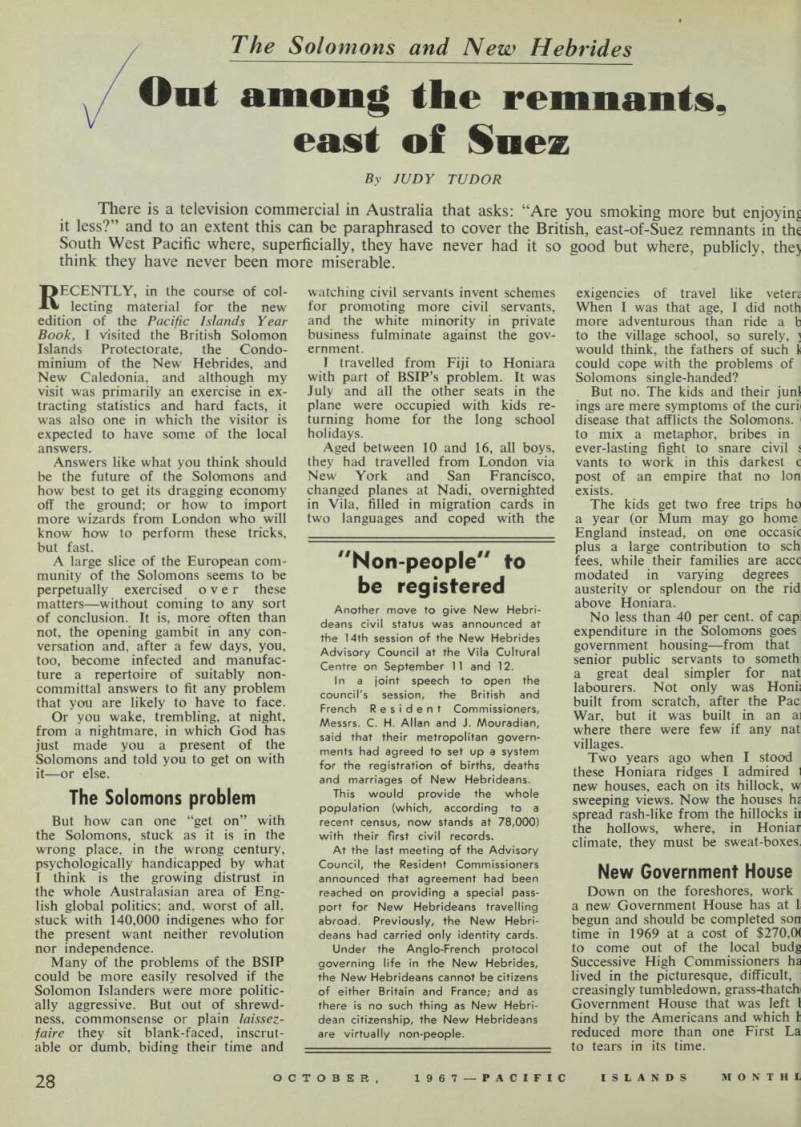
[?] member of the Assembly who made [?] rous useful contributions to the [?] et session was Mr. lan Downs, [?] ber for the Highlands (Special) electo- He also announced that he would [?] e a candidate for the new Assembly [?] year. Of the elected members, he [?] he longest unbroken period of service [?] ing been elected to the Legislative Council in 1957.
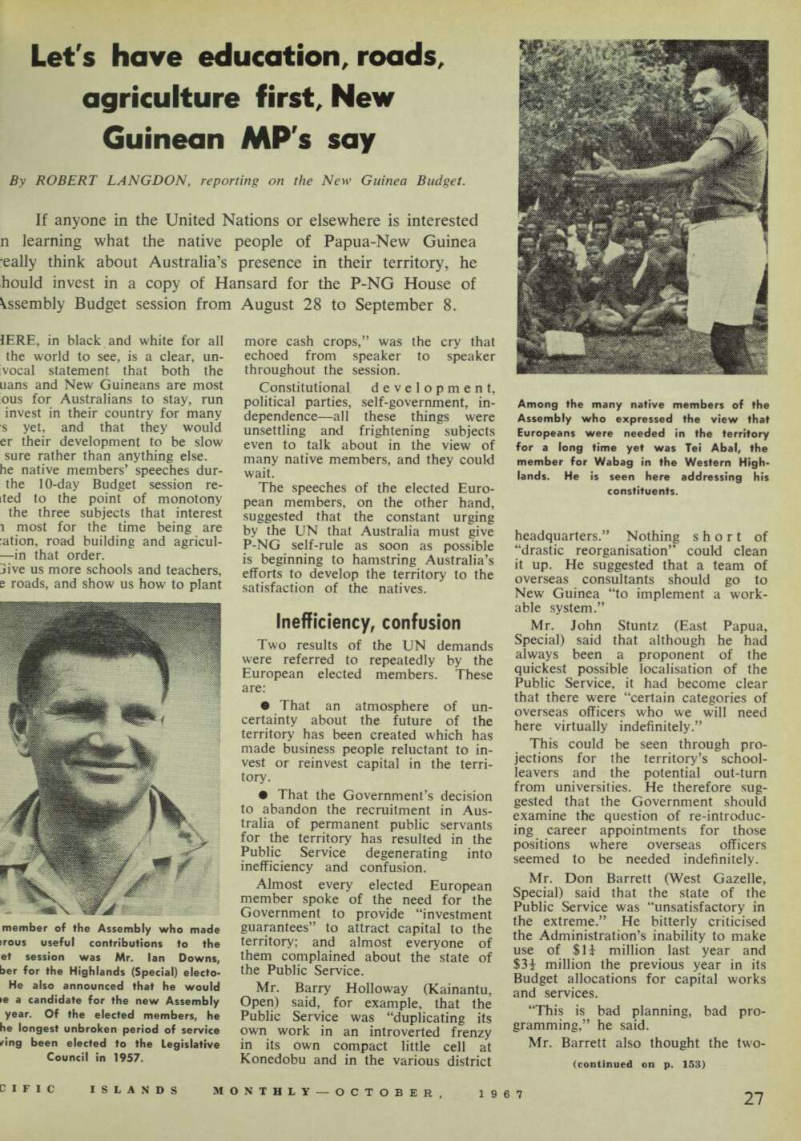
Among the many native members of the Assembly who expressed the view that Europeans were needed in the territory for a long time yet was Tei Abal, the member for Wabag in the Western High lands. He is seen here addressing his constituents.
contract system for overseas ic servants was unsatisfactory; he seriously questioned the Ad oration’s ability to recruit 2,186 ble local public servants this cial year (as proposed in the ;et) because, he said, only about ) Form 3 and Form 4 students now at territory schools. Of many would be recruited for iniversity, the Institute of Higher nical Education, the Vudal mltural College, several teachers’ ges, the Papuan Medical College, Forestry College, Army, Police ; and private enterprise, r. Barrett, who is chairman of “watchdog” Public Accounts mittee, said that the Public Ser was in such a bad way that at lext Assembly session, he would : that a firm of consultants should a “comprehensive overall re ’ of the organisation of the inistration and make a report e House.
Too complicated
•. Barrett’s notice of motion on the last day of the Budget •n which was notable also for: Numerous attacks by elected pean members on the Depart of Territories. (The general was that the Territories Depart interfered unnecessarily in many ts that could be dealt with by ■louse and the Administration).
Statements by the Speaker, Mr. e Niall, and members of the rnment that because the native 3ers had found the business ie House too complicated to v, efforts should and would be to make things easier for them e new Assembly to be elected year.
A concerted, but unsuccessful by the elected European mem in the last hours of the session ve the tax on public and private anies reduced from the 22i per as proposed in the Budget, to 3er cent. e session got off to a lively start a motion moved by Mr. Graham ore, member for South Mark special). is was that before any further opment towards self-govern or independence took place in territory, a referendum should ;ld in Papua to see whether the ans wished to form a full and anent constitutional union with Yust Territory of New Guinea,
or whether they wanted to retain theii link with Australia and their present Australian citizenship.
The motion was subsequently amended to read that both Papuans and New Guineans should be given a referendum or plebiscite to state their views before any irrevocable act took place to unite them con stitutionally.
Speaking to the original motion in Pidgin, Mr. Gilmore said: “If the Papuans want to join us, I think New Guinea can be a strong country.
However, if we join and get self government or independence and the Papuans decide that no one asked them whether they should be joined together or not, there will be trouble.
This has happened in Africa where people have decided that groups should be united without telling them, and there are many fights and wars because of this,”
The contributions by many of the native members to the six-hour debate that followed left no doubt that they had no clear idea of what the motion meant, and that the very idea of talking about it was dangerous.
“We do not want a lot of talk that may divide the country and the people,” said Edric Eupu, member for Popondetta, Open.
Zure Zurecnuoc (Finschhafen, Open) thought the “mistake” of hav ing two territories should be rectified “while the Australians are still here.”
But he was emphatically against haste. “Please give us more time—a little time —we are up against time,” he said. “We cannot absorb every thing because so many things are coming at once.”
Wrong time
Lepani Watson (Esa’ala-Losuia, Open) thought the present was the wrong time to discuss the motion, and that it would be more appropriate to pass a motion to educate the people so that they would know the difference between Papua and New Guinea.
Pita Tamindei (Maprik, Open) ex pressed no view on the motion at all, but made it clear that a lot of disturbing talk emanated from the educated young men in the towns.
“We in this House must not hear what these young men have to say,” he said.
Kaibelt Diria (Minj, Open) said that Papuans and New Guineans were “all one kind,” but he thought the Europeans were trying to spoil the country with their alien ideas.
“You, Europeans, started the idea of political parties, and the idea of self-government came from you, too,” he said. He added: “If we work easily and go slowly, then later on we can stand up and be strong.”
Tei Abal (Wabag, Open) denied that the “white man is trying to de stroy us,” but said the natives should “not be too anxious to get something and then collapse and blame the white man.”
“I agree with Mr. Gilmore’s motion, but I do not want to hurry it up,” he said.
Of the many other native members who spoke, all took similar stands to those quoted.
The European elected members strongly supported the motion; while the Government opposed it on the ground that it would cut across a decision already made by the House —that the ultimate constitution for Papua-New Guinea should be left until experience gained in the light of recent constitutional developments could be a guide for the future.
It was not surprising, therefore, that when the motion was finally put to the vote, it was soundly defeated —3O votes to 19.
The debate on the Gilmore motion overshadowed all other business— apart from the presentation of the Budget—during the first four days of the session, and it did not show the native members up as very promising material for a fully self governing House.
There was, however, one debate in which they did shine. This was on a motion by Gabriel Ehava Karava (Lakekamu, Open) that the Admin
Mr. Keith Tetley (Gulf, Open) had some critical things to say on the Budget.
'G Assembly
on should do more to actively rage small-holder rice-growing. :e was a subject they could all understand, and they spoke on istructively. i rice debate put everyone in ght sort of mood for nearly two of talking on such matters as jvernment, political parties and tion.
Abal reiterated an oft-expressed on his part that the people in Astern Highlands did not want uropeans to go away, and this was echoed by a number of the native members, iye Siune, who thought it was yet time for political parties,”
“Many Papuans and New ans on the coast have had the nment with them for a long and they understand many and their businesses are pro ig well. But we people from lighlands—we are still newly ered people. We have not seen lace progress properly yet.”
Budget criticised
>ates on a variety of minor sub kept the House so busy that j not until the evening of the h sitting day that members got to discussing the main item j notice paper—the Budget, m the European members, at this came in for quite a “roast while the native members took >ut to tell the government over ver again how much their dis needed schools, teachers, roads, s and economic development. main complaints about the t from the European members that: Fhe Administration had made brt to reduce unnecessary and wasteful expenditure.
Company taxes were too high act or keep capital in the terri- Fhe Administration was trying rt at the top and work down, as it should be starting at the • level and working up.
Fhe natives were not doing ti to pay for their own develop- Keith Tetley (Gulf, Open) said ne way of putting the country irm economic footing would be r down the new university and ae material to build primary s in the villages. He also >ed the appointment of an asso
ciate professor in prehistoric archae ology for the university at nearly $lO,OOO a year.
Mr. Percy Chatterton (Central, Special) said he did not entirely share Mr. Tetley’s objection to prehistoric archaeology, but he did think there was a need to get down quickly to the problem of basic education.
Between 50 and 60 per cent, of the territory’s school-age children were going to grow up illiterate be cause there were no schools for them to go to, he added.
Considering the enormous amount
of emphasis that native members placed on education, public works and agriculture, the message of the Budget session clearly was that Aus tralia could well afford to forget about the United Nation’s urgings for a while, and concentrate on try ing to give the people what they really want.
WORK has begun on a new hotel at Erakor Lagoon, an attractive spot behind Vila, the New Hebrides capital. There are two other hotels in Vila.