Book Reviews
pp. 93-95 · Read in the full issue
Vivid Life Of "Chinese"
Morrison, Venturesome
Australian Journalist
Papuan spears ended his South Seas career
In the museum of the medical school at Edinburgh Uni versity, Scotland, there is a tapering fragment of wood about three inches long which has an unusual medical history.
IHE piece of wood, which is the point of a Papuan spear, was Tacted from the abdomen of adventurous Australian, George nest Morrison, after it had lain ;re for nearly nine months.
Morrison “collected” the spear tip Papua in 1883 when he led an sedition into the wilds of that terri ■y as a correspondent for the Mel urne Age. This was at the time icn people in Australia were eagerly sporting the action of Thursday and police magistrate, Henry tester, in annexing eastern New linea for Great Britain—an act that d been repudiated by the British wernment.
The spear tip was one of the least ■eeable items that Morrison ac ired in a notable career as a col tor of things (particularly books) d as a newspaper correspondent in : H. M. Stanley tradition.
Much of Morrison’s career was :nt in China as correspondent for e Times, of London, and he was pularly known as “Chinese” Morri i. But he did many other things sides.
Mass of material
Indeed, his life was so adventurous, usual and colourful that a bio tphy of him would no doubt have in written long ago if it had not in for the huge mass of source terial that he left behind him.
Morrison’s passion for collecting ngs (or of never throwing anything ay once he had acquired it), plus lifetime diligence in keeping ries, resulted in no less than 255 ices, volumes and packets of letters, igrams, cuttings, cards, photo iphs, hotel bills and even pawn cets being given to Sydney’s
Mitchell Library after his death in 1920.
Such a formidably rich lode of material is enough to scare off most would-be biographers. But Morrison has now found a Boswell in noted Australian journalist and author Cyril Pearl, who, besides sifting through the mass of Mitchell Library material, also carried out research in China, Japan and England.
His biography, Morrison of Peking, is an eminently readable account of Morrison’s life, despite its somewhat forbidding bulk (431 large size pages) and long quotations from Morrison’s own writings.
Born in Melbourne
The first 50 pages or so are of particular interest to those with a taste for Pacific history, as Morrison, in the early part of his career, made a foray into the New Hebrides to investigate the blackbirding trade in addition to his ill-starred expedition to Papua.
Morrison, the son of a Scottish schoolmaster, was born in Melbourne in 1862. He went to his father’s school, Geelong College, until he was 18.
The last two years of his school days are well documented, for at 16 he began the practice of keeping a diary which he kept up with few interruptions for the rest of his life.
At 17, Morrison compiled a book about Australian exploration which he dedicated to “Henry Moreland
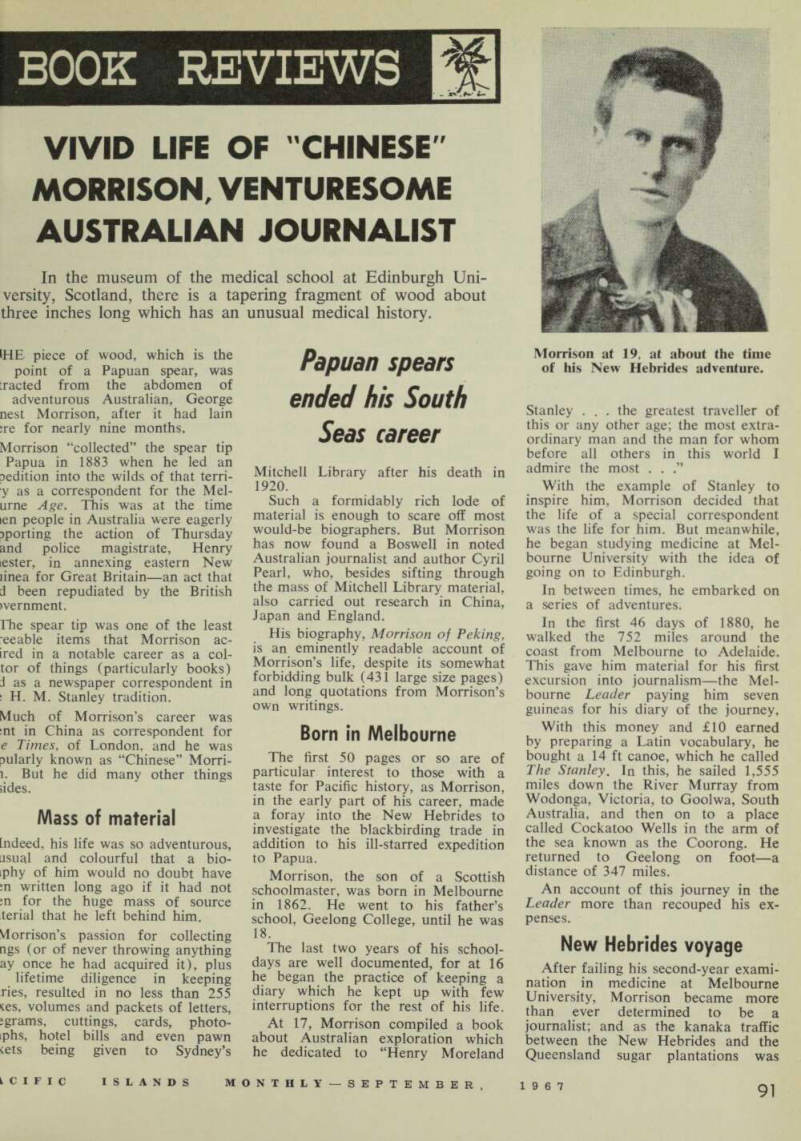
Stanley , . . the greatest traveller of this or any other age; the most extra ordinary man and the man for whom before all others in this world I admire the most . .
With the example of Stanley to inspire him, Morrison decided that the life of a special correspondent was the life for him. But meanwhile, he began studying medicine at Mel bourne University with the idea of going on to Edinburgh.
In between times, he embarked on a series of adventures.
In the first 46 days of 1880, he walked the 752 miles around the coast from Melbourne to Adelaide.
This gave him material for his first excursion into journalism—the Mel bourne Leader paying him seven guineas for his diary of the journey, With this money and £lO earned by preparing a Latin vocabulary, he bought a 14 ft canoe, which he called The Stanley. In this, he sailed 1,555 miles down the River Murray from Wodonga, Victoria, to Goolwa, South Australia, and then on to a place called Cockatoo Wells in the arm of the sea known as the Coorong. He returned to Geelong on foot—a distance of 347 miles.
An account of this journey in the Leader more than recouped his ex penses.
New Hebrides voyage
After failing his second-year exami nation in medicine at Melbourne University, Morrison became more than ever determined to be a journalist; and as the kanaka traffic between the New Hebrides and the Queensland sugar plantations was
Morrison at 19, at about the time of his New Hebrides adventure.
Labour recruits beaten, terrorised
then a controversial topic, he pro posed to the Melbourne Age that he should ship as a seaman on a black birding vessel and write a report about it.
The Age welcomed the idea, and Morrison sailed from Mackay to the New Hebrides in June, 1882, aboard the 119-ton brigantine Lavinia.
The Lavinia cruised through the New Hebrides from Vanua Lava in the north to Futuna in the south, collected 76 recruits, and returned to Mackay in 100 days, where the re cruits fetched £l6 a head.
Six articles, entitled “A Cruise in a Queensland Slaver, by a Medical Student” subsequently appeared in the Leader.
They were written, according to Morrison’s biographer, in a “banter ing, would-be humorous style”, which softened much of the author’s criticism of the labour traffic.
However, Morrison later wrote a 2,700-word letter to the Melbourne Age in which he forcefully denounced the traffic, saying that most of the recruits were obtained by false pre tences, that they were shot if they attempted to escape, and that in Queensland some of them were kicked, beaten and terrorised with stockwhips.
Inquiry
Morrison’s charges led to the Colonial Secretary asking the Queens land Governor to hold an inquiry.
This was entrusted to Queensland’s Inspector of Pacific Islanders and the Police Magistrate at Mackay (which was rather like present-day instances of asking the police to investigate charges of police brutality).
Morrison was not asked to give evidence, and the only witnesses were the men involved. Not sur prisingly, the Governor was eventu ally able to tell the Colonial Secretary that “no facts were elicited corrobo rating in the slightest degree the serious allegations of Mr. Morrison”.
Meanwhile, Morrison had gone off on other adventures.
Ten days after arriving back in Mackay from the New Hebrides, he took a steerage passage in the steamer Ranelagh for Cooktown, but the voyage terminated abruptly when the ship was wrecked at Bowen.
From there, he worked his way north via Cooktown to Port Moresby, where he went on a bird-shooting expedition with the naturalist Andrew Goldie.
Returning to Queensland, Morrison prepared to make a journey he had long contemplated— to walk across Australia from Normanton to Mel bourne, a distance of more than 2,000 miles.
His plan, roughly, was to follow the route of the disastrous Burke and Wills expedition of 1860-61, in which seven men, equipped with 25 camels, 23 horses, a number of wagons and 21 tons of equipment, lost their lives. leaving Normanton on December 19, 1882, with no more than he could carry on his own back, Morrison slogged southwards in violent winds, torrential rain, fearful heat and enervating humidity; he marched through bogs, rivers, “wretched country of clay pans and sand ridges . . . uninteresting scrub . . . vast flats of salt-bush, and occasional stretches of barren hills”.
Much of it seemed “the very in carnation of dreary desolation”, and for 1,700 miles he did not see a single kangaroo. He reached Mel bourne on April 21, 1883, in what he described as “perfect condition”, and earned a humble £4/10/- from the Age for a 6,000-word account of his journey.
Morrison’s return to Melbourne co incided with the start of something of a furore over the British Govern ment’s repudiation of Henry Chester’s act —carried out at the instigation of the Queensland Premier—in taking formal possession in Port Moresby of “all that portion of New Guinea . . . lying between the 141st and 155th meridians of east latitude, in the name of and on behalf of Her Gracious Majesty Queen Victoria, her heirs and successors”.
Australia's security
There was general indignation at Britain’s action, the Australian view being that British rule in New Guinea was essential to Australia’s security, Morrison saw in the New Guinea question another opportunity to play the part of a special correspondent, and he told the Age that he was pre pared to lead an expedition into the wilds of that territory.
Pearl’s book does not make it clear what Morrison hoped to accomplish, but whatever it was—assuming that Morrison knew himself—the Age agreed to it, and gave him the grandiloquent title of “Special Com missioner of the Melbourne Age", without pay.
A rival paper, the Argus, soo learned of Morrison’s plans and hi fore long it, too, was equipping a expedition to New Guinea under th leadership of Captain William Armi whom it described as “a Fellow of th London Linnean Society ... a forme officer of the Queensland Nativ Police, an accomplished writer, an a gentleman specially qualified fc such an hazardous enterprise”.
"Drunken scamp"
Morrison, on the other ham described Armit as “a drunke scamp” and a “bullying, boastfu lying, man of 35, with no mor claims to the title of Captain than have to General”.
Morrison left Melbourne for Poi Moresby on June 6, 1883, and ai rived there a month later, having er gaged two white men, a Hebridean and a Malay in Cool town to join his expedition. He als had a large collection of trade good for the conciliation and civilisatio of the natives, the Age having wire him “not (to) study economy in me; or equipment” as the Sydney Mornin Herald was sharing expenses.
Morrison beat “Captain” Armit t Port Morseby by three days; cava lierly took possession of 15 horse that were running wild at the LM; mission station of the Revs. W. G Lawes and James Chalmers; am wrote to his mother that by this acl he had “simply euchred” Armit.
Leaving Port Moresby with th horses on July 11, 1883, Morrisoi
planned to cross the Owen Stanleys to Dyke Acland Bay on the north coast, a distance of about 100 miles.
By the beginning of October, they were in densely populated country, and native pilferers were so trouble some that Morrison decided to fire on one of them—at a distance so as not to do serious injury—to show that he would no longer submit to their thievery.
It was a foolish action. Next day, as the expedition was preparing to move off from its camp, warriors with heavy bundles of spears gathered in crowds, and the long grass “fairly bristled with spears”.
As Morrison moved off through the grass, leading his horse, he was struck violently by two spears. One penetrated his stomach just under the chest; the other entered the hollow of his right eye and struck the bottom of the bridge of his nose.
Qualified as doctor
Morrison pulled the two spears out —the one in the abdomen coming iway more readily than that in the J ace; fired his gun in the direction hey had come from; and collapsed n a torrent of blood.
One of Morrison’s white com >anions then took command of the :xpedition; and with Morrison worry ng about what the Age would say ibout his failure, he rushed him, in treat pain, back to Port Moresby.
Morrison lost nearly four stone in weight as a result of his wounds: md back in Australia, even the ountry’s leading surgeon could not emove all the pieces of spear that tad remained in his body after the hafts had been pulled out.
The surgeon, however, recom nended that Morrison be put in the sands of the celebrated John Chiene, 'rofessor of Surgery at the Uni ersity of Edinburgh.
Lame and suffering severely, Morri on arrived in England in May, 1884, nd six weeks later, Chiene and an ther distinguished surgeon, Joseph fell, removed another three inches f spear from Morrison’s abdomen— nth 16 other surgeons looking on.
The successful removal of this -agment brought an end to Morri s’s South Seas career; but this was sally only the beginning of his Ktremely eventful career.
Following his operation, he re amed his medical studies at Edin urgh; graduated in August, 1887; d a wandering life in Europe and anerica for the next nine months r so; and then became assistant irgeon to the Rio Tinto mines in pain.
Then followed another period of wandering, which included a long journey through China to Burma dressed as a Chinaman. This gave Morrison material for a book, which was published in London in 1895 as An Australian in China.
This led to The Times inviting Morrison to go out to Peking as correspondent for the paper; and Morrison accepted on condition that he could first go to Indo-China and Siam, which he thought were more
interesting.
Magnificent library
Morrison spent 17 years in the service of The Times, and became, in the words of the editor, one of the paper’s “greatest ornaments”. His reports had considerable sway at the Foreign Office and in British financial circles, and his advice was sought after by both Chinese and Westerners.
When Morrison left The Times to become political adviser to Yuan Shih-k’ai, the first president of the Chinese republic, The Times treated him with what he described ironically
as “characteristic generosity”, paying him only £73 for his passage back to London from Peking.
During his years in China, Morri son visited every province and assembled a magnificent library of Chinese works, many of them rare.
Morrison’s passion for book collecting frequently left him short of funds. But when he sold it, to a Japanese baron towards the end of his life, it fetched £40,000.
It was Morrison’s wish that the library should remain intact for all time; but his biographer reports that the books have now been distributed through the library of the Tokyo Institute of Oriental Studies and can be identified “only by the sad and reproachful kangaroo that looks out from the bookplate”.
This, certainly, is not much of a remembrancer for an Australian who became one of the foremost figures in the Far East of his time. But Cyril Pearl has now rehabilitated his memory in fine fashion with his
fascinating biography.-
RL.
(Morrison Of Peking. Angus And
Robertson. $6.95.) • Macmillans, the publishers of Nancy Phelan’s amusing novel Serpents in Paradise, inadvertently gave us the wrong price in sending us the copy reviewed in our July issue (p. 99). The correct price is $3.15, not $3.75. The novel concerns life in the mythical Peaceful Islands Colony, which our reviewer described as a “cross between Rarotonga and the Gilbert and Ellice Islands”.