yesterday
p. 91 · Read in the full issue
Countless millions of snails, some up to seven inches long, were destroying vegetables and threatening food sup plies on New Britain and New Ireland, PIM reported 20 years ago. Introduced by the Japanese during their occupa tion, the snails had run wild and had multiplied, eating every plant in their path. European planters claimed that after a shower, there were three snails for every square foot of roadway on New Britain, and that the points of the snails’ shells were sharp and hard enough to puncture jeep tyres.
OTHER items in PIM for Sep tember, 1947, included: rO British ships, each of 10,000 tons, had been bought by the W. R. Carpenter group of companies and were to be refitted in Canada before starting trans pacific services. The ships. Spurn Point and Dungeness, brought the total number of Carpenter ships to eight. Most were running in the Pacific. r ELVE men had been arrested in Papeete following a dis order on the waterfront when the French liner Ville d’Amiens ar rived on June 22. Young French- Tahitians, mostly returned soldiers, were protesting because the liner had brought three high officials from France for service under the Governor of Tahiti. They felt that such posts could be capably filled from the local population.
FOR the first time in 15 years a plane carrying the French Tricolor visited the New Hebrides.
It was a Catalina of the Trapas Company, which was to start an air service linking Noumea with Vila and Santo, New Hebrides.
TTIGH prices for copra and XX cocoa were causing a boom in Western Samoa. The Adminis trator’s annual report for 1946 showed that imports were £478,695 and exports £719,050 — a record.
The population at March 31, 1947, was 71,460.
A CONSIGNMENT of Plaesius javanus beetles had been rushed from Fiji to Guam, via Honolulu, to cope with an out break of weevil-borer in Guam’s newly-established banana planta tions.
THHE rarely heard-of Tokelau X Group, consisting of three small atolls and 1,000 natives, was
to issue its own postage stamps— and PIM described the plan as a racket. “The quiet Polynesians of the Tokelaus do not use a stamp per person per annum,” it said.
A BANANA dehydrating plant had started in Suva. The bananas were dehydrated whole instead of being split into three in the Samoan way. They were wrapped in transparent paper with distinctive Fijian labels.
THE new Governor of French Oceania, Mr. Maestracci, had arrived in Papeete to replace Mr, J. C. Haumant.
MARCHING Rule movements, under which the natives set up illegal courts, refused to recog nise government courts, and de fied the district officers, were re ported on north Malaita, BSIP.
The acting Governor of Fiji and High Commissioner for the Western Pacific, Mr. J. F. Nicol, had left Suva for the Solomons to investigate. rE six Norwegian Kon-Tiki raft scientists, led by Thor Heyerdahl, reached Papeete on August 28, 1947, from Raroia in the Tuamotus. They made the trip in a French Government ship,
Tamara, which also towed their damaged raft. They had left Callao, Peru, on April 29 and had drifted 4,360 miles to Raroia to prove that pre-Inca inhabitants could have peopled Polynesia.
PlM’s cover picture, captioned “Sons of New Guinea”, showed three small Rabaul boys— Bruce Kensett, son of Mr. S. Ken sett, John Biffen, son of Mr. R.
H. Biffen, and Joe Bartlett, son of Mr. J. Bartlett. The boys would now be in their mid-twenties.
Where are they now?
THE Weekly Guardian, a news paper for Fiji, made its first appearance in Suva on August 29.
It had eight pages and was edited by a New Zealander who had lived in Fiji for several years, Mr.
George A, Furby.
Mr. F. T. Goedicke-Van
ASTEN, of Ha’apai, Tonga, said in an article: “When I arrived in Ha’apai, in 1885, there were over 100 Europeans in the Ha’apai Group. Today, Ha’apai can count only five in Lifuka, besides one father and two sisters of the Catholic Mission. On all the other islands of the Ha’apai Group, only one other European is still alive—your humble servant and correspondent.”
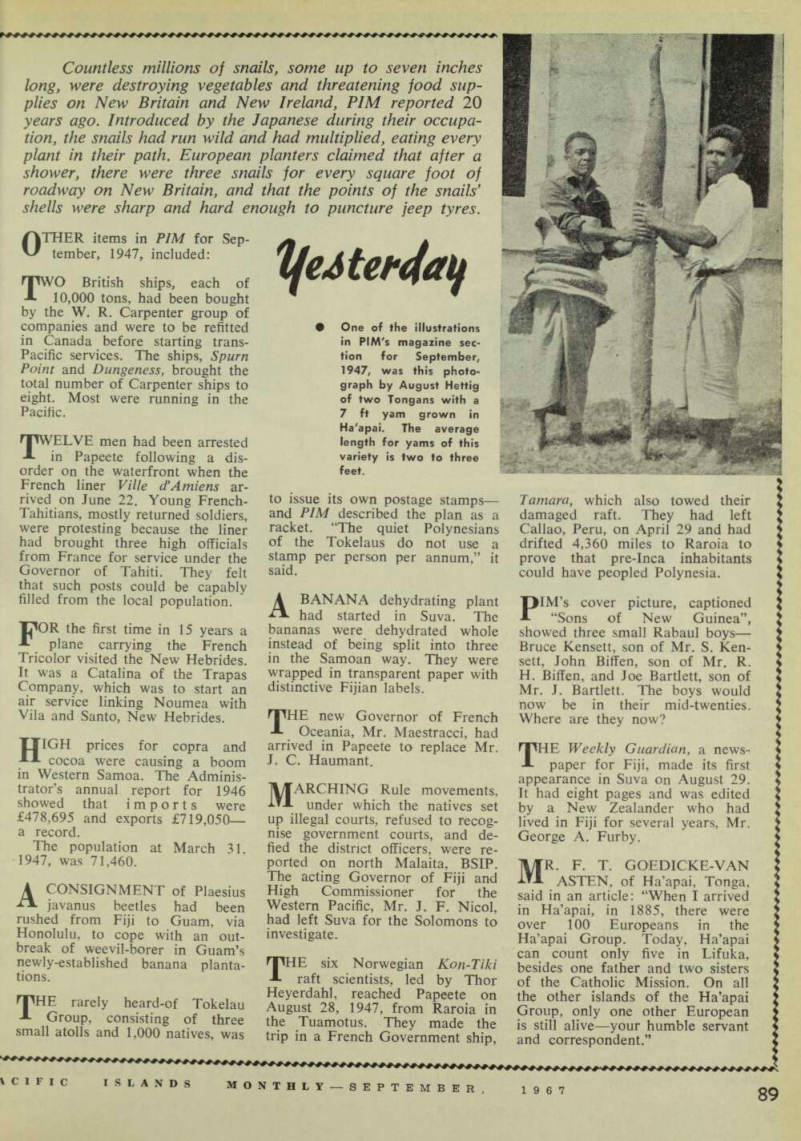
• One of the illustrations in PlM's magazine sec tion for September, 1947, was this photo graph by August Hettig of two Tongans with a 7 ft yam grown in Ha'apai. The average length for yams of this variety is two to three feet.