Polynesian visitors?
pp. 67-70 · Read in the full issue


Another Pacific mystery Who were Walpole Island's Polynesian visitors?
From FRED DUNN in Noumea An expedition in late June and early July to uninhabited Walpole Island, an outlier of upraised coral rock some 80 miles east of New Caledonia’s Isle of Pines, has resulted in the dis covery of some intriguing relics of Melanesian and Polynesian visitors of former times.
A PARTY of French soldiers, sailors and scientists visited Wal pole in the French naval vessel L’Orientaise. They included the curator of the Noumea Museum, Mr.
Luc Chevalier, Their objectives were to survey the state and extent of the island’s guano deposits; its vegetation; and to investigate a theory that survivors of the La Perouse expedition of 180 years ago had ended their days on the island.
Walpole Island is a little over li miles long and 650 yards wide at the widest part. It is nearly 300 feet high, with almost vertical cliffs honeycombed with caves.
Landing can only be accomplished at certain tides and in calm weather, but even then it is a hazardous under taking.
The island’s known history goes back only to the year 1794 when it
was discovered by Captain Butler of the British ship Walpole.
In 1888, a party of guano prospec tors landed on the island and took samples for testing; and in the follow ing year a Mr. Desmazures obtained a lease to exploit the guano deposits for a rental of 250 francs a year.
In 1908, this lease was transferred to the Austral Guano Company, of Melbourne.
This company exploited the de posits at intervals for about 20 years until 1936, occasionally shipping out as much as 20,000 tons of guano a year, mainly to New Zealand. The operation was then taken over by a consortium of Noumea businessmen, which abandoned the island in 1940 because of lack of shipping. The personnel, mainly Javanese labourers, were evacuated to Noumea, and a stock of about 6,000 tons of treated guano was left on the island.
Four banished
In May of the following year, Walpole Island sprang sensationally into the (censored) news in Noumea after four citizens, who had played prominent parts when New Caledonia rallied to the flag of General de Gaulle, were banished to the island.
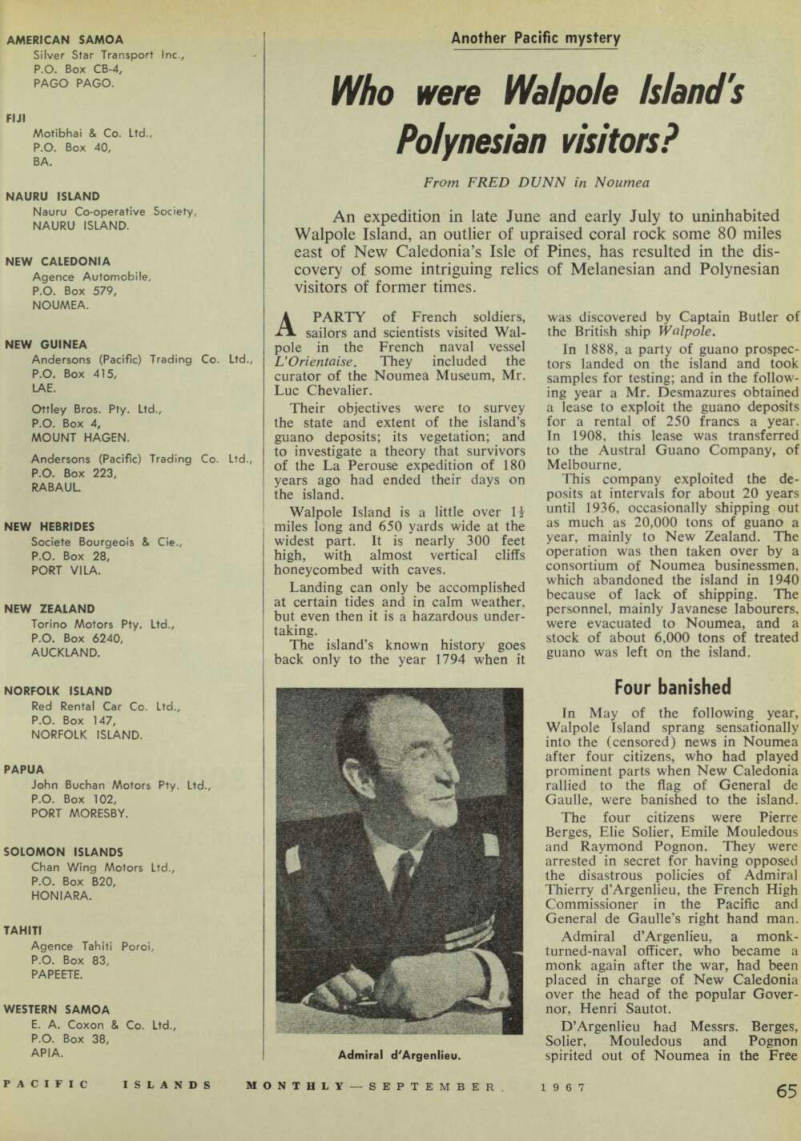
The four citizens were Pierre Berges, Elie Sober, Emile Mouledous and Raymond Pognon. They were arrested in secret for having opposed the disastrous policies of Admiral Thierry d’Argenlieu, the French High Commissioner in the Pacific and General de Gaulle’s right hand man.
Admiral d’Argenlieu, a monk turned-naval officer, who became a monk again after the war, had been placed in charge of New Caledonia over the head of the popular Gover nor, Henri Sautot.
D’Argenlieu had Messrs. Berges, Sober, Mouledous and Pognon spirited out of Noumea in the Free
Admiral d'Argenlieu.
Bones, buttons
French vessel Chevreuil and left on Walpole Island—the Chevreuil con tinuing to New Zealand with Gover nor Sautot, who had also been arrested and exiled.
The admiral’s act triggered off one of the ugliest public reactions ever witnessed in New Caledonia; and it was only after General Patch, the American commander in the country, had intervened that the public calmed down and d’Argenlieu agreed to bring the four exiled New Caledonians back to Noumea. They were on Wal pole Island for 11 days.
One of the exiles, Mr. Pognon, subsequently became receiver in the bankruptcy of the Walpole Island guano company, and in 1955, he wrote to the then Governor of New Caledonia about various tales that had circulated on the island during the days that the guano had been exploited.
According to these tales, native labourers exploring some of the caves on the island had found human re mains, with bits of clothing and brass buttons, which suggested that they were the bones of European naval officers.
Complete skeleton
One of the labourers, who subse quently went to work for Mr. Willy Johnston, the recently retired British consul in Noumea, told Mr, Johnston that he had seen a complete skeleton, around which were a number of loose bones and pieces of wood which seemed to have once been part of a boat.
Mr. Johnston, himself, stated that
an Australian named Mac Kay had also seen the skeleton.
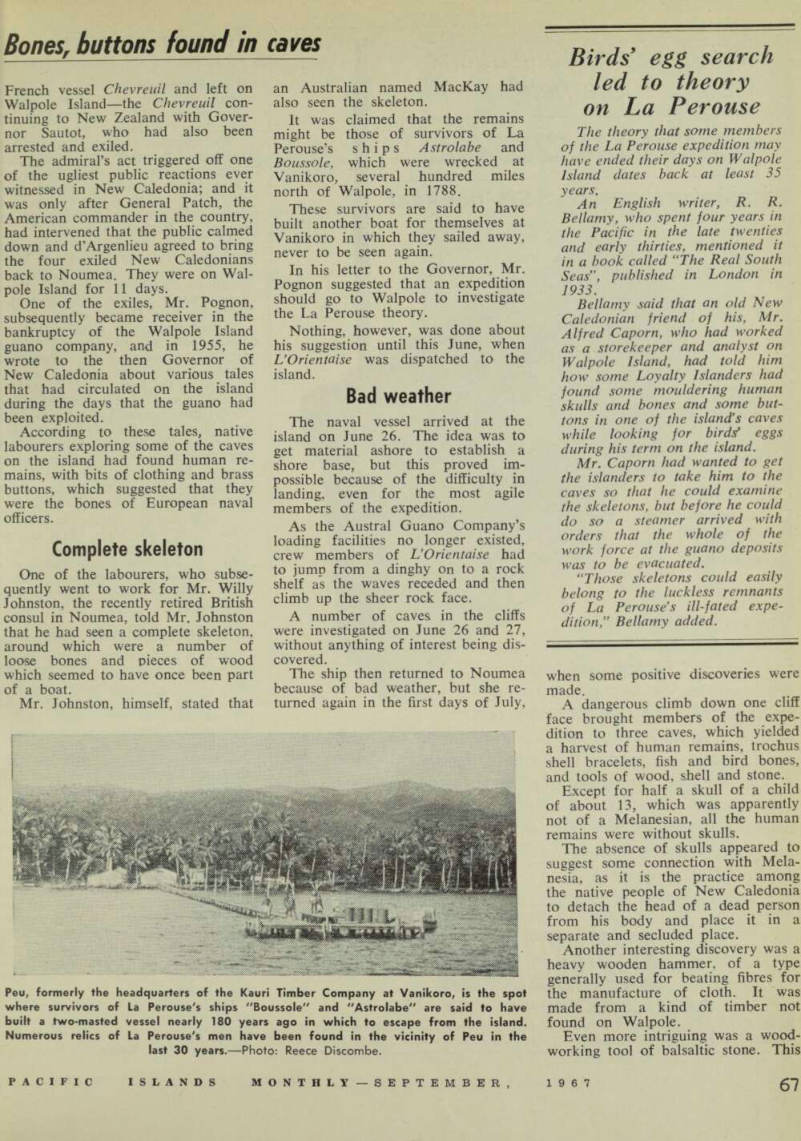
It was claimed that the remains might be those of survivors of La Perouse’s ships Astrolabe and Boussole, which were wrecked at Vanikoro, several hundred miles north of Walpole, in 1788.
These survivors are said to have built another boat for themselves at Vanikoro in which they sailed away, never to be seen again.
In his letter to the Governor, Mr.
Pognon suggested that an expedition should go to Walpole to investigate the La Perouse theory.
Nothing, however, was done about his suggestion until this June, when L’Orientaise was dispatched to the island.
Bad weather
The naval vessel arrived at the island on June 26. The idea was to get material ashore to establish a shore base, but this proved im possible because of the difficulty in landing, even for the most agile members of the expedition.
As the Austral Guano Company’s loading facilities no longer existed, crew members of L’Orientaise had to jump from a dinghy on to a rock shelf as the waves receded and then climb up the sheer rock face.
A number of caves in the cliffs were investigated on June 26 and 27, without anything of interest being dis covered.
The ship then returned to Noumea because of bad weather, but she re turned again in the first days of July,
when some positive discoveries were made.
A dangerous climb down one cliff face brought members of the expe dition to three caves, which yielded a harvest of human remains, trochus shell bracelets, fish and bird bones, and tools of wood, shell and stone.
Except for half a skull of a child of about 13, which was apparently not of a Melanesian, all the human remains were without skulls.
The absence of skulls appeared to suggest some connection with Mela nesia, as it is the practice among the native people of New Caledonia to detach the head of a dead person from his body and place it in a separate and secluded place.
Another interesting discovery was a heavy wooden hammer, of a type generally used for beating fibres for the manufacture of cloth. It was made from a kind of timber not found on Walpole.
Even more intriguing was a wood working tool of balsaltic stone. This
Peu, formerly the headquarters of the Kauri Timber Company at Vanikoro, is the spot where survivors of La Perouse's ships "Boussole" and "Astrolabe" are said to have built a two-masted vessel nearly 180 years ago in which to escape from the island.
Numerous relics of La Perouse's men have been found in the vicinity of Peu in the last 30 years. Photo; Reece Discombe.
Theories on relics
was unquestionably of Polynesian origin, and was the first Polynesian relic of its kind ever found in or near New Caledonia.
The scientists hope that a detailed analysis of this tool will enable them to establish exactly where the stone came from; and they expect that charcoal found in the same layer of debris will establish the date of its arrival on Walpole.
Mr. Chevalier believes that the tool could have been brought to Wal pole by a canoe travelling between Polynesia and New Zealand, as Wal pole is not a great distance from the Polynesia-New Zealand route .
Asked whether it might not have come from Futuna (in the Wallis Group) when some Futunans migrated to Ouvea Atoll (Loyalty Group) in the fairly recent past, Mr.
Chevalier said he had thought along those lines, but he knew of no such tools at Ouvea. He said he had been to Ouvea and had carefully studied the site where the Futunans had landed, but although he had found bones and remains of canoes, there was no trace of tools of any kind.
The Melanesian relics may possibly have come from Mare Island in the Loyalties or from the Isle of Pines, south of the New Caledonian main land, as the natives of both islands have traditions about visits to Wal pole Island.
Canoes blown away
In the case of the Isle of Pines, there is an authenticated case of a fleet of fishing canoes being carried to Walpole in bad weather in 1868 and of returning to their home island several months later when the winds permitted.
Mr. Chevalier said that the fact that the L’Orientaise expedition had found no European remains on Wal pole did not mean that such remains did not exist.
The expedition’s time on the island was limited and not all the caves could be examined.
However, Mr. Chevalier said it was regrettable that the New Caledonian authorities had not followed up Mr.
Pognon’s suggestion in 1955 for an investigation then, as witnesses were still alive at that time who could have guided an expedition to the caves where European remains had been found.
He hoped that another expedition could be sent to Walpole in the near future to make a further search for the European remains.