To The Point
pp. 63-65 · Read in the full issue
With
Percy
Chatterton
In my young days there was a popular song known as the Froth-blowers’ Anthem, which were repeated over and over again the words “the more we are together the happier we’ll be”. Even with alcohol’s artful aid this optimistic sentiment is not always borne out by facts.
DURING the last few years there has been much talk in P-NG bout national unity. Most of it has ome from our politicians and our elf-styled “elite”. And most of it, /ell-intentioned as it may have been, las been little more than froth lowing—amiable sentiments about iow nice it is to be united, and a athetic belief that “one name, one lag, one anthem” will solve all the roblems. A similar slogan in Indo [esia doesn’t seem to have solved aany of their problems.
Don’t get me wrong. I am not gainst national unity. Far from it. 4or do I underestimate the very con iderable achievement of our students, /ho come from so many different ribal backgrounds, in living together i amity.
But more than frothy slogans, and lore than the ability to live together micably in the sheltered world of ae college campus, will be needed a build a national unity which will tand up to the stresses and strains f unequal educational opportunity, nequal economic development, and, Doner or later, independence. What
Achieving P-NG unity is easier said than done
has happened in Nigeria could happen in New Guinea.
Incidentally, as we break down the old tribal barriers, we seem to be in some danger of creating a new set of tribes —the elite tribe, the army tribe, the public service tribe, and so on— with tribal loyalties and prejudices just as strong as the old ones.
The plain fact is that the territory of Papua and New Guinea is, like so many of the newly emerging “nations”, a mere accident of colonial history.
Mutual suspicion and jealousy be tween Britain and Germany in the game of colonial grab split apart the natural unity of Papua and mainland New Guinea. The adoption of dif ferent linguae francae widened the breach, and the gratuitous perversity of Australia in renaming British New Guinea “Papua” instead of simply substituting “Australian” for “British” deepened it.
Patron saint
This cleavage makes no sense at all either geographically or culturally, but it has been there for 80 years, and to suppose that it can be healed by the shouting of slogans and the waving of flags seems to me to be wishful thinking.
On the other hand, the so-called “New Guinea Islands” are only part of New Guinea because Ger many included them in her grab.
If the people of New Britain and New Ireland chose to say, “Our islands are not a part of New Guinea and we are not New Guineans”, it would be difficult to gainsay them; and if the people of Bougainville de clared “We are Solomon Islanders”, it would be impossible to contradict them.
There was a time when Paul Lapun seemed to be saying something like this, but I suppose that he has recanted now that he has joined Pangu Pati.
As for little Manus Island, all it needs is a supply of phosphate to enable it to establish itself as an independent State, with Paliau Maloat as its first president and Margaret Mead as its patron saint.
The problems of national unity affect not only the “new” nations, but older ones too —for example, Canada. And the United Kingdom itself has not had complete success in solving them. There are still a few Scottish Nationalists around de manding home rule for Scotland.
Wales has recently succeeded in hav ing its place-talk officially recognised.
And a large part of Britain’s largest off-shore island has seceded from it altogether. (over)
aliau Maloat, first President of the inde [?]endent State of Manus Island . . . ?
And Margaret Mead, patron saint?
If New Ireland decided to follow the example of old Ireland, we Britishers could hardly afford to look down our noses at her.
Experience has shown that waving flags and singing anthems does not guarantee national unity. In fact, it may work the other way round.
The flag of “Free Papua” rallies West Irianese who are opposed to national unity with Indonesia, And if our Papua should ever produce a secessionist movement, what a wonderful gift the song “Papua”, with its swinging rhythm and Motu words, would be to it. 0 Papua, waken your children, Teach them and make them strong, Then in the days to come With wisdom gained they will say: Our Land, our Land, We will strengthen our Land, Now, now, let us arise, Now, now, let us raise her up.
A good song, with Motu words written by a Papuan for Papuans.
One of these days, perhaps, the Special Branch of the Paradesian Police will be arresting people for
singing it.
1 believe it is true that outside the ranks of the students, who seem to think that calling one another brothers and sisters solves all the problems, many Papuans are worried about the prospect of their absorption into an independent New Guinea. Of course, there isn’t really a viable alternative for them. And in the main
Leave Language problem to solve itself
they are worrying about the wrong things.
Some are worrying about their status as “Australian citizens”. They would do well to recognise that in practice this alleged “citizenship” gives them few, if any, privileges that are not equally enjoyed by New Guineans as “Australian protected persons”.
Status
In fact, in this matter of status the boot is on the other foot. When a United Nations Mission visits the territory, New Guineans can make representations to it. Papuans cannot.
It is true that the last UN Mission to visit us did meet a group of repre sentative Papuans in Port Moresby.
But the Mission’s chairman opened the proceedings by explaining that they were purely informal, and that the Mission could not take cognizance officially of anything said to them by Papuans.
Yet any recommendations emanat ing from these missions which are subsequently implemented by the Administration affect the lives of Papuans quite as much as they do those of New Guineans.
Then again some Papuans seem to be worried that they may have to talk Pidgin. The best thing that both Papuans and New Guineans can do with the language problem is to leave it to solve itself.
If we do that, our various languages
—English, Pidgin, Motu and the in numerable place-talks—will find their own levels of use or disuse. This will happen quite naturally if we let it.
On the other hand, the best way to make a language hated, and the people who impose it hated with it, is to force people to use it. This has proved to be so again and again in every part of the world.
However, there are some things that Papuans may well be excused for worrying about. They may well worry over the fact that most of them live in areas which have very limited economic potential, and that they are therefore liable to be pushed aside in the economic rat race. They may well worry that they will be pushed aside even in those fields where they might make a bit of progress.
Worrying matters
For most of my years in Papua I have lived among people who in habit an area where poor soil and in adequate rainfall make it hard for them to sustain themselves by sub sistence agriculture. Cash crops, except perhaps for a bit of market gardening, are “out”.
But they do have good clay, and their women-folk are expert pot makers. So I rejoiced for my Papuan friends when I heard that the ILO was sending an expert to look into the economic possibilities of pottery
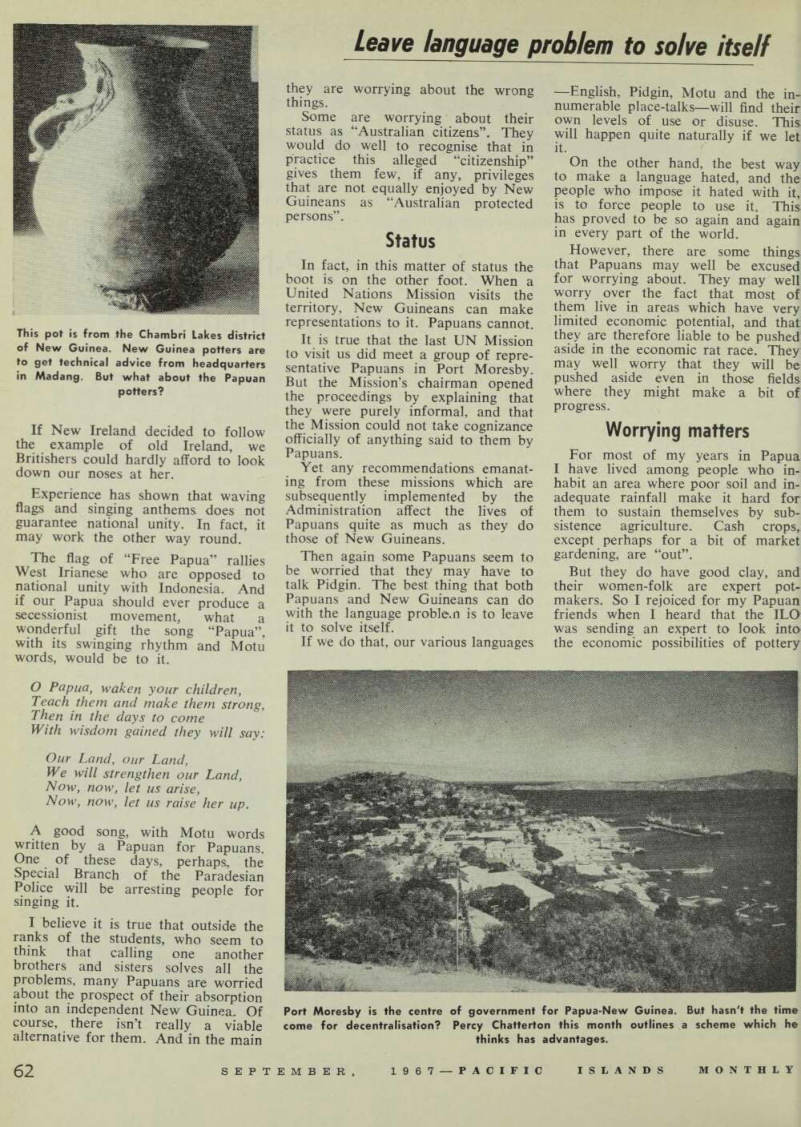
This pot is from the Chambri Lakes district of New Guinea. New Guinea potters are to get technical advice from headquarters in Madang. But what about the Papuan potters?
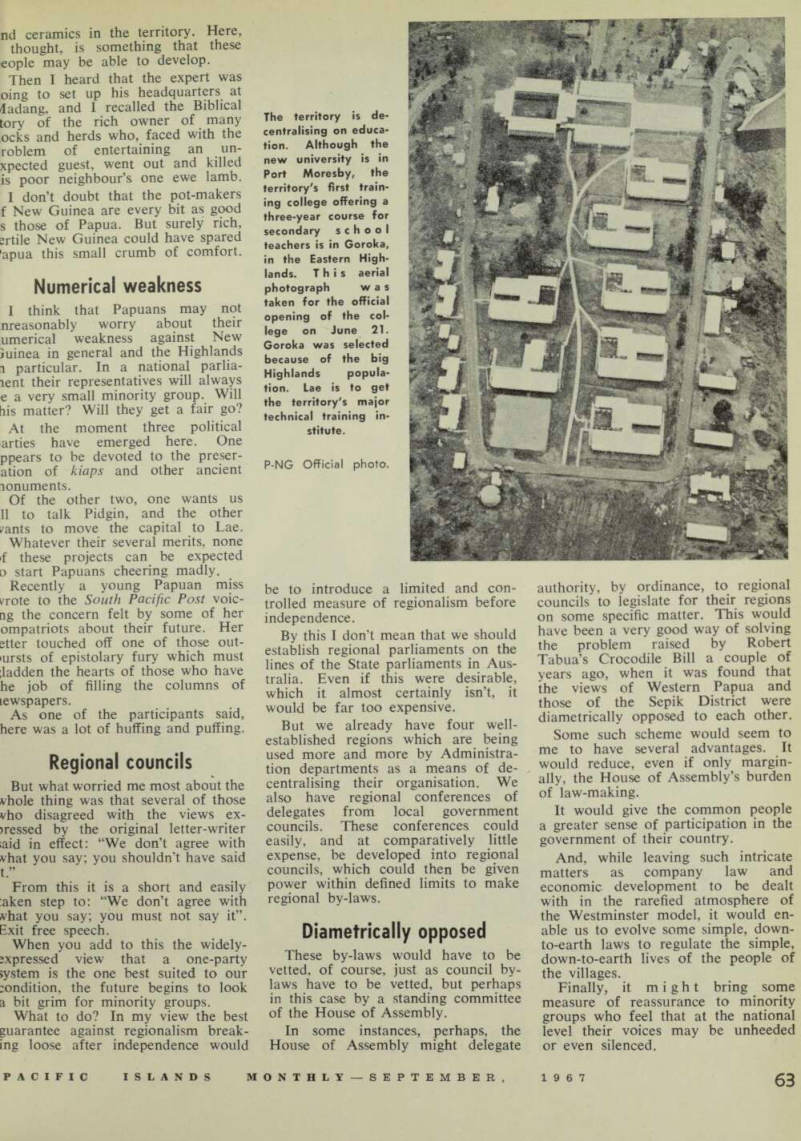
Port Moresby is the centre of government for Papua-New Guinea. But hasn't the time come for decentralisation? Percy Chatterton this month outlines a scheme which he thinks has advantages.
nd ceramics in the territory. Here, thought, is something that these eople may be able to develop.
Then I heard that the expert was oing to set up his headquarters at ladang, and I recalled the Biblical tory of the rich owner of many ocks and herds who, faced with the roblem of entertaining an un xpected guest, went out and killed is poor neighbour’s one ewe lamb, I don’t doubt that the pot-makers £ New Guinea are every bit as good s those of Papua. But surely rich, srtile New Guinea could have spared 'apua this small crumb of comfort.
Numerical weakness
I think that Papuans may not nreasonably worry about their umerical weakness against New juinea in general and the Highlands i particular. In a national parlia lent their representatives will always e a very small minority group. Will tiis matter? Will they get a fair go?
At the moment three political arties have emerged here. One ppears to be devoted to the preser ation of kiaps and other ancient lonuments.
Of the other two, one wants us 11 to talk Pidgin, and the other /ants to move the capital to Lae.
Whatever their several merits, none >f these projects can be expected o start Papuans cheering madly.
Recently a young Papuan miss /rote to the South Pacific Post voic ng the concern felt by some of her ompatriots about their future. Her stter touched off one of those out ►ursts of epistolary fury which must Madden the hearts of those who have he job of filling the columns of icwspapers.
As one of the participants said, here was a lot of huffing and puffing.
Regional councils
But what worried me most about the vhole thing was that several of those vho disagreed with the views ex >ressed by the original letter-writer laid in effect: “We don’t agree with vhat you say; you shouldn’t have said t.”
From this it is a short and easily ;aken step to: “We don’t agree with vhat you say; you must not say it”.
Exit free speech.
When you add to this the widely jxpressed view that a one-party »ystem is the one best suited to our xmdition, the future begins to look a bit grim for minority groups.
What to do? In my view the best guarantee against regionalism break ing loose after independence would
be to introduce a limited and controlled measure of regionalism before independence.
By this I don’t mean that we should establish regional parliaments on the lines of the State parliaments in Australia. Even if this were desirable, which it almost certainly isn’t, it would be far too expensive.
A i j u c n But we already have four wellestablished regions which are being used more and more by Administration departments as a means of decentralising their organisation. We also have regional conferences of delegates from local government councils. These conferences could easily, and at comparatively little expense, be developed into regional councils, which could then be given power within defined limits to make regional by-laws.
Diametrically opposed
7 rr These by-laws would have to be vetted, of course, just as council bylaws have to be vetted, but perhaps in this case by a standing committee of the House of Assembly.
In some instances, perhaps, the House of Assembly might delegate
authority, by ordinance, to regional councils to legislate for their regions on some specific matter. This would bave ' seen a ver y 8 9 wa V problem raised e Tabua s Crocodile Bill a coup e years ago, when it was found tbe Vle ws of Western apua a those of the Sepik District diametrically opposed to each other. 0 Some such scheme would seem me to bave advantages. It would reduce, even if only margin tbe H9 use Assembly s burden °* law-making.
It would give the common people a greater sense of participation in the government of their country, And, while leaving such intricate matters as company law and economic development to be dealt with in the rarefied atmosphere of the Westminster model, it would en able us to evolve some simple, down to-earth laws to regulate the simple. down-to-earth lives of the people of t h e villages.
Finally, it might bring some measure of reassurance to minority groups who feel that at the national level their voices may be unheeded or even silenced.
The territory is de centralising on educa tion. Although the new university is in Port Moresby, the territory's first train ing college offering a three-year course for secondary school teachers is in Goroka, in the Eastern High lands. This aerial
photograph was
taken for the official opening of the col lege on June 21.
Goroka was selected because of the big
Highlands popula
tion. Lae is to get the territory's major technical training in stitute.
P-NG Official photo.