travel
pp. 51-53 · Read in the full issue
[?]Ew Company
Akes Over Apia's
Asino Hotel
The Western Samoa Hotel
tompany Ltd., which was
irmed recently to develop hotel
icilities under the auspices of te Department of Economic De- Hopment (PIM, Feb., p. 125) as taken control of Apia’s asino Hotel.
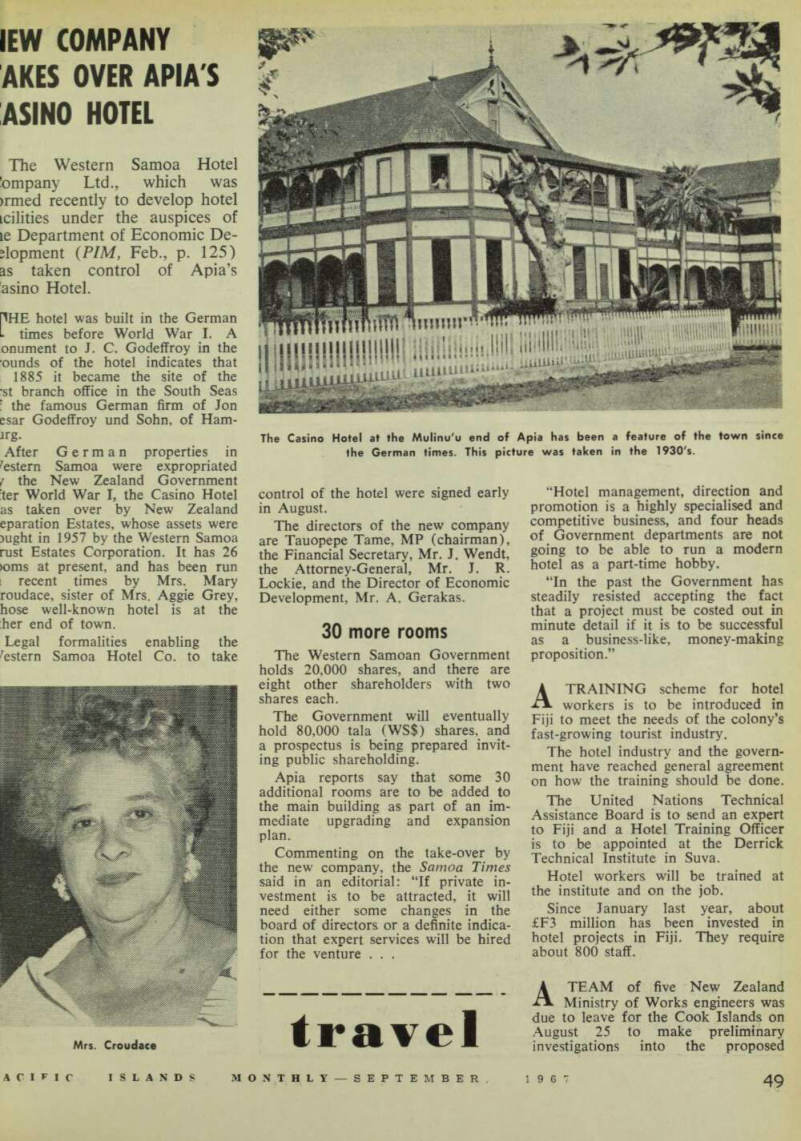
HHE hotel was built in the German 1- times before World War I. A onument to J. C. Godeffroy in the ounds of the hotel indicates that 1885 it became the site of the •st branch office in the South Seas : the famous German firm of Jon esar Godeffroy und Sohn, of Ham irg.
After German properties in Astern Samoa were expropriated / the New Zealand Government ter World War I, the Casino Hotel as taken over by New Zealand eparation Estates, whose assets were night in 1957 by the Western Samoa rust Estates Corporation, It has 26 >oms at present, and has been run i recent times by Mrs. Mary roudace, sister of Mrs, Aggie Grey, hose well-known hotel is at the her end of town.
Legal formalities enabling the Astern Samoa Hotel Co. to take
travel
control of the hotel were signed early in August.
The directors of the new company are Tauopepe Tame, MP (chairman), the Financial Secretary, Mr. J. Wendt, the Attorney-General, Mr. J. R.
Lockie, and the Director of Economic Development, Mr. A. Gerakas. on mnm mnmc OU more rooms The Western Samoan Government holds 20,000 shares, and there are eight other shareholders with two shares each.
The Government will eventually hold 80,000 tala (WS$) shares, and f n f™S U cL i l^ldfnJ’ rePared iDVit ' mg public shareho ng.
Apia reports say that some 30 additional rooms are to be added to the main building as part of an immediate upgrading and expansion l an 6 * p ’ , , Commenting on the take-over by the new company, the Samoa Times said in an editorial: “If private investment is to be attracted, it will need either some changes in the board of directors or a definite indication that expert services will be hired for the venture . . .
“Hotel management, direction and promotion is a highly specialised and competitive business, and four heads of Government departments are not going to be able to run a modern hotel as a part-time hobby.
“In the past the Government has steadily resisted accepting the fact that a project must be costed out in minute detail if it is to be successful as a business-like, money-making proposition.”
A TRAINING scheme for hotel workers is to be introduced in Fiji to meet the needs of the colony’s fast-growing tourist industry.
The hotel industry and the govern ment have reached general agreement on how the training should be done.
The United Nations Technical Assistance Board is to send an expert to Fiji and a Hotel Training Officer is to be appointed at the Derrick Technical Institute in Suva.
Hotel workers will be trained at the institute and on the job.
Since January last year, about £F3 million has been invested in hotel projects in Fiji. They require about 800 staff.
A TEAM of five New Zealand Ministry of Works engineers was due to leave for the Cook Islands on August 25 to make preliminary investigations into the proposed
Mrs. Croudace
The Casino Hotel at the Mulinu'u end of Apia has been a feature of the town since the German times. This picture was taken in the 1930's.
lengthening of the airstrip on Ran tonga.
If test bores on the coral ato reveal suitable sub-surface strata, th Government plans to build a 7,000 : sealed runway to take either Electn or pure jets for a direct air servic to the islands.
The existing 5,000 ft coral-surface strip will support only DC3s an similar aircraft.
A FORMER manager of the famou old Mocambo Hotel, at Fiji Nadi airport, is returning to th colony to take up the managemer of a new hotel—the Tradewinds, £ the Bay of Islands, near Suva.
He is Mr, W. J. Koster, wh managed the Mocambo from 195 until 1960, when the hotel was virtu ally a transit lounge for trans-Pacifi air travellers. The new Mocamb is on another site.
For the past seven years he has hel senior posts in the Hawaii hotel ir dustry. His first appointment wa manager of the Coconut Grove hote and he later became an executiv assistant manager of the Sherato: Hotel Corporation’s activities i: Hawaii. He was for some tim manager of the Waikiki Biltmor Hotel.
In August he visited Fiji brief!; to see progress on the Tradewinds which will take bookings in Januar or February.
Constructed and operated by th Bay of Islands Hotel Compan; Limited, the hotel renews ties be tween Mr. Koster and Australia’
Philp family, pioneers in hotel de velopment in Fiji.
Managing director of the compan; is Mr. Colin Philp, brother of Mr Stuart Barry Philp, who was pro prietor of the old Mocambo, forme owner of the Deuba Beachcombe and builder of the Mocambo hote that replaced the old structure.
Mr. Koster, accompanied by hi wife Beryl and two young sons, wil return to Fiji to take up active dut} in mid-September.
IF it’s Pacific sunshine they want Nadi, Fiji, is the place for the tourist to head for.
Statistics supplied to the Lautok£ Chamber of Commerce by the Nad meteorological office, covering many Pacific centres, show that on the average the sun shines longer al Nadi than at any other centre on the
There is an average of 2,617 urs a year, a short-head in front Honolulu, with an average of >OO hours.
The weather men considered that utoka would have a similar srage to Nadi, being only 16 miles ay.
Other centres listed, and their irly averages are: Noumea, 2,555; peete, 2,546; Apia, 2,530; Sydney d Auckland, 2,470; Bora Bora, 195.
The Lautoka Chamber of Com :rce will use its new information step up publicity for the Nadi utoka area, referred to scathingly Suva-ites as “The Burning West”, va’s average, of 1,894 hours, would rdly tan a tourist’s knee, according unimpressed Lautoka-ites. ►RICE increases of five per cent. on air fares and freight, which gan from August 14 on air services tween Australia and Papua-New linea and throughout territory, ve been sharply criticised by terri ians.
TAA, Ansett-ANA and MAL reduced the increases on all their is. Now the single economy fare >m Sydney to Port Moresby is $94 rise of $4.50) and the same first tss fare $106.50 ($5.10 rise).
The “through” single economy fare Lae from Sydney (by 727 and kker) is $133 ($6.40 rise) and the ne first class fare $120.50 ($5.80 e).
Mr. B. E. Fairfax-Ross, president the Planters’ Association of Papua, d he had been surprised to hear the increases.
“Airline operation is rationalised d protected against open compe ion, and as far as territory opera ns is concerned we do not know any inquiry having been held to itify the new rates,” he told the iw Guinea newspapers.
He said air fares and charters were important element in labour and oduce transport costs, adding, “as r as the association knows, air erations within the territory are ccessful financially and we are at loss to understand why local :reases have been made,”
It appeared the price increases had en “tagged on” to blanket increases Australia, Mr. Fairfax-Ross said.
Mr. I. L. Chipper, vice-president of e Rabaul Chamber of Commerce, id: “We were promised when we ►t these new fast aeroplanes that res would go down. It is to be )ped that with increased air freight larges we might get improved ser ce too.”