Tropicalities
pp. 32-33 · Read in the full issue
Although the population is rising, and there are an increasing number of tourists, Suva’s famous Indian tailors are getting fewer. And those who are left are not exactly making easy fortunes. They are more than willing to defend themselves against Jane Gregor’s complaints in May PIM (p. 20) that they “blithely keep regular local customers dangling for weeks while they rush off orders for tourists,” and that it would be better business for them “to build up a nucleus of good, satisfied regular customers, because through them comes the best foundation for
profits.”
In Defence
Of Suva's
Tailors
SUVA’S tailors, all Indian, reply that if the tailoring business was as simple as that there would not have been the decline in their num bers. Many trained men have gone overseas, to the UK, America, or Canada, and others have discarded needle and thread for trade in transistor radios and cameras, where the turnover is better and the head aches considerably less. It takes three years to train a tailor.
The tailors admit visitors are often better to deal with. They pay promptly and require less after-sale attention. Locals often demand un reasonable attention.
Unfair accusations
Suva tailors do not ask for de posits from local people, but some clients will leave suits in the shop, unpaid for, for several months, and then expect alterations at no extra cost. Others take the suit away, pay for it, but then return it weeks later for alterations.
The tailors say that if the suit were incorrectly tailored in the first place then naturally alterations are free; but too often local clients blame the tailor instead of their expanding or decreasing waistline. Sometimes people will expect a suit to be altered free after returning from leave. They don’t even offer to pay dry-cleaning costs. Occasionally they want style changes “because their friends don’t like it.”
For the sake of customer-relations, reputable tailors put up with this
and also with unfair accusations that they are giving priority to tourists when in fact some of their tailors have been ill and they are merely be hind in their orders.
Most tailors arrange to phone local clients about suitable times for fit tings and thus there is no reason why clients should be inconvenienced. If they want urgent attention they only need say so, the tailors claim.
Reputable tailors say they refuse to make a suit for a tourist who is not prepared to give them adequate time.
According to Mr. R. B. Narotam, manager of Narotam and Co., Suva’s oldest tailors, a suit made in 24 hours for, say, £FI7, is “worse than ready made”.
A suit needs at least two fittings and will take three to four days if the time has been reserved in advance —otherwise five days. Average price for a decently tailored suit, he says (it depends on material) is about £F2I or £26/£27 for two pairs of trousers. Mr. Narotam advises any intending visitor to Suva to write ahead and book time with the tailor of his choice. If they don’t know one,
ask the Fiji Visitors Bureau, or local contact.
Narotam’s was started in 1912, a the principal now is Mr. B.
Narotam, Mr. Narotam’s father, w is president of the Merchant Tailo Association. They employ 12 ( perienced tailors in the shop whi has a famous clientele, includi most of Fiji’s governors and ma senior Government people.
Seventy-five per cent, of Narotan customers are local, and Narotam says that many of ] regular clients recommend him visitors.
It's an art
Tailors, more than anybody, c pend on recommendations and says therefore that any reputal tailor would concentrate on givi attention to local clients. It woi be bad business not to.
“People don’t understand t h tailoring is an art, and that it can* a lot of responsibility,” he says. are tailors because we believe in and I personally would like to s as many tailors as possible trainee “I deplore the decline in numb< in Suva. After all, Suva’s tailor! is one of its tourist attractions a the tailoring business helps to ma money for this colony.”
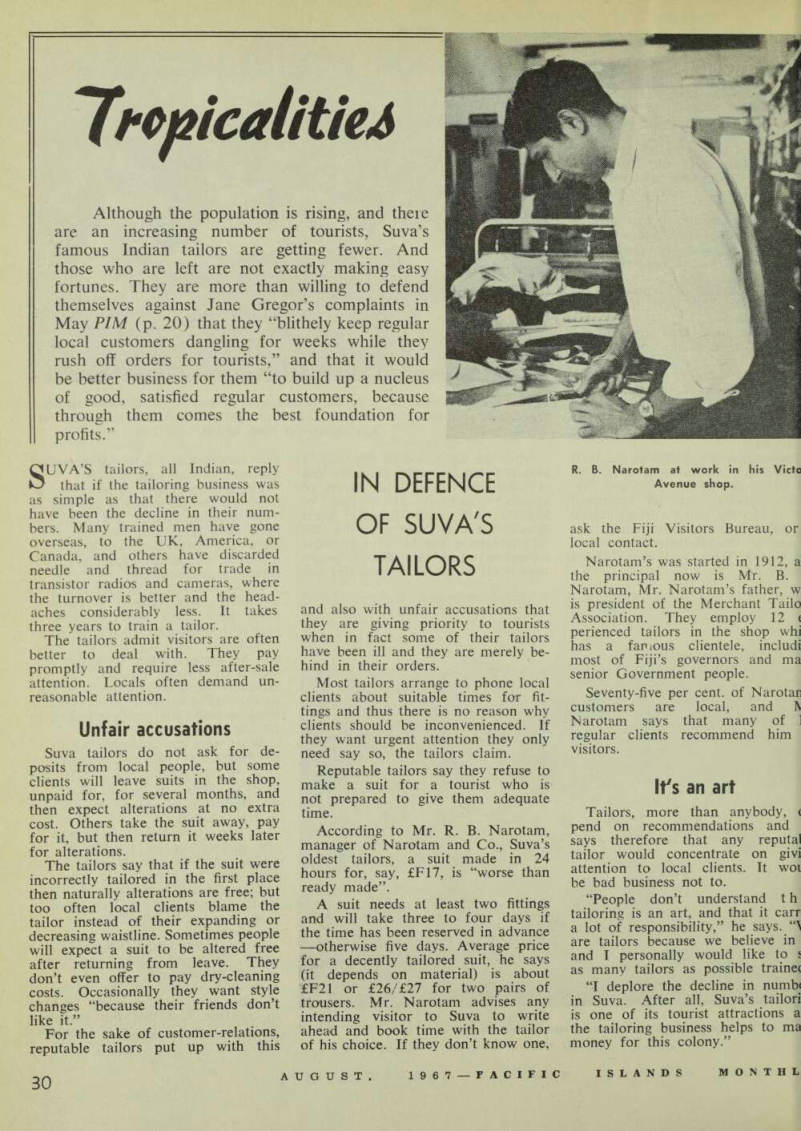
R. B. Narotam at work in his Victo Avenue shop.
Dff to a
lying start
f/fOST fathers have a feeling of »-■- walking on air when their first aby is born. But BSIP District fficer, Mr. Peter Jackson, was :tually in the air when his daughter •rived at 12.20 p.m. on June 26. nd so was his daughter—for she as born 3,000 feet above Sea Lark hannel, off the coast of Guadal mal, on board the Dove aircraft of [egapode Airways.
Captain Harold Hall had flown to ira Kira that morning to bring Mrs. ickson to the Central Hospital in oniara. Four seats were taken out : the aircraft to make room for her retcher.
On board when the aircraft left ira Kira just before lunchtime ire Doctor MacDonnell, Mr. Jack n, Mrs. June Wood of Megapode irways—and a nine-year-old girl th a fractured arm who was also >und for the hospital.
It soon became obvious that Mrs. ckson’s baby would arrive before e aircraft reached Kukum airfield, d she was delivered 15 minutes fore touch down—to whoops of y from the doctor and father.
And above the noise of the engines, iptain Hall heard the cry of the ungest passenger he has ever flown. : said afterwards; “I turned round d saw them holding the baby up the feet.
“If it hadn’t been for that little y I wouldn’t have known there is a baby being born at all. erything went very smoothly.”
At Kukum the aircraft was met an ambulance, and the mother d her new born baby were rushed the hospital, where the baby was :ighed. She was 7 lb 9 oz.
The baby has been named Susan— name well known in the Ellice Dup, where Mrs. Jackson, formerly iss Samoala Kofe, comes from.
The Jacksons were married at inafuti last year.
,ong-time consul
:rikes his flag
|NE of Britain’s longest-s e r v i n g “soldiers of the Queen” in the cific laid down his arms in Noumea :ently to go into retirement.
He is Mr. William A. Johnston, io for 33 years, served as Her itannic Majesty’s consul in New ledonia.
Mr. Johnston (Willie to the pro le) took up his post in January,
1934, following the death of his father in 1933.
Mr. Johnston, Sr., who was British consul from 1922 until his death, arrived in New Caledonia in 1883 and founded a commercial house which is still in the hands of his family.
Our Noumea correspondent, Fred Dunn, says the Johnston family is probably the most respected foreign family in the country.
Probably the most moving episode in Mr. Willie Johnston’s career as consul was just after the fall of France in June, 1940, when New
Caledonians refused to recognise the armistice with Germany.
A long line of Noumean citizens, headed by returned soldiers and members of the Conseil General marched into the British consulate to inform Mr. Johnston that New Caledonia had decided to continue the struggle at the side of Britain.
Mr. Johnston was asked to inform the British Government of this de cision. This was before New Cale donians had rallied to the banner of General de Gaulle.
Round about the same time the Vichy Government sent a telegram to the Conseil General ordering the arrest of Mr. Johnston.
Reporting Mr. Johnston’s retire ment, one of Noumea’s newspapers said: “His qualities earned for him the esteem and respect of all. He served his term as consul with de votion and affability like his father before him.
“He has gained the affection not only of British subjects in the country, but of New Caledonians without ex ception.
“He was particularly appreciated by the various governors of New Caledonia, who had to deal with him in international matters.”
No eye for an
eye with them
A COUPLE of Americans earned the deep gratitude of hundreds of Cook Islanders recently when they visited Rarotonga, Aitutaki and Mangaia with what fellow Americans might call their own private giveaway programme.
The Americans are Dr. H. A.
Iverson, an eye specialist of Eureka, California, and his wife.
Their programme was to examine the eyes of anyone with eye trouble, and to provide treatment and spectacles where necessary.
A total of 420 people were examined. Dr. Iverson performed surgery on 32 people in Rarotonga and seven in Aitutaki, and supplied many others with spectacles—all free.
Dr. and Mrs. Iverson, who spent six weeks in the Cooks, were on a working holiday that started early this year when they flew from Cali fornia to Madagascar. In Madagascar they gave their services free to a Lutheran Hospital, then travelled to New Zealand via Mauritius and Perth, Western Australia. They arrived at Rarotonga in the Moana Roa on April 19 and left for Tahiti by the Holmburn on June 7.