What we did at Nondugl
pp. 30-31 · Read in the full issue
By Sir Edward Hallstrom
Soon after the end of World War 11, I found in my office one day a parcel of native spears and curios from New Guinea.
I did not know the sender but after I contacted him, I found he was Mr. Nep Blood, then District Officer in charge of Mount Hagen. He gave me a very warm invitation to visit New Guinea and see the people, and the birds of paradise and other fauna there.
IN due course I accepted Mr.
Blood’s invitation to Mount Hagen, and I was tremendously im pressed with the work he and his staff and the natives were doing at the station, which looked to me like a piece of paradise. There were gardens and flowers in profusion, well-cared for, and the whole place was pleasant and tremendously interesting.
It was not very long before we were chatting about the natives’ lack of warm clothing, and while I re mained there I became more and more interested in the Highlanders.
They were so very friendly and I had the feeling that I had to do some thing in the way of pioneering.
Shortly afterwards we decided that I would send up some sheep, dairy cattle, horses and bees. We decided on the bees because it was noticed that most of the introduced flowers were not setting their seed and some attempts to grow fruit trees had failed because of the lack of bees.
Fascinating fauna
The other great fascination for me in Mount Hagen was the fauna, par ticularly the birds of paradise and the tree-climbing kangaroos. When the native people found that I was interested in the fauna, they delighted in bringing live specimens to the station for me to see and, for the first time, I saw the bird of paradise in several large-sized aviaries at the station.
I was fascinated by the fact that these birds, freshly brought from the bush, had never been touched be fore by human hand, yet when allowed to stand on my forefinger, with my thumb holding the feet so the bird could not fly away, it would eat wild raspberries from my other hand. I found also that I could walk into the aviaries with a bunch of wild berries and the birds would fly to my hand and enjoy the fruit.
After an enjoyable two weeks in that primitive and interesting country, I returned to Sydney deter mined to carry out some work in
Mount Hagen district. It was de cided to send to New Guinea 25 head of sheep, six head of Jersey cows, some horses and two hives of bees.
On account of the distance from Sydney, the cattle had to be well chosen; a leading stock agent was consulted, and good quality stock obtained. This all arrived at Lae by ship and was walked inland.
The walk was not so successful.
Some of the cattle and horses were lost; half the sheep were left at Goroka and one hive of bees. The balance of the sheep and another hive of bees were taken to Mount Hagen, The shipment probably could be described as premature, as it was dif ficult country into which to take horses and stock and there was some tick infestation. Some of the cattle losses were due to tick. However, the bees did particularly well and we de cided to send another seven hives to Nondugl.
I returned to Mount Hagen later to look over the stock that did arrive safely. The sheep were in the care of one of the local farmers, who still
• Now that New Guinea famous Nondugl Trust site he been sold, PIM asked S Edward Hallstrom—a keen sul scriber for many years—for h story of how it was founded, h wrote us this article.
has this breed of sheep on his pr perty (about 20 generations later).
I then realised that I needed mo help, and that cattle, sheep and hors should be brought up in a much bigg way. In the meantime my goc friend, Mr. Blood, had been lookii for a suitable soil, and had recor mended Nondugl, a fine stretch i land. The native grasses were n looked upon favourably for grazii sheep, cattle or horses, so work cor menced on clearing.
In this district the natives we particularly friendly and co-operativ and were tremendously interested the sheep and cattle. The new planted grasses were soon coverii the land, and we decided to bring the sheep and some cattle.
A DC3 aircraft was measured i to see how many sheep could 1 carried in one trip. The first plai carried 70, but later 100 sheep we loaded. Each week for 17 weeks DC3 loaded with sheep left Sydm for Nondugl, and the animals d well after arrival.
Buildings were soon erected. Nati labour was taught to shear and b came expert at machine shearing, tl tallies being quite good. The shei and cattle both prospered and it w a wonderful sight to see nice her of sheep grazing in this newly plant pasture.
It was soon apparent that a nur ber of animals required expe handling. We decided to get a go< sheep man from Australia. I se for a relative, Mr. Ted Anderso to come and help with the sheep Mr. Blood continued the manap ment and Nondugl became famoi People were interested in the wo going on there. I took no money oi it all went back again. One gre feature about the place was how wi kept the stock and pastures were, ai great credit was due to the manag ment.
On the one hand I had the fascin tion of seeing the improving stoc and of shipping wool to Sydney. C the other hand, there was the beau of the place. There were flowe everywhere, for following Mr. Blooc example, the native people had e
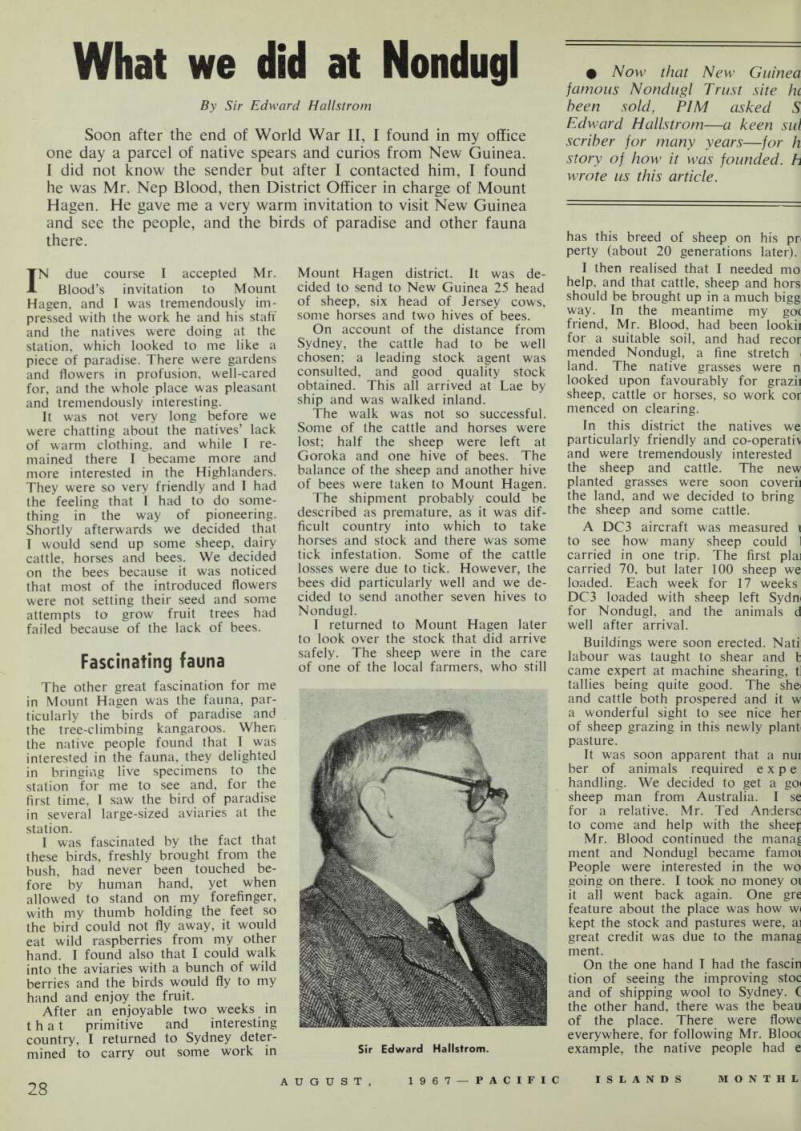
Sir Edward Hallstrom.
ided the planting of flowers for !es around.
About this time, to help the pro t and the territory, I gave a sum money to the then Administrator, lonel J. K. Murray, to establish a rary in Sydney for the benefit of School of Pacific Administration, ich trains all young officers going d the service of our Australian ritories. Today this is a very fine r ary and is used extensively at the 001.
Back at Nondugl, I had secured )ther piece of land on which to Id aviaries, and soon large ones re being built, and I gave instruc is to build more. New all-steel aries eventually replaced the oden ones, and were filled with Is of paradise.
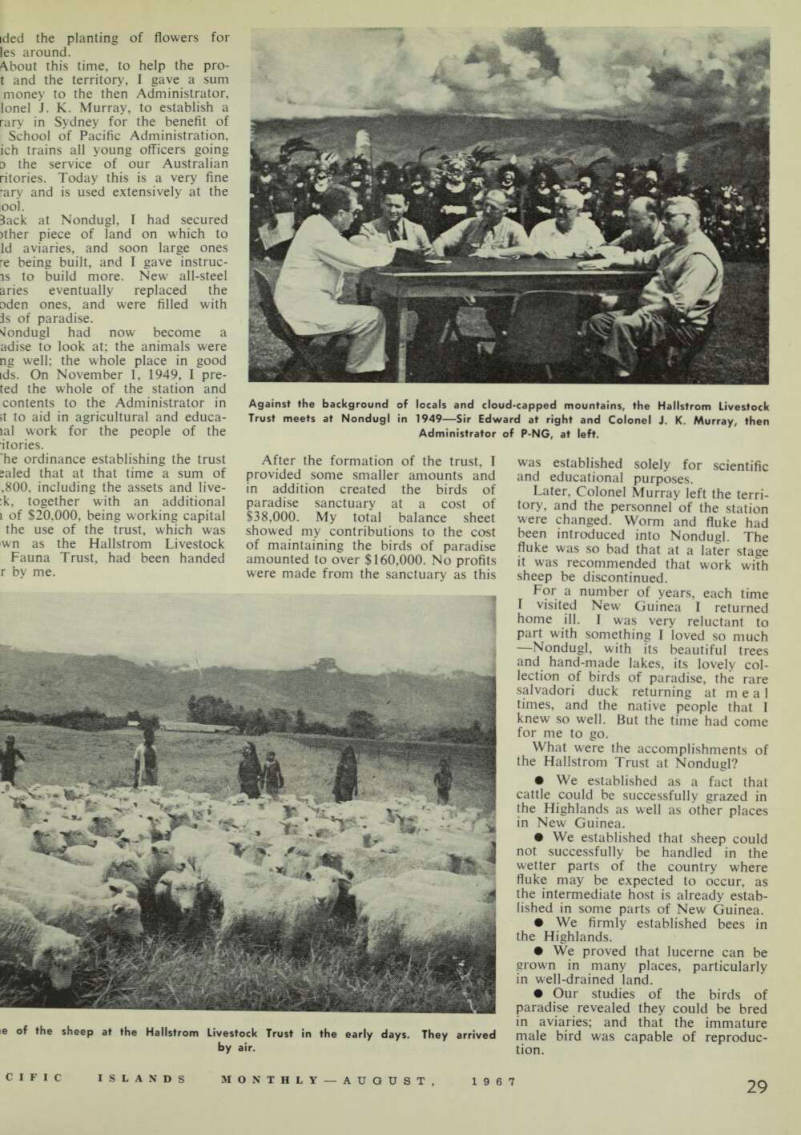
Nondugl had now become a adise to look at; the animals were ng well; the whole place in good ids. On November 1, 1949, I pre ted the whole of the station and contents to the Administrator in it to aid in agricultural and educa lal work for the people of the itories. he ordinance establishing the trust saled that at that time a sum of ,800, including the assets and live :k, together with an additional i of $20,000, being working capital the use of the trust, which was wn as the Hallstrom Livestock Fauna Trust, had been handed r by me.
After the formation of the trust, I provided some smaller amounts and in addition created the birds of paradise sanctuary at a cost of $38,000. My total balance sheet showed my contributions to the cost of maintaining the birds of paradise amounted to over $160,000. No profits were made from the sanctuary as this
was established solely for scientific and educational purposes.
Later, Colonel Murray left the terri tory, and the personnel of the station were changed. Worm and fluke had been introduced into Nondugl. The fluke was so bad that at a later stage it was recommended that work with sheep be discontinued.
For a number of years, each time I visited New Guinea I returned home ill, I was very reluctant to part with something I loved so much —Nondugl, with its beautiful trees and hand-made lakes, its lovely col lection of birds of paradise, the rare salvadori duck returning at meal times, and the native people that 1 knew so well. But the time had come for me to go.
What were the accomplishments of the Hallstrom Trust at Nondugl? • We established as a fact that cattle could be successfully grazed in the Highlands as well as other places in New Guinea. • We established that sheep could not successfully be handled in the wetter parts of the country where fluke may be expected to occur, as the intermediate host is already estab lished in some parts of New Guinea. • We firmly established bees in the Highlands. • We proved that lucerne can be grown in many places, particularly in well-drained land. • Our studies of the birds of paradise revealed they could be bred in aviaries; and that the immature male bird was capable of reproduc tion.
of the sheep at the Hallstrom Livestock Trust in the early days. They arrived by air.
Against the background of locals and cloud-capped mountains, the Hallstrom Livestock Trust meets at Nondugl in 1949—Sir Edward at right and Colonel J. K. Murray, then Administrator of P-NG, at left.