Book Reviews
pp. 98-99 · Read in the full issue
Was this what happened to Amelia Earhart?
Reviewed by JUDY TUDOR In June, 1937, Lae, New Guinea, consisted of Guinea Airways’ airstrip, Guinea Airways’ workshops and hangars, Mrs.
Flo Stewart’s hotel, Henry Eekhoffs store and not much else.
Nonetheless, when a couple of round-the-world fliers arrived there on June 29, the event was of far greater significance to the sensation-hungry world at large than it was to either Lae or to the rest of New Guinea.
NEW GUINEA, at the time, was far more concerned with the Rabaul eruption that had occurred a month earlier; and with the fire on the Burns Philp Macdhui in mid- June that disrupted communications with Australia and was to put every one on short rations for several months to come.
There was then no local broad casting service in NG, no Australia- New Guinea air service. For many people on isolated plantations, mining leases and in the bush, the first news of the fliers’ visit to Lae and their subsequent disappearance somewhere between there and the tiny equatorial Pacific island of Howland came in Australian newspapers received many months later.
The fliers were Mrs. Amelia Earhart Putnam and her navigator Frank Noonan. If they caused no more than a ripple in New Guinea, they caused a virtual tidal wave of interest in the United States and have continued to do so ever since.
Rumours
In the 1930’s it was not rare for pioneer aviators to come to mysterious ends, to be lost without a trace—Australia’s Kingsford-Smith and Ulm were cases in point—and although Earhart and Noonan dis appeared in a part of the Pacific that Japan had already made mysterious in a different way, no great sig nificance was attached to the fact that they had failed to make Howland and presumably had crashed in the sea. (The Pacific Islands Monthly, which devoted a lot of editorial space to Japanese activities in the Pacific between 1935 and 1942,
reported the fliers’ disappearance briefly and as straight news in the issues of 1937).
Rumours that the fliers might have been taken prisoners by the Japanese were a gradual and later develop ment. and none was ever sub stantiated. The situation might have remained that way had it not been for the efforts of a San Francisco radio newsman, Fred Goerner, who became interested by chance, delved deeper than anyone else and, as he puts it, eventually became hooked.
His book. The Search for Amelia Earhart, in which he catalogues his five years’ of investigation, was pub lished last year.
Saipan woman's story
Goerner’s book is an extraordinary compilation for several reasons. It shows how far a newsman of a big organisation can go to get a story, even when it shows up his own country in a poor or ridiculous light; it shows—or seems to show—how far security and military organisa tions in the United States will go in prevarication, denial and evasion to cover up a chain of events that happened almost 30 years before; and it also provides a lot of incidental ammunition for professional doubters who always see Western power politics as blacker than black.
Goerner did not become interested in the fate of Earhart and Noonan until 1960. At that time he was working on topical news and inter view programmes for San Francisco’s Radio KCBS, a station on the CBS network. One day he read a report from a California newspaper in which a Saipanese woman, then living in
California, had reported seeing two American fliers, a man and a woman, on Saipan in 1937.
At first he was sceptical, but after he had interviewed the woman and her husband, he began to believe that there might be something in the old Earhart-Noonan rumours.
Thousands of interviews
His almost emotional involvement with the Earhart mystery developed in the next five years. It took him to Saipan four times; it took him through interviews with thousands of people from Marine privates to the late Admiral Nimitz. It got him digging up graves on Saipan, sifting bones and teeth of people who turned out to be neither Noonan nor Earhart; it got him in Dutch with the US Navy and the Central Intelligence Agency who regarded his investigations on Saipan with about as much enthusiasm as a cage full of canaries would regard a prowling tomcat.
It gave him, quite incidentally, one of the news beats of the decade— the discovery, during his second, 1961, visit to the Marianas, that the US was using Saipan as a train ing school for Nationalist Chinese infiltrators of China and South-East: Asia.
He did not use this information, on a promise from CIA that he should have that privilege when the wraps came off. In the event, the news was broken in Honolulu by ai journalist who visited Saipan late ini 1962 after the spy-school was closed! and the Marianas returned to Depart ment of Interior control.
But what really happened toi Amelia? At the end of five years,,
red Goerner had the results of a lousand interviews, a thousand inter >cking pieces of the jig-saw that fit ut could not be locked into place ntil someone, high up, produced the ey.
Although Goerner and his CBS iperiors put pressure on those who eld the key, no key was ever pro uced. There was no key, according > the High-Ups. Goerner, therefore, » far as his book is concerned, mnot clinch the matter; cannot say lis is what really happened. In the id he has to fall back on reconstruc on.
Powerful engines
Originally, he believes, the round le-world flight of Earhart and foonan was nothing more than what seemed: A publicity gimmick, or mised by husband George Putnam ho spent most of his time organis ig such stunts for Amelia, his most
iluable property.
But somewhere along the line the unt became more—it became a sort f 1930 version of the U-2 flights f the 1960’5. To this purpose much tore powerful engines than those 3rmal in a twin-engined Lockheed lectra 10-E and radio equipment ipable of sending and receiving over mg distances were installed. In Idition, the US Government built i airstrip especially for these ■ivate fliers on Howland Island, ationed a ship half way between ae and Howland and another be /een Howland and Honolulu to jide them, and placed a small Coast uard vessel at Howland to provide idio homing signals.
Furthermore, when the fliers did Dt arrive, the search instituted was ir beyond anything that could be expected in such an event id was of a nature that drew iticism from the US Congress.
All these factors Goerner found, ith reason, very strange.
There had, he reasoned, to be more jhind the Earhart-Noonan flight than ie establishment of a private endur ice record. Was that something the ict that, for years, the United States id wished to find out what the ipanese were doing with their man fled islands?
To that date no ruse that the US id devised had been able to break
the ring of security that surrounded the Japanese islands. Then, into this situation and offering a solution, came the proposed round-the-world flight of Mrs. Putnam and her navigator.
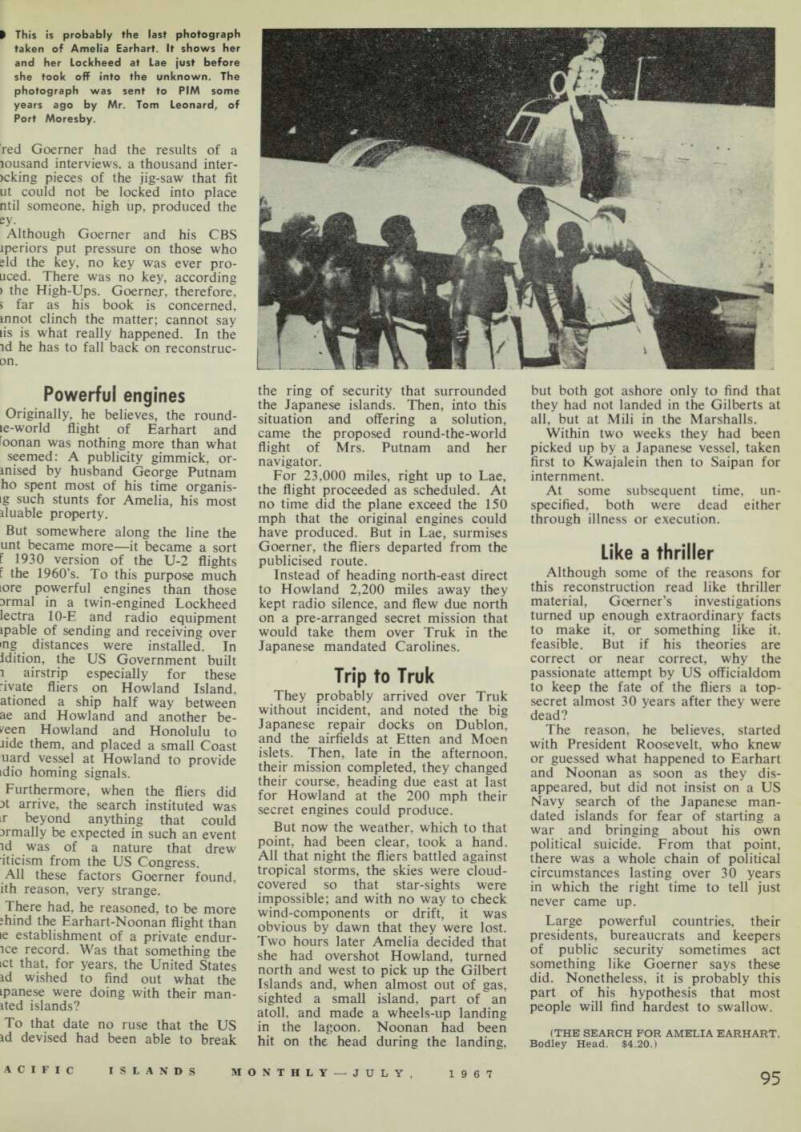
For 23,000 miles, right up to Lae, the flight proceeded as scheduled. At no time did the plane exceed the 150 mph that the original engines could have produced. But in Lae, surmises Goerner, the fliers departed from the publicised route.
Instead of heading north-east direct to Howland 2,200 miles away they kept radio silence, and flew due north on a pre-arranged secret mission that would take them over Truk in the Japanese mandated Carolines.
Trip to Truk
They probably arrived over Truk without incident, and noted the big Japanese repair docks on Dublon, and the airfields at Etten and Moen islets. Then, late in the afternoon, their mission completed, they changed their course, heading due east at last for Howland at the 200 mph their secret engines could produce.
But now the weather, which to that point, had been clear, took a hand.
All that night the fliers battled against tropical storms, the skies were cloud covered so that star-sights were impossible; and with no way to check wind-components or drift, it was obvious by dawn that they were lost.
Two hours later Amelia decided that she had overshot Howland, turned north and west to pick up the Gilbert Islands and, when almost out of gas, sighted a small island, part of an atoll, and made a wheels-up landing in the lagoon. Noonan had been hit on the head during the landing,
but both got ashore only to find that they had not landed in the Gilberts at all, but at Mili in the Marshalls.
Within two weeks they had been picked up by a Japanese vessel, taken first to Kwajalein then to Saipan for internment.
At some subsequent time, un specified, both were dead either through illness or execution.
Like a thriller
Although some of the reasons for this reconstruction read like thriller material, Goerner’s investigations turned up enough extraordinary facts to make it, or something like it. feasible. But if his theories are correct or near correct, why the passionate attempt by US officialdom to keep the fate of the fliers a top secret almost 30 years after they were dead?
The reason, he believes, started with President Roosevelt, who knew or guessed what happened to Earhart and Noonan as soon as they dis appeared, but did not insist on a US Navy search of the Japanese man dated islands for fear of starting a war and bringing about his own political suicide. From that point, there was a whole chain of political circumstances lasting over 30 years in which the right time to tell just never came up.
Large powerful countries, their presidents, bureaucrats and keepers of public security sometimes act something like Goerner says these did. Nonetheless, it is probably this part of his hypothesis that most people will find hardest to swallow.
(The Search For Amelia Earhart.
Bodley Head. $4.20.)
This is probably the last photograph taken of Amelia Earhart. It shows her and her Lockheed at Lae just before she took off into the unknown. The photograph was sent to PIM some years ago by Mr. Tom Leonard, of Port Moresby.